Thursday, January 13, 2011

"Jumblatt (the 'collaborationist' as per Elliott Abrams) may find it harder to resist Syrian pressures to side with the opposition"

Oxford Analytica: Excerpts: (Hariri 'Buying time' is, our analysis, NOT an option!)

 "... A key question is whether Hariri will be re-appointed as prime minister:
  • The 'March 8' coalition has not yet declared its candidate, but is unlikely to nominate Hariri. ..... few Sunnis would accept the replacement of Hariri in what is developing into a sensitive sectarian situation.
Suleiman is facing considerable pressure to take sides. Yet his regional power base includes both the Saudis and the Syrians, making it hard for him to do this. 
The decisive voter is Druze leader Walid Jumblatt: collaboration of his bloc would alter March 8's prospects, securing a parliamentary majority. Nonetheless, despite his rapprochement with Syria, Jumblatt may not feel able or willing to challenge Hariri and Saudi Arabia in such an explicit manner. He is likely to condition his votes on a prior agreement, ....... in the event of prolonged deadlock, he may find it harder to resist Syrian pressures to side with the opposition..... Therefore, a long period of negotiations is likely. Such an outcome need not be detrimental to Hariri. No major government decisions are pending, allowing him to continue his strategy of buying time (Not an option!), at the head of a caretaker government. However, it will likely entail paralysis of official institutions...... 
Israel will watch the unfolding of events closely. It is unlikely to intervene unless a significant victory is delivered to Hizbollah or a worsening of the domestic situation leads to rising tensions on the southern border. The outlook could depend much on the approach of Syria and Iran:
  • Syria. With rejection of the STL off the negotiating table, Syria has been forced either to concede to an agreement that will maintain the STL or reject the negotiations and allow political escalation and a possible deterioration in the security situation. Current developments indicate that it will choose the second route. There will be considerable regional pressure on Damascus to make concessions and exert a moderating influence on the situation. However, while it may act to delay escalation, succumbing to international pressure and allowing the STL to press ahead with its work would represent a significant defeat. Syria is unlikely to accept this at present.
  • Iran. Tehran's approach hinges on the direction of US-Iranian relations. An imminent round of nuclear negotiations is unlikely to make progress, and Washington has been hinting at the possibility of tightening international sanctions further. The fact that a possible Israeli strike on Iranian nuclear facilities looks further off as the nuclear programme shows signs of struggling reduces the risk of retaliatory escalation via Hizbollah, but the failure of nuclear talks and the introduction of other punitive measures nonetheless could provide incentives for Iran to seek further escalation in Lebanon.
Clashes? In the context of institutional paralysis, the danger of violent clashes has increased. (OA fails to name the 'protagonists')  Efforts to prevent this are underway....  However, in the absence of a possible political solution and in view of the regional deadlock, it seems probable that tensions will rise, and might be instrumentally related to the political bargaining taking place. Faced with major hurdles to forming a new government, and unable to influence the existing one, Hizbollah might resort to localised disturbances as a way of pressuring Hariri and his regional allies..."

Not a word!

The man leaks!

... meanwhile, Sleiman is busy with Royalty...

Graeme Bannerman: "The US has "an alternative agenda, which is to weaken Hezbollah & therefore Syria & Iran..."

"... IIeana Ros-Lehtinen, the Republican who heads the House Foreign Affairs Committee, called for robust support of the tribunal and warned not to "repeat past mistakes where we failed to stand up to those who threaten Lebanon and all free nations.".... But Graeme Bannerman, a Lebanon expert at the Washington-based Middle East Institute, said US insistence on the tribunal had backfired as it was clear many Shiites -- one of the country's three main groups -- would not accept it. "Probably no one in the world wants the tribunal more than Hariri, but he has a whole series of other considerations. He can't govern without consensus" among the three groups, he said. In backing the tribunal, the United States also has "an alternative agenda, which is to weaken Hezbollah and therefore Syria and Iran. It doesn't take into consideration how the Lebanese political system works." "I think we are an essential part of Hariri's problem. I think we are making his life more difficult rather than easier," Bannerman said."

An 'Invigorated' Abbas

Another pigeon ...
"His spirits are noticeably much higher and he's much more in control of things," said Maher al Masri, an influential Palestinian businessman and politician. "I think he has gained a lot of political and public support because of the strong stands he's taken recently."

WikiLeaks [36]: Shi'as in Lebanon are "frightening"...


S E C R E T SECTION 01 OF 02 ALGIERS 001327
SUBJECT: ALGERIAN MFA WARY ON EVE OF ASAD VISIT
1. (S) Ambassador delivered reftel demarche December 21 to the MFA Director General for Arab Affairs on the eve of Syrian President Bashar al-Asad's expected visit. On foreign fighters, DG Abdelhamid Bouzaher said that the flow into Iraq had declined in recent years from a 2003-05 peak. He added that many young returning Algerian fighters had been "disillusioned" by their experience, not wanting to be used merely as suicide bombers. Ambassador noted Syria was still the main route into Iraq and Damascus needed to do more. On Iran, Bouzaher saw Syria's relationship with Iran as less one of "strategy and substance" than convenience and temporary interest. Ambassador noted that, over the years, Syria had facilitated Iranian access to Lebanon but the Syrian government was likely to listen carefully to any concerns Algeria might voice. Ambassador asked that Algeria lend its weight to pressing Syria to adopt a more positive approach to Lebanon, including the normalization of relations, which was important for the security and stability of the entire region. He also raised the need for Arab countries to normalize relations with Iraq, rather than leave the diplomatic field in Baghdad to Iran.....
4. (S) Bouzaher saw the resolution of the Israel-Palestine conflict as the "key to the entire region," including all of the issues involving Syria. In the case of Iran, he said, solving this problem would rob them of their vision of a "divine mission" to reclaim Jerusalem, and therefore, by implication, make it easier for Syria to stand against Iranian support for Hizballah in Lebanon. Bouzaher saw Syria's relationship with Iran as less one of "strategy and substance" than of convenience and temporary interest. Ambassador noted that, over the years, Syria had facilitated Iranian access to Lebanon but the Syrian government was likely to listen carefully to any concerns Algeria might voice. Bouzaher repeated that Syria had been a victim of its own isolation, and said that he did not believe it had any real substantive interest in close relations with Iran. Instead, he said al-Asad wanted to improve his relations with the U.S, a desire that "was complicated" by recent cross-border U.S. military actions inside Syria.
5. (S) Ambassador asked that Algeria lend its weight to pressing Syria to adopt a more positive approach to Lebanon, including the normalization of relations, which was important for the security and stability of the entire region. Bouzaher stressed that Algeria had "an Arab nationalist duty" to support Lebanon and would continue to do so. He said Algeria has consistently pushed for a full investigation into the assassination of former prime minister Rafik Hariri, but in the absence of specific proof, was not eager to blame Syria outright. Bouzaher stressed that Algeria's relationship with Syria had suffered greatly in the 1990s over the terrorism issue, but was now improving. Bouzaher believed that Syria "has intentions to normalize" relations with Lebanon, and added that Syria has to realize that the situation in Lebanon could be very damaging to Sunni interests. As Sunni Arabs, he said, Algeria found the Shi'a in Lebanon "frightening;" it was a situation not at all favorable to "our way of seeing things." Bouzaher said that the core issue in Lebanon was the arming of Hizballah, "as everyone knows.".."

Book on Hezbollah guy: "Hezbollah is willing to sacrifice Lebanon in its perpetual war against Israel..."

"... What options remain for the younger Mr. Hariri? He leads a fractious and shrinking coalition .... if he has the stomach for it: stick with the tribunal and let it air its evidence at trial....... The odds of this strategy succeeding are not great: Hezbollah is likely to emerge the end winner because it is willing to sacrifice the Lebanese state to maintain its standing in the Middle East and its perpetual war against Israel. But Lebanon’s lonely prime minister has no better choice than to play the long shot for a just resolution; otherwise, he’ll become a steward of Hezbollah’s impunity."

... meanwhile ...

'I have shown you that specific pigeon before, haven't I?...'

US denies scuttling Syrian-Saudi efforts

"... “We did not discourage the Saudis in their efforts with the Syrians,” said the source, who spoke on condition of anonymity. (but) “Lebanon should not be forced to choose between justice and stability,” said the U.S. diplomatic source. “Any deal structured this way is not in the long-term interests of Lebanon.”.."

Nabih Berri: "The consultations will start on Monday at noon,"

Lebanese politicians will launch talks on forming a new government on Monday, the parliament speaker said, after the resignation of Hezbollah ministers and their allies toppled Prime Minister Saad al-Hariri's government. "The consultations will start on Monday at noon," speaker Nabih Berri told reporters on Thursday after meeting President Michel Suleiman.

Wednesday, January 12, 2011

"... the US has fewer options in Lebanon..."

" Even as tensions over Iran’s nuclear program seemed to ease a bit, a new Middle East crisis erupted Wednesday during Secretary of State Hillary Rodham Clinton’s Persian Gulf tour, with the collapse of Lebanon’s government after a walkout by Hezbollah ministers.in contrast to the Iranian case, where the Obama administration doggedly stitched together a sanctions campaign that it claims has delayed Iran’s pursuit of a nuclear bomb, the United States has fewer options in Lebanon.......
critics say the administration’s engagement in Lebanon has been episodic, in part because it is preoccupied with bigger problems in the region — not just Iran, but the Israeli-Palestinian peace talks and the terrorist threat in Yemen. The United States also has little leverage over pivotal players in the drama, most notably the Islamic militant group, Hezbollah....
Mrs. Clinton said the United States would consult with all countries that have a stake in Lebanon to prevent the situation from deteriorating. A senior administration official traveling with her said she had been in touch in recent days with officials from Saudi Arabia, Egypt and France. But it was not clear that the United States was talking to Syria, he said... last weekend it was clear the Saudis had grown frustrated and decided to cut off the talks, according to Arab and Western diplomats who had roles in the talks and spoke on condition of anonymity, under diplomatic protocol. The American role has largely been confined to advising Mr. Hariri to stand firm in his support for the tribunal....
Administration officials have previously criticized Syria for interfering, but on Wednesday Mrs. Clinton held her fire."We don’t think it is at this moment useful to be pointing fingers or blaming or going about the business of recriminations about what did or didn’t happen, or who did or didn’t do what,” she said.... The only hopeful note, the administration official said, is that Hezbollah is using constitutional means to undermine the special tribunal, not turning its members out on the streets..."

"We've got more time than we thought,..... "

"..."We've got more time than we thought," said Gen. Michael Hayden, former director of the Central Intelligence Agency.
Hayden said he now believes the "key decision point" for possible military action against Iran has been postponed until the "next (U.S.) presidential term" which would be after the 2012 election.
At the same time, current and former U.S. national security and intelligence officials believe Iran is actively trying to assemble the infrastructure and know-how for atomic bomb production if and when political leaders decide to build one. ..."

Israel: "this is a Lebanese internal affair"

Arab League: Lebanon at risk of civil war - Israel News, Ynetnews

Saudi Arabia: 'There will be blood in Lebanon!'

Saudi Arabia, Turkey urge Hezbollah to rejoin Lebanon government - Haaretz Daily Newspaper | Israel News

Why the demise of the Middle East ‘peace process’ may be a good thing

"... Paradoxically, this breakdown may well be a good thing. It finally puts to rest the fiction that a Palestinian state will emerge from even the best intentions of the West instead of from the political realities of the Middle East itself..."

Elliott Abrams: "Hariri will be finished, having compromised his family & country's honor..."

"...Hizballah’s power comes less from its popularity among Shia Lebanese than from its army, which is far stronger than the official Lebanese Armed Forces......If Hariri complies with Hizballah’s demands, he is in my view finished as a national and as a Sunni leader, having compromised his own, his family’s, and his country’s honor. It appears that Hariri won’t do it, which is both a moral and a politically intelligent decision. Instead he and his country are left floating, .... The United States has been firm, verbally, in backing Hariri and the Special Tribunal for Lebanon, which is perhaps all we can do for now; in the long run, the greatest contribution we can make would be to reassert American influence in the region and diminish the sense that Iran and its ally Hizballah are the rising powers....
But at bottom this is far less a test of the United States than of the Lebanese. No one will resist Hizballah unless they do. The majority of Lebanese who oppose Hizballah, and who are mostly Maronite Catholics, Druze, and Sunni, must demonstrate that they have the will to keep their country from complete domination by the Shia terrorist group. This is asking quite a bit, to be sure, but Lebanese should have learned from the impact of their March 14, 2005 demonstrations that world support can be rallied and their opponents can pushed back. But they must take the lead. There is good reason for skepticism, from the collaborationism of the Druze leader Walid Jumblatt (who would rather switch than fight, then switch again, and then again) to the way in which the entire political establishment of Lebanon lined up to cheer the return of the terrorist and child-murderer Samir Kuntar in 2008. Those who wish Lebanon well must also hope that its political leaders and its populace show the considerable courage that this crisis demands of them. ..."

"We view what happened today as a transparent effort by forces inside Lebanon, as well as interests outside Lebanon, to subvert justice & undermine Lebanon's stability ..."

"Secretary of State Hillary Clinton blamed Lebanon’s political crisis Wednesday on those seeking to subvert the findings of a tribunal investigating the 2005 assassination of former Lebanese Prime Minister Rafik Hariri.
"We view what happened today as a transparent effort by those forces inside Lebanon, as well as interests outside Lebanon, to subvert justice and undermine Lebanon's stability and progress," Clinton said in Doha, Qatar, referring to the Lebanese government collapse in the wake of Hezbollah’s withdrawal..."
The White House

President Obama met today with Prime Minister Saad Hariri of Lebanon.  The President commended the Prime Minister for his steadfast leadership and efforts to reach peace, stability, and consensus in Lebanon under difficult circumstances.  The efforts by the Hizballah-led coalition to collapse the Lebanese government only demonstrate their own fear and determination to block the government’s ability to conduct its business and advance the aspirations of all of the Lebanese people. The President and Prime Minister reaffirmed their commitment to strengthening Lebanon’s sovereignty and independence, implementing all relevant United Nations Security Council Resolutions, and continuing a wide-ranging and long-term partnership between the United States and Lebanon. 
During their meeting, the President stressed the importance of the work of the Special Tribunal for Lebanon as a means to help end the era of political assassinations with impunity in Lebanon.  The President and Prime Minister specifically discussed united efforts with France, Saudi Arabia, and other key international and regional actors to maintain calm in Lebanon and ensure that the work of the Tribunal continues unimpeded by third parties.  The President and Prime Minister expressed their determination to achieve both stability and justice in Lebanon during this challenging period of government volatility, and agreed that all parties should avoid threats or actions that could cause instability.

Hariri cuts Washington visit 'short' to return to Beirut to deal with whatever hit the fan...

... His visit to Washington was cut short? Like there were more items on the agenda to be discussed with Obama? Hariri is said to stop by Sarkozy on his way to Beirut.

11th minister (in 'escrow') Assayed Hussein, resigns. Government of Lebanon, collapses.

Ministers in 'escrow' are a Lebanese invention. Adnan Assayed Hussein was the Opposition's minister in 'escrow' logged under President Sleiman's share of the government.

US considers military option against Hezbollah

"...The United States would potentially intervene militarily in Lebanon if Hezbollah resorts to violent measures when challenging the International Tribunal's indictment, due to be issued in the next few weeks, an Israeli news website claimed.israeli and American military officials told Tid Debkka, an Israeli website specialising in intelligence-related news, that the Obama administration have given the Pentagon orders to further strengthen the US military presence near the Lebanese coast. The sources added that intensive reinforcements will be arriving to the Mediterranean Sea near Lebanon tomorrow. Among these, will be included the “USS Enterprise”,  a US aircraft carrier, along with the Enterprise Carrier Strike Group which is composed of 5 ships and 6,000 troops. “The US, by intensifying its presence in the Mediterranean Sea near Lebanon, is sending a clear message to Iran and Hezbollah that Washington will not hesitate to use force to defend the Lebanese government” the source added.
He also stated that the US, France, Saudi Arabia and Lebanon have agreed to a new set of measures to face the consequences of an International Tribunal indictment which might implicate senior members in Hezbollah of being involved in the assassination of ex-premier Rafiq Al-Hariri...."

5.04pm Beirut time: Opposition Ministers resign

White House: Obama to meet Hariri 'ten minutes earlier'!

This is too funny. Would the opposition resign 20 minutes earlier so as to make the meeting between a president and a former PM?
Stay tuned!

If Wikileaks were all about Iran ...

... then, and with the absence of new valuable 'cables', we can suspect the whole enterprise. Throwing a few bones here and there like Elias Murr...etc. do not alleviate our suspicions. We hope to be proven wrong.

Will Obama meet 'former' Prime Minister Hariri?

“The beginning of the unknown.”

"Hezbollah and its allies threatened to withdraw from Lebanon’s government ...The threat returned Lebanon to familiar terrain, where Hezbollah and its foes have wrestled over the direction of the small Mediterranean country since Rafik Hariri was killed in a bombing along Beirut’s seafront in 2005....
There was a sense of inevitability to the resignation threat. For months, Hezbollah has warned that it would not stand by as its members were accused of involvement in the assassination of Mr. Hariri’s father. Though it is technically part of the opposition, Hezbollah joined a unity government formed after elections in June 2009. It has emerged as the single most powerful force in the country, aided by its alliance with a powerful Christian general and the fracturing of its foes......
A government official, speaking on condition of anonymity, said that 11 ministers of the 30-member cabinet would resign on Wednesday, forcing the government to dissolve. He said the ministers would blame their resignation on the cabinet’s refusal to convene an emergency session to take a position on the international court. “The Saudi-Syrian initiative was an attempt to prevent strife in the country,” said Walid Sukkariyeh, a lawmaker allied with Hezbollah’s bloc in Parliament.A leading opposition newspaper, Al Akhbar, underlined the sense of unease with an editorial headlined, “The beginning of the unknown.”

Tuesday, January 11, 2011

FLC's 'expetation' for Lebanon

We could be wrong, but here ...
Michel Sleiman has been asked, by the Opposition, to summon Hariri back to Lebanon (we just learn that Hariri is due at the White House tomorrow) to preside over a council of ministers & deal with the 'tribunal', and if this fails, the Opposition WILL resign as a whole from the government, bringing it down.
Our guess: After some tractions, we are headed to a government of 'One Color' headed by a Sunni 'hardliner' from the shelved ranks of the Opposition! We do not foresee any trouble on the ground, because all indications do point to a state of 'panic within the ranks of March 14'. However, we are told by Senior Opposition figure &(regional representatives) that should they 'squirm', the riposte is ready.
'Regional representatives' tell us that Michel Sleiman is trying to buy time, pretending that Hariri is refusing to come back.... 

EGYPT: Death of church-bombing suspect while in police custody

EGYPT: Death of church-bombing suspect while in police custody prompts protests

Lebanon's Hariri to the Opposition: 'You go ahead & pressure Sleiman, and I'll see Obama on Wednesday!'

' ... due on Wednesday"

Lebanon's Opposition: "Michel Sleiman was 'served notice'!

...Call for an immediate meeting for the Council of Ministers...  
Click image to close window

Netanyahu: Iran will stop only if it 'thinks' the US is about to strike!

Netanyahu: Only 'credible military option' can stop nuclear Iran - Haaretz Daily Newspaper | Israel News

Clinton to Abdallah & Hariri: "We will not accept any 'solution' in Lebanon before Hezbollah's indictments!"

ذكرت قناة "الجزيرة" عن مصادر موثوقة أن وزيرة الخارجية الأميركية هيلاري كلينتون أبلغت رئيس الحكومة سعد الحريري والملك السعودي عبد الله بن عبد العزيز صراحة أن الولايات المتحدة لن تقبل على الإطلاق أي حل يسبق صدور القرار الاتهامي.

Michel Aoun: "Saudi & Syria fail to reach Lebanon deal"

"The two countries, who traditionally back rival camps in Lebanon, have worked since July to calm a dispute over the U.N.-backed tribunal investigating Hariri's killing which has paralyzed Lebanon's government and revived fears of sectarian conflict. Aoun, a political ally of the Shi'ite militant group Hezbollah, said the Saudi and Syrian initiative "has ended without a result," blaming supporters of Sunni Prime Minister Saad al-Hariri -- son of the slain leader -- for the impasse.... "Prime Minister Saad al-Hariri's team has not responded to the (Saudi and Syrian) efforts and we have reached a dead end," Aoun told a televised news conference. Aoun said a delegation of ministers from Hezbollah and its allies were meeting President Michel Suleiman to discuss finding "another way out of the crisis." He also called for a meeting of opposition ministers later on Tuesday to discuss the stalemate..."

"...conspicuously muted responses in the United States & the EU..."


Oxford Analytica: Excerpts:
"... Tunisia's carefully nurtured image of a stable, orderly and mildly prosperous North African country was shaken by the eruption of widespread protests on December 17, which have continued into their fourth week with persisting intensity despite the initial conciliatory tone of the government. The riots were sparked by the desperate act of an unemployed 26-year-old university graduate who, having had his fruit and vegetable cart confiscated by local authorities, attempted to commit suicide by setting himself alight. Mohamed Bouazizi died from his wounds on January 4 and inspired nation-wide indignation, as well as other dramatic acts of suicidal protest. In the space of three weeks, the protests had spread to more than a dozen towns and cities, including the capital Tunis. Opposition parties, trade unions and various civil society activists (lawyers, teachers and journalists) offered their support to and joined in with the young protesters. Over the weekend, the unrest took a dramatic turn. Clashes with police resulted in 14 protesters being killed by gunfire, according to official figures (opposition and human rights groups put the number higher). The army has been deployed to the most troubled areas in the centre and west of the country. A small explosion also occurred at the Tunisian consulate in a Paris suburb, though no one has yet claimed responsibility. In the absence of international media presence, reports on the events in Tunisia have heavily relied on internet blogging and online social-media feeds. The confrontation between the government and protesters has extended to the internet ...
Since 1987, current President Zine El Abidine Ben Ali's rule has relied on an implicit bargain with the population which meant authoritarian stability was the price Tunisians paid for tourism, foreign investment and jobs. Somewhat vindicated by the unrest that plagued neighbouring Algeria in the 1990s, Ben Ali's political approach has been very effective at driving opposition parties deep underground or into exile. For a long time, the tight grip maintained by this policies was tolerated, even hailed as an example, at home and abroad. 
However, over the last few years, the fabric of Ben Ali's model began to fray:
  • The waning of the Islamist threat, the increasingly open and tactless brutality of the regime, and widespread stories of corruption, especially within the president's entourage, led to the growing questioning of the status quo by many Tunisians.
  • The recent re-election of Ben Ali -- who is 74 -- to a fifth term, the continued domination of parliament by his Constitutional Democratic Rally (RCD) party, and his rumoured plans to run for another five-year term in 2014 have all contributed to the growing frustration among young Tunisians, who represent 65% of the population.
Perhaps most importantly, Tunisia's economic development model seems to have failed to provide sufficient and adequate job opportunities for the many yearly new entrants into the job market. At 14%, the official unemployment rate in Tunisia is among the highest in the region. Opposition groups estimate that up to 30-35% of youth, especially those with a university degree, are unemployed. This is due to the fact that:
  • Tunisia's growth model suffers from excessive specialisation and overdependence on one market, the EU (70% of trade);
  • the liberalisation of the economy has not benefited the young and the disadvantaged owing to endemic corruption, favouritism and lack of the rule of law....
Region-wide malaise. Tunisia is not the only Arab country that has seen widespread anti-government protests recently. Riots have erupted in Jordan, Egypt and Algeria in what seems to be an increasingly conspicuous wave of popular discontent with incumbent regimes.  Algeria in particular, where localised riots have been a more common feature of the socio-political landscape over the last five years, was engulfed on January 5 by a massive wave of protests that spread to 20 cities and lasted four days.... Although the protests seemed to have quietened down as soon as the government reversed those measures and announced a temporary suspension of tax on staple goods, there can be little doubt that the price increases -- just like the desperate act of Bouazizi, the New Year church bombing and police brutality in Egypt were simply triggers for wider, long-accumulated discontent. Ultimately, it is the absence of credible political institutions capable of ensuring both adequate representation of society and good governance that is pushing young Arabs to revolt against their decaying living conditions. 
Western reactions. The events in North Africa have met with conspicuously muted responses in the United States and the EU, at least at the beginning. It was not until arrests of protesters began on a large scale that Washington began to express concern last week, and a response from Brussels, Paris and the UN came only after the violence of clashes between rioters and government forces escalated dramatically over the first weekend in January. Western governments are wary of undermining incumbent regimes, but it appears that the recent developments may have shaken the long-standing, unspoken preference of outside actors for stability over political change in these countries.  The riots in Tunisia do not appear to be running out of momentum despite government concessions and violence. Without explicit pressure from the international community, the regime in Tunis is most likely to survive the uprising -- though it will come out of it seriously shaken vis-a-vis both domestic opposition and international partners. With the EU notably, it risks losing support for its achievement of 'advanced status'.  In the meantime, the revolt will have encouraged the Tunisian opposition to join forces and emboldened its demands for political change. The absence of credible and charismatic opposition leaders across North Africa is the main insurance policy of incumbent regimes for now. Yet the ongoing events will serve as a stark warning to the region's ageing leaders and could force them to reconsider their plans for hereditary succession. .."

"...According to Israeli estimates, Iran is 13-15 years “overdue” in acquiring nuclear weapons..."

"...If we accept these assessments, they are obviously good news for anyone who does not want Iran to acquire nuclear weapons. It is also good news that such assessments are being voiced publicly by senior Israelis, because they seem to make it less likely that the possible action that has posed the greatest risk of severely damaging U.S. interests in the Middle East—an Israeli military attack on Iran—will happen anytime soon. But given the divergence between these recent pronouncements and the alarmist statements about Iran we have become accustomed to hearing from Israel, how can one explain the remarks by Yaalon and Dagan? I can think of a half dozen possible explanations.
One is that they are more or less straightforward reflections of careful, straightforward analysis by Israeli experts of the actual state of the Iranian program. Not every statement by a public official needs to be a disingenuous manipulation of the facts in pursuit of a policy objective....
A second possible explanation is that the remarks are self-serving for both the professionals and the policymakers, in the sense that they were taking credit for slowing down the Iranian program, whether through software worms or other means. For Mossad in particular ...
Third, what we are hearing may be well-reasoned thoughts from Israelis who have come to realize that resorting to military force against Iran would damage Israel's interests along with the interests of others. And thus they are trying to take the military option off Israel's table...
A fourth explanation is that Israeli leaders have come to realize that the alarmism and saber-rattling about Iran were having deleterious effects on Israel's society and public confidence, ...
A fifth explanation is that the Israelis were trying to show that sanctions against Iran are working...
The sixth possible explanation is the one that is most in line with the virtuosic manipulation of the U.S. political process that we have come to expect from Israel. It is a matter of timing. Israeli policymakers would prefer a U.S. military strike on Iran over an Israeli strike, because given U.S. capabilities it would be more operationally feasible and effective. But Israelis do not see this happening under the current U.S. administration. So they already are looking ahead to January 2013 and a hoped-for new administration that would be more to their liking and more likely to do Israel's bidding. Israel is saving more of its rhetorical and lobbying ammunition on the Iranian nuclear issue for when it is most likely to have the desired effect, a couple of years from now.............Probably the sixth and final explanation best represents the thinking of the Netanyahu government...."

Israel & supporters starting to grudgingly accept the US Intelligence Community' Iran 'Estimates'..

"... Mr. Dagan's estimates also coincide with recent U.S. intelligence community analysis that states Iran has run into difficulties in acquiring the refined equipment it needs to produce more centrifuges and to run the machines properly...." (from the Washington Times!)

IAEA' Amano: 'We don't know that Iran wants the bomb'

(...)
SPIEGEL: According to the most recent estimates, Iran is only a year away from building a bomb.
Amano: I'm not so sure about that. Despite all unanswered questions, we cannot say that Iran is pursuing a nuclear weapons program.
SPIEGEL: Because you lack the conclusive evidence, the "smoking gun?"
Amano: That's not my choice of words. I'm talking about unanswered questions. What purpose do components for a highly explosive ignition system serve? What are neutron triggers needed for? Are there nuclear developments that suggest a military background? Iran must provide clarity on these issues. That's the point.
(...)
SPIEGEL: Israel, which feels particularly threatened by Iranian President Mahmoud Ahmadinejad, has demonstrated, most recently in September 2007, that it does not shy away from military strikes. In Syria, an ally of Iran, Israel destroyed a complex of buildings where plutonium was presumably being produced. Do you have any new information about Syrian President Bashar Assad's nuclear plans?
Amano: Syria isn't letting our inspectors into the country to examine this location in detail. In a letter to the Syrian foreign minister in November, I was critical of his country's cooperation. We also need progress in this case. And then we have a second problem with Syria: The research reactor in Damascus is under IAEA supervision, and we conduct routine inspections there. We have now found traces of uranium from a source unknown to us, which is something we also want to know more about. We have been given two explanations to date, but we don't consider them sufficient. Even if it's only a matter of a few grams, we still want to know where they came from and why they are there..."

Monday, January 10, 2011

Shepherd Hotel developer top donor to Ros-Lehtinen

POLITICO: Laura Rozen: on foreign policy - Shepherd Hotel developer top donor to GOP foreign affairs chair Ros-Lehtinen

"...The British colonizers planted a political minefield to check the spread of Islam..."

"...the British colonizers planted a political minefield in the 1920s when they drew a line across the bottom third of Sudan and declared that northern and southern Sudanese should remain separate. Part of the reason was to check the spread of Islam. To this day, the upper part of Sudan is mainly Muslim and controlled by Arabs; the lower third is mostly animist and Christian, linguistically and culturally more in tune with Kenya, Uganda and central Africa..."

OA: "Violence in Jordan will persist absent real reform"

Oxford Analytica: Excerpts: 
"Riots in Maan on January 4 and clashes following the University of Jordan student union election in December highlight the rising number of violent incidents in Jordan and raise questions about future stability. The disgruntlement of tribes and Jordanians of Palestinian origin is increasing as regime policies accentuate social and political cleavages and fail to integrate constituencies....
Tribes and government. Indigenous tribes have traditionally been the backbone of support for the regime, and the manpower for security forces and state bureaucracy. In its bid to nurture its power base, curb political Islamism and dampen calls for political reform, the regime continues to support tribalism, despite its fragmentation of national identity into competing parochial loyalties. Tribalism serves as a shortcut for employment, university enrolment and even obtaining medical services, and tribal sentiment has been rising....Decades of pampering and patronage by the state have had destabilising political effects that are now surfacing. Competition for patronage has fostered corruption, favouritism, intra-tribal hostility and hostility towards Jordanians of Palestinian origin whose improving economic prospects threaten tribes who fear Palestinians' final resettlement in Jordan. Coupled with worsening economic conditions in an already aid-dependent state, weak local government institutions and a diminishing ability to placate tribal leaders, the government's approach is finally backfiring as members develop a duty to their tribes that overrides their duty to obey political authority. 
Youth engagement. Under 30s make up 70% of the population. Yet youth are denied a political voice. To curb the influence of Islamists and stave off dissenting views to peace with Israel, the government has tightened its grip on universities and de-politicised campuses -- leaving a cultural and political vacuum to be filled by tribal activism.... Sectarianism and tribal bigotry have fuelled a number of violent incidents among students....
National identity. Rather than being a moderating force, the concept of national unity is highly problematic. Jordanians of Palestinian origin suffer from a significant amount of discrimination affecting their sense of belonging: The government's failure to integrate Palestinians impedes their active citizenship and the newly elected parliament is the least representative yet of Jordanians of Palestinian origin....... December's football match clashes reveal the simmering division between the two groups,  .... The government continues to deal with such clashes as a security rather than political issue, with a lack of transparency. ....  
Deficient political reform. In November's election, only 67 of the 764 candidates represented political parties. The regime still pays lip service to political reform but this has translated into few concrete changes. While it insists on elections to keep a semblance of democracy, the curbing of civil liberties under various laws and a prevalent security culture have weakened civic action and pushed citizens away from political action towards decisions based on kinship. In the absence of fully developed political parties, the one-man one-vote system and other policies entrench tribalism to the detriment of democratic development. 
Outlook. Violent incidents are likely to increase, although will remain sporadic and isolated without a unified agenda or political demands. The government is likely to respond through increased security measures and a possible scaling back of civil liberties. .... King Abdallah is focusing on economic reform as a substitute for meaningful political reform, and for the sake of Jordan's reputation, he is likely to exert every effort to contain the violent incidents quietly. Yet such incidents and the way the government deals with them chip away at its credibility and perceived ability to control its citizens; the regime can no longer claim that Jordan is a bastion of stability. "

“The greatest threat to Turkey.”

Once Turks thought that Turkey was located in a very hostile environment and was surrounded by enemy nations. Now things seem different; they think that the threat to their country comes mainly from afar, the United States
A recent public opinion survey conducted by MetroPOLL on the threat perception of the people of Turkey rings alarm bells. As a person who was part of the research team, I was shocked when I learnt the answer to a question we asked about “the greatest threat to Turkey.” People point to two countries, the US and Israel, both of which are supposed to be Turkey’s allies and neither of which Turkey has ever been involved in a hot conflict. According to the poll, 43 percent of people feel threatened by the US and 24 percent by Israel, while only 3 percent regard Iran as a threat and 2 percent Greece..."

Patriarch Sfeir: "Muslims' appetite for many children is never satiated .."


- كيف تغيرت أوضاع المسيحيين في لبنان خلال السنوات الأخيرة؟
المسيحيون كانوا الأكثرية وكان لهم موقع خاص، ولكن بدأت الكثافة السكانية تتغير، والعائلة المسيحية تكتفي بأن يكون لها ثلاثة أو أربعة أولاد، بينما العائلة المسلمة ربما لها عشرة أو خمسة عشر ولدا، وهذا فارق كبير بين العائلتين. ولذلك فإن عدد المسلمين أصبح يفوق بكثير عدد المسيحيين، لا سيما أن المسيحيين وبعض المسلمين يهاجرون إلى بلدان بعيدة..
- هل يمكن أن يصبح رئيس لبنان في يوم من الأيام من غير المسيحيين؟
لا أدري، ربما إن تطورت الأمور وأصبح المسيحيون قلة، فربما، هذا علم الله. وهذا يتعلق باللبنانيين، فإذا كثر عدد غير المسيحيين في لبنان وقل عدد المسيحيين ربما ترتفع أصوات بالمناداة بتغيير الرئاسة.

The West: "Things are surprisingly going well in Sudan ..."

"..."Things are going, surprisingly, in a positive direction. There is an expectation that the transition to a new state won't be as difficult as was imagined," a Western official based in Southern Sudan said in a phone interview on the condition of anonymity.
Sudanese President Omar Bashir, who has been indicted by the International Criminal Court on charges of war crimes for atrocities in the western province of Darfur, is facing growing criticism from northerners who blame him for the likely loss of the south.
Legally, Southern Sudan cannot make a declaration of independence until July. Post-referendum issues, including border demarcation, oil revenue-sharing, currency and citizenship, are to be settled after the vote.
Western officials and analysts say the biggest flash point is the oil-rich province of Abyei. Under the CPA, a second referendum to decide whether Abyei would go with the south if it secedes also was to be held this week. ..."

trouble in Sudan ...

"At least 23 people have died in clashes between tribespeople and Arab nomads near Sudan's north-south border, leaders in a contested region said on Monday, on the second day of a week-long referendum on southern independence.
Analysts cite the central region of Abyei as the most likely place for north-south tensions to erupt into violence during and after the vote, the climax of a troubled peace deal that ended decades of civil war.
U.S. President Barack Obama Saturday warned both northern and southern leaders not to use proxy forces over the voting period, highlighting international concerns that both sides might be resorting to tactics used in past campaigns.
Southerners are expected to vote to split from the mostly Muslim north, depriving Khartoum of most of its oil reserves...."

Sunday, January 9, 2011

Jumblatt to Al Mustaqbal: "Geagea' is lying because he is seditious..."

وصف رئيس "اللقاء الديموقراطي" النائب وليد جنبلاط، في تصريح لـ"المستقبل"، كلام الرئيس الحريري للزميلة "الحياة" بأنه "إيجابي وواضح"، معتبراً أن كلام رئيس الحكومة "أكد أخيراً أن هناك مبادرة سعودية سورية، بينما كان البعض من قادة 14 آذار يشكك بوجود مبادرة لأنه لا يريد حلاً يحفظ لبنان".
وقال :" بما أنني لست مطلعاً على تفاصيل المبادرة التي هي محصورة بالرئيس الحريري، ورئيس مجلس النواب نبيه بري، والأمين العام لحزب الله السيد حسن نصر الله، والرئيس السوري بشار الأسد، والملك عبد الله، أحكم عليها بعد الإعلان عن تفاصيلها، لكن المهم يبقى درء تداعيات القرار الاتهامي".

"Washington has kicked ass, but mostly its own so far"

"... The center of gravity of the issues among them is what happens in Lebanon, but it is not really mainly about what happens to or in Lebanon. It is mostly about Israel, Iran, and Syria’s role in the region, which includes a major focus on Hizbullah and wonderment about what will happen when The Hague-based Special Tribunal for Lebanon (S.T.L.) announces the indictments .... What is most fascinating about these relationships – especially the Washington-Damascus relationship – is that they are heavily defined by uncertainty and concerns about the others’ intentions ... This thick diplomatic soup has been stirred anew with the announcement last week that President Barack Obama had taken advantage of the recess in the U.S. Congress to sign the paperwork allowing his nominated ambassador to Syria, Robert Ford, to assume his post – 10 months after his appointment was held up by politics in the U.S. Senate.....
This American tone is in keeping with the recent legacy of the “kick-ass” style of foreign policy that George W. Bush used in the Middle East and that Obama has only slightly altered. With Syria and Iran, in particular, Washington persists in assuming the worst in those countries’ foreign policy aims in the Middle East and responds with tough words and occasional sanctions, or symbolic moves like withholding the ambassadorial appointment. This may be psychologically and politically satisfying for American politicians in their domestic arena where pro-Israeli interests prevail, but in the field it is largely a failure. The Syrians, Iranians and others who have been subjected to such diplomacy have not changed their domestic or foreign policies in any appreciable way. Washington has kicked ass, but mostly its own so far.... The American tough-guy statements on the ambassadorial move, Syria, and the S.T.L. were routine reiterations of existing positions, and thus were not especially enlightening or noteworthy.  Both the Americans and Syrians have been saying to each other for years that they want the other to engage in “actions, not words,” so this action by the U.S. should be acknowledged as a constructive one that simply brings things back to a normal operating mode where diplomacy can occur at its most efficient level. A thorough, serious and ongoing diplomatic negotiation with Syria is crucial because of Damascus’ complex, multiple links with every single major player and conflict in the Middle East, where the Syrians often use their own in-region brand of tough-guy rhetoric and “kick-ass” foreign policy. 
The key element here is “negotiation,” not mere “engagement” or “dialogue.” This is made more complex by Lebanese politics, the S.T.L.’s implications, Iranian and Arab interests, and the Arab-Israeli conflict. Yet unless serious American-Syrian and American-Iranian negotiations over each of the countries’ respective strategic interests take place, we can expect only sustained stress and perpetual conflict, which would only make fools of all concerned."

Going to school in Baghdad ...


The Assistant Secretary of State for Near Eastern Affairs, of the United States finds time to respond to a story in the New York Times on an Arab newspaper!

Never seen before ... But this is Jeffrey Feltman ..

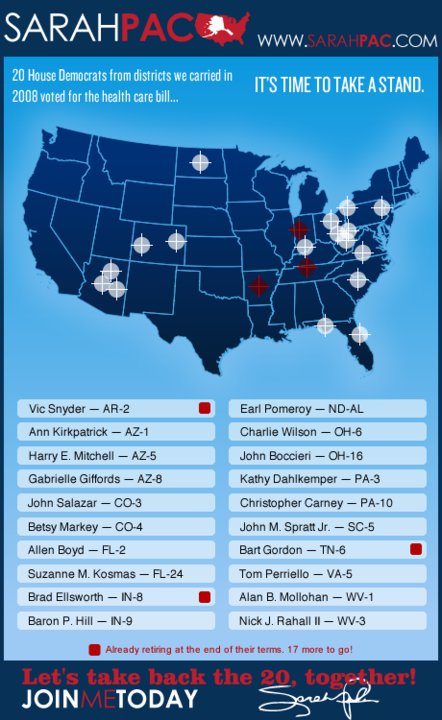
Sarah Palin's 'gunnery'!

Palin Crosshairs
The violent language of “elimination,” “putting in the cross-hairs,” (as with Palin’s poster, above) “taking back,” “taking out,” to which members of that movement so often resort, has created a heated atmosphere that easily seeps into the unconscious of the mentally disturbed. That is Dupnik’s point.

"... By making his position public, Dagan has written a warning firmly on his name. .."

"... So what does Dagan suggest, according to those conversations documented on Wikileaks? The joint move conception, stalling the Iranian project instead of going to war. Dagan is preaching for a shared global effort that includes, alongside tightening the sanctions, stopping the purchase of parts essential for the progress of the nuclear program, encouraging the Iranian opposition, and, of course, covert operations. The very fact of a significant delay to the Iranian plan (considering Israeli intelligence originally estimated the Iranians would have the bomb by 2007 ), would seem to testify some of this is already being carried out...."

As intended by Joseph Samaha, Al Akhbar 'upsets' Jeffrey Feltman..


To the Editor:

As ambassador to Lebanon from 2004 to 2008, I was the person whom Al Akhbar’s editorial chairman, Ibrahim al-Amine, hoped to upset every morning with his newspaper’s coverage (“A Rarity in the Region, a Lebanese Paper Dares to Provoke,” news article, Dec. 29).
Mr. Amine did get my attention, but not in the way he intended. The hilariously erroneous accounts of my activities reported as fact in his newspaper provoked morning belly laughs. (Feltman is used to the accuracy of Al Mustaqbal, An Nahar, Al Hayat, AsSharq al Awsat & mostly, MEOWLebanon!)
While posted to Lebanon, I met with the editorial boards of Lebanon’s lively media, even stridently anti-American ones, for off-the-record, two-way conversations. Of all the requests I made, only Al Akhbar’s editorial board refused to receive me.
Sadly, Al Akhbar is less maverick and far less heroic than your article suggests. Al Akhbar will no more criticize Hezbollah’s secretary general, Hassan Nasrallah, than Syria’s state-run Tishreen newspaper would question the president of Syria, Bashar al-Assad.
One of the curiosities I discovered as ambassador to Lebanon was the number of Western journalists, academics and nongovernmental representatives who, while enjoying the fine wines and nightlife of Beirut, romanticized Hezbollah and its associates like Al Akhbar as somehow the authentic voices of the oppressed Lebanese masses. Yet, I don’t think that many of those Western liberals would wish to live in a state dominated by an unaccountable clerical militia and with Al Akhbar providing the news.
Samir Kassir and Gebran Tueni, who worked for the newspaper An Nahar and were killed by car bombs, and the grievously mutilated but courageous television journalist May Chidiac paid the price for real journalism in Lebanon — not the writers of Al Akhbar.

Jeffrey Feltman
Assistant Secretary of State
for Near Eastern Affairs
Washington, Dec. 30, 2010

Saturday, January 8, 2011

Israeli media: "Jewish congresswoman shot"

oh... and she is American! israeli media failed to note that a "Christian Federal Judge" also died in the shooting, and perhaps some of the victims of this tragedy were "Atheists, Buddhist, Muslims, Zoroastrians, ...etc."

"We will shake the ground under the Americans, if they will not withdraw,"

Main Image
"... Sadr's return to Iraq has jolted the country as it prepares for the full U.S. withdrawal at the end of the year,  Some minority Sunnis are apprehensive of a revival in Sadr's militia, but most Iraqis appear to hope Sadr's return at this juncture will help solidify Iraq's fragile stability as overall violence falls, despite continuing attacks by insurgents. Sadr said occupiers should be resisted "by all means" but added that arms were for "people of weapons only," a comment that seemed to endorse the authority of the army and the police and could calm fears of a return of the Mehdi Army..."

"Hosni Moubarak a encouragé l’essor des salafistes pour contrer les Frères musulmans"

Via AngryArab, in Liberation:
"... Mais c’est ce même Sadate qui a initié une politique d’islamisation de la société afin d’en finir avec les restes de la gauche nassérienne. C’est lui qui, se faisant appeler «le président de la science et de la foi», a élargi les Frères musulmans alors en prison. Lui qui a cru bien faire en allégeant la taxe foncière des immeubles dans lesquels un local était réservé à une salle de prière. D’où l’explosion des zawiya, dirigées par des imams autoproclamés. Cette multiplication des lieux de culte musulmans se double d’une politique d’entrave draconienne à la construction d’églises. La communauté copte étant travaillée par le même mouvement de réveil religieux que les musulmans, elle vit ces limitations comme une injustice.Après l’assassinat de Sadate - par un commando islamiste -, Moubarak a continué sur la même voie, alimentant le feu qu’il cherchait à éteindre. Pour montrer qu’il était inattaquable sur le chapitre de la bigoterie, il décréta l’interruption des programmes télévisés cinq fois par jour pour la prière. Il laissa Egyptair bannir l’alcool de ses menus, etc. Autant de petits symboles qui, mis bout à bout, ont contribué à polariser la société sur la question religieuse..."

'Mrooj', Lebanon

by Carine Lahoud

كوخ البنات"، مطعم 'صاج'، المروج، لبنان"

by Carine Lahoud

Loving Saudi Arabia ....again

Frenemies Forever - By Steve LeVine | Foreign Policy

"... sighs of relief & a few mischievous smiles..."

"...What's increasingly clear is that low-key weapons -covert sabotage and economic sanctions - are accomplishing many of the benefits of military action, without the costs. It's a devious approach - all the more so because it's accompanied by near-constant U.S. proposals of diplomatic dialogue - but in that sense, it matches Iran's own operating style of pursuing multiple options at once...."

"Excellent"


"... A source present at the half-hour meeting between Hariri and Clinton at a New York hotel said that "Secretary Clinton very clearly expressed her support for the Hariri tribunal." Asked if the Lebanese premier also supported it, the source said, "That goes without saying." The source said Clinton also expressed strong support for the independence and sovereignty of Lebanon, a phrase often used to imply criticism of attempts by neighboring Syria to exert control over Lebanese affairs. Clinton herself made no comment to reporters other than to praise her meeting with Hariri as "excellent." Immediately before meeting the Lebanese leader, Clinton held a 45-minute meeting in an adjacent hotel with King Abdullah of Saudi Arabia, who had back surgery in New York last month..."
hariri - Reuters - January 8 2011 

March14 to Saudi Arabia: 'We need US$3 billions to regenerate...'

قال مرجع سعودي "رفيع" لمسؤول عربي خلال محادثة هاتفية مطولّة تمّت خلال عطلة الأعياد، إنّ فرقة 14 آذار عندما كانت تشارك منذ اسبوعين بزفاف الأمير عبد العزيز بن فهد، طلب من النائب الثاني لرئيس مجلس الوزراء السعودي دعماً مالياً بقيمة 3 مليارات $ لكي تعيد تأهيل إنتشارها.

Friday, January 7, 2011

Can Pakistan strike Israel?

Just wondering: who do we believe? Geagea' who .....

.. said that in his meetings with senior Saudi officials, he never sensed that an SS 'settlment' was never in the cards, or his 'ally', Hariri who divulged to Al Hayat that such a settlment was reached over a month ago?

Did Turkey Win the Iraq War?

"... The consensus has it that the big winner of the Iraq War was Iran, in that the toppling of the Saddam Hussein regime removed the major barrier containing Iran's regional ambitions. Certainly the Shiite-dominated and Iran-friendly government in Baghdad has freed up Tehran's hand across the region -- even if, as I've argued before, the inherently volatile nature of Iraqi politics means that Iran has inherited some time- and energy-consuming responsibilities in Iraq along with its increased influence. But I'd argue that the fears among Middle Eastern Arab states of Iran's growing regional reach have more to do with their own domestic politics, often with regard to Shiite minorities, than with the strength of Iran's influence, the gravitational pull of its industry, or the attractiveness of its governance model.
The same can't be said for Turkey, which has also benefitted from the dramatic changes in the region's geostrategic landscape wrought by the Iraq War. This N.Y. Times article detailing Turkey's enormous and growing trade ties in the Kurdish north, as well as its political influence in Baghdad, is only part of the story. Ankara's opposition to the war, and the Bush administration's obstinacy in pursuing it, in some ways prepared the way for Turkey's rebalancing of its foreign policy approach from a Western-focused alignment to a Turkey-centric strategic hub. And the power vacuum created by the fall of Saddam Hussein, though initially as destabilizing as Ankara had feared and warned, subsequently helped create the space for Turkey to assume the regional role it aspired to. ..."

New US ambassador to Syria, sworn in ...

The new US ambassador to Syria, Robert Ford, was sworn in on Friday. He is expected to take up his post by the 4th week of January

".. entire regions of our territory are in a state of occupation by Muslims & the Mafia.."

The daughter as de-demonizer - Haaretz Daily Newspaper | Israel News

Haririte minister: "Nabih Berri is not privy to the SS 'settlment' details, ... but my boss is"

"... "The statements issued by Hariri, who is at the core of ongoing contacts, are the correct ones but we don't know if House Speaker Nabih Berri has so far been informed of the details of the settlement," Rahhal stressed...."

Mossad's Dagan pushes Iran 'threshold' even further .... and further...

Israel is (suddenly) concurring with Washington's estimates, and in some cases pushing the dates of Iran's threshold enen further... the US does not consider the Iranian program as an immediate threat and Israel is suddenly saying that Iran' threat is serious, in comparaison to Hezbollah's 'acute' threat... Recent articles describing Mossad's prowess & feats under Dagan are intended to say: "This man should be trusted: let us not be hasty!"
The WaPo:
"... newly retired spy chief thinks Iran will not be able to build a nuclear bomb before 2015, Israeli media reported Friday - further pushing back Israeli intelligence estimates of when Tehran might become a nuclear power....as recently as 2009, Israeli Defense Minister Ehud Barak said Iran would be able to build a nuclear bomb by 2011. But since then the projected deadline has been extended. The Israeli Cabinet minister in charge of strategic affairs, Moshe Yaalon, said last week it would take the Iranians at least three years to develop a nuclear weapon. The assessment by Dagan adds another year to that estimate. Dagan also said Israel "should not hurry to attack" Iran, according to the Yediot Ahronot report..."

Hariri travels to see Clinton & Abdallah ... amidst accusations

"... Saad Hariri headed to New York on Friday to meet with Saudi King Abdullah and US Secretary of State Hillary Clinton on the political crisis in Lebanon, a government official said. The official close to Hariri, speaking on condition of anonymity, told AFP the talks would focus on the deadlock in Lebanon created by a UN probe into the 2005 murder of Rafiq Hariri...."I am going there to discuss ways of boosting the mediation efforts that are a guarantee to Lebanon's stability," Hariri was quoted as saying.he revealed that Saudi-Syrian mediation had led to an agreement months ago but accused Hezbollah of not living up to its end of the deal..."

Dick Gephardt meeting Sec. Clinton to 'explain his representation of Ankara...'

Laura Rosen:
"lobbying records Gephardt filed with the Justice Department indicate he e-mailed Secretary of State Hillary Clinton’s chief of staff Cheryl Mills in May (5/5/2010 & 5/6/2010) seeking a meeting with Clinton regarding his representation of Turkey..."