Monday, January 9, 2012

Saudi Official after meeting Japanese Official: "It's an 'Internal' matter if Japan buys Iran oil"

These 'crippling' sanctions!
"... The comments by the Oil Ministry official were reported on Monday by the Saudi daily Al-Watan a day after Japanese Foreign Minister Koichiro Gemba met with senior Saudi officials in the kingdom's capital, Riyadh.... Japanese officials asked Saudi Arabia, to make up for the potential loss of Iranian oil for Japan. The Asian nation is now even more heavily dependent on oil and natural gas imports after last year's tsunami forced the shutdown of nuclear reactors.... Saudi officials have said that Gulf oil producers are ready to step in and offset any loss of Iranian oil in the market, though it remains unclear if the necessary pipelines that would reroute the oil away from the strait are all fully operational....
China, a major Iran oil importer, has resisted the sanctions effort. The Asian powerhouse's deputy foreign minister, Cui Tiankai, said Monday that China's trade relations with Iran have nothing to do with Tehran's nuclear program and that sanctions alone cannot resolve the dispute...."

CNN: "This is a leader who appears to be able to weather this storm!"

"Muslims with weapons of mass destruction are scary"

Fighting Words - By Michael A. Cohen | Foreign Policy

King Hamad on Hanukkah: "Iran is a threat to both Israel & Bahrain!"

"...Rabbi Marc Schneier, vice president of the World Jewish Congress, said the king told him he was alarmed by the Islamic Republic during a 45- minute meeting held in the capital city of Manama late last month.
“I made a point how it’s ironic how we share a common enemy and he acknowledged that Iran has been a threat,” said Schneier, who gave the king a hanukkia at the end of their conversation...."

IAEA says "enriching at Fodo is under IAEA surveillance", but the US says it's "an escalation!"

Who is escalating?
"VIENNA — The UN atomic agency said Monday that Iran is now enriching uranium at a new site ...IAEA spokeswoman Gill Tudor said that all nuclear material "remains under the Agency's containment and surveillance" at Fordo
US State Department spokeswoman Victoria Nuland said that Iran's enriching uranium at the Fordo site was "a further escalation..."

'Hundreds' of Syrian deserters in North Lebanon

"Under cover of darkness, in a shabby rented house in the northern Lebanese mountains, a dozen Syrian men huddle round a wood stove, candlelight flickering on their drawn faces. All of them claim to be defected soldiers,...This loose collection of defectors and armed civilians claims thousands of members and posts footage of attacks on military infrastructure on Facebook. But the men in north Lebanon, all of them Sunni Muslims, said that they lived in poverty and secrecy, numbering a few hundred at most, and had limited access to weapons, prompting questions about the capability of the organization to have a substantial impact on well-armed and organized Alawite-led Syrian security forces...  They receive no international help and had been visited by no military attaches, they said, although they would take arms, money or supplies from almost anyone if they offered it. ..."

Sunday, January 8, 2012

'The Sorry Lot': Sending US forces back to Iraq "by force" & call to arms against the Islamic world!

".... Romney - His utterances appear to be a mish-mash of well rehearsed and vetted responses that political consultants (the best that money can buy) have provided him.  It doesn't really seem that Romney believes a lot of his own  "pablum."  His bleating about "America the Beautiful" rings holllow in the face of the bald fact that neither he nor any of his richboy sons ever chose to spend some of their oh so valuable time in the US military.  Better things to do?  The military is something for the lower classes to do?  His responses to questions over his leadership of a largely desructive Wall Street M&A company that specialized in wrecking distressed companies to profit from sale of pieces of the wrecks are always to claim that he knows how to "run" the US because he was so good at the wrecking.  Among other things this ignores the very different nature of business and government.  At the most elemental level business exists to make money by selling things and minimizing costs and government exists to spend money it collects in taxes or creates and provide services otherwise unavailable.  Perhaps the most enjoyable of his bleatings was the moment in which he referred Diane Sawyer to Ron Paul on a point of information concerning the US Constitution.
Gingrich - Ron Paul has called him a "chickenhawk."  In other words, someone who thinks other people should fight.  The basis for this is Gingrich's failure to serve during the draft and the VN War.  He appears to love wars in which he, personally, will not fight.  When confronted by this "awkwardness" he goes on about his father's 26 years of service in the US Army as though it were his own.  He also goes on to cite his "experience' as a child of seeing his father go to war as though that is somehow ennobling.  This is rubbish and someone should "call" him on it.  Been there, done that, and it is not an informative experience.
Perry - Sad.  The fool actually said that he would send US forces back into Iraq by force so that the Iranians would "stop taking over the country."  Even Sawyer managed to stop contemplating her own beauty long enough to express surprise.  "Well, these Iraqi individuals" as he referrred to the government that we "mid-wifed" into being "should be talked to..."  Perhaps a constitutional amendment barring presidents from Texas might be contemplated.
Santorum.  Last night's SNL sketch on him should be savored.  Santorum, aside from the Google joke, still seems to justify my earlier comment that he must have been some Sister Mary Margaret's favorite little boy student.  So far as I know he is not an Opus Dei type but he surely looks like one, sounds like one, and walks like one.  He really seems to be running for Holy Roman Emperor.  His world view seems medieval.  His obsession with what he calls "radical Islam" is transparently a call to arms against the Islamic World.  He clearly believes that "radical Islam" is a threat to.... What?  The USA or is it Israel?  His attitude ignores the simple truth that Islam is not one thing.  It is many, many things as is Christianity.  As I recall, there are a lot of widely differing Jewish sects as well.  The number of Muslims who are real threats to the USA is minuscule.  Those people are being well "dealt with" by SOF, clandestine intelligence and alliances with foreign police.  The COIN wars have been nothing but welfare for generals and  self-serving theorists.  If Santorum is president look for an official renewal of the crusades..."

Russian Naval Officer in Tartous: "The port call is aimed at bringing the two countries closer together and strengthening their ties of friendship,"

(AFP) - "The port call is aimed at bringing the two countries closer together and strengthening their ties of friendship," the official SANA news agency quoted a Russian naval officer it named as Yakushin Vladimir Anatolievich as saying.
"The commanders of the Russian naval vessels docked in Tartus took turns to express their solidarity with the Syrian people," the news agency added..."

Despite the continued bloodshed in Syria & Iraq, the Administration is showing little interest in becoming involved

As anticipated, President Obama’s January 5th announcement on defense strategy set the stage for an approximately 8% reduction in military spending over the next decade. Precise details of where the cuts will fall will be worked out in consultation with the Congress. However, with reductions in numbers for both the army and the marines, the shape of the US military is transitioning away from an expeditionary format based around overseas ground wars to a format in which the US relies on naval, air and space assets to project power. Obama confirmed the “pivot” in US strategic priorities from Europe to the Asia-Pacific region, while leaving a considerable military capability in the Middle East. He stressed that, even with these cuts, the US would still be spending as much as the next ten nations combined and that no reduction in US global supremacy would result. Indirectly, this is intended to signal to China that the US will remain a significant actor in East Asia. US officials interpret Chinese expressions of concern in the regard as indicating that they “have got the message.” Given the critical reaction by leading Republican presidential contenders to the new strategy, Obama’s policy is not the last word on this subject. However, from our contacts at the Pentagon and with the presidential campaigns, we expect the main lines to endure. The one exception may be Iran which, as we expected, is emerging as a touchstone of “toughness” in the presidential campaign rhetoric. The Administration remains, as we have reported, resolutely opposed to a military strike on Iran. Nonetheless, recent Iranian threats over shipping in the Strait of Hormuz have raised the level of alert in Washington to a possible uncontrolled escalation of events in the Gulf. Orders to the Firth Fleet are to observe restraint.  The US and Israel will hold week-long joint missile and air defense exercises in Southern Israel beginning on January 8th. Elsewhere in the Middle East, the pattern is reversed. Despite the continued bloodshed in Syria and Iraq, the Administration is showing little interest in becoming involved. In Egypt, US diplomats are extending their contacts with the Muslim Brotherhood. On North Korea tension is also relaxing with State Department officials in the region expressing relief at the stable transition of leadership.

Friday, January 6, 2012

STATE's Nuland sneeringly describes South America as "interesting places"

"... State does not think much of Iranian President Mahmoud Ahmadinejad's visit to several countries in Latin America this week, including Ecuador, Venezuela, Cuba, Guatemala and Nicaragua. "Well, as the regime feels increasing pressure, it is desperate for friends and flailing around in interesting places to find new friends," Nuland said. "We are making absolutely clear to countries around the world that now is not the time to be deepening ties, not security ties, not economic ties, with Iran."

(Yesterday) 'Comment' on Al-Jazeera Direct threatens a Free Syrian Army operation in Damascus' 'Midan Square'

IDF: 'Egyptian Beduin NOT Gaza Palestinians behind August attack'

"...Israel immediately responded to the attack by bombing the Gaza Strip and killing five top leaders of the Popular Resistance Committees, a Gaza-based terror group, which it accused of orchestrating the attacks.
The question of why Beduin would participate in such an attack against Israel and on behalf of Palestinians in Gaza is under review in the IDF. One theory is that the Beduin were paid for their involvement, but the decision to wear suicide bomb belts indicates a strong ideological or religious factor as well (well, duh!). ..."

"It’s becoming North Korea with less military power!"

David Keyes: Why Is Obama Selling Arms To A Theocratic Dictatorship? | The New Republic

'The Ugly face of the Muslim Brotherhood'

"... In Egypt, the New York Times uncovered an intensive flirtatious relationship between the US government and the Ikhwan. But the newly found love is two-sided: varieties of Islamists from Tunisia to Palestine (exemplified by Hamas) are now sending signals of reassurance and moderation to the US and even Israel. Hamas is now (deceptively and in contradictory messages) expressing willingness to abandon armed struggle against Israeli occupation and to settle its aspirations for 22 percent of Palestine (Hamas is now officially following in the footsteps of Fatah – and Fatah was launched by individuals inspired by Ikhwan thinking).It is now clear that the Ikhwan (and variants of them) will dominate the new political arena vacated by the ouster of a few Arab dictators. In Egypt, there is a competition between the Ikhwan (sponsored by Qatar) and the Salafites (sponsored by Saudi Arabia). They are, more than any other political current – or as much as the liberal right-wingers – willing to compromise with the remnants of the ousted regime and with US and Israel. The signs are evident now.
The Syrian Ikhwan, however, may become an extreme example of opportunism that has characterized the movement.
I saw Muhammad Tayfur, the Deputy General Inspector of the Syrian Muslim Brotherhood of Syria on MTV the other night. His discourse reveals much about the movement. Tayfur was pitted against Jubran Urayji of the SSNP (a pro-Syrian political party that does not express any disagreements with the Syrian regime). Urayji intended to expose the hypocrisy of the Muslim Brotherhood and he succeeded. He simply asked Tayfur about the Ikhwan’s plan to liberate the Golan Heights. Tayfur did not hesitate to give his answer. He said that the Syrian Muslim Brotherhood believes in peaceful struggle to liberate the Golan Heights. Here, the hypocrisy of the long-standing Ikhwan’s stance is revealed. For years, the Ikhwan have been (rightly) mocking the stance of the Assad regime vis-à-vis the Golan: they have consistently criticized the inaction of the regime towards Israel and its unwavering willingness to negotiate peacefully with Israel.
So the Syrian Ikhwan now admit that they will settle for the same position of the Assad regime. It is now clear that they have no objections to the foreign policy of the regime toward the Arab-Israeli conflict (with the exception of support for Hezbollah and Hamas which the Ikhwan and their right-wing liberal allies would end promptly). After all those years, the Ikhwan now basically admit that they have no objections to the inaction by the regime on the Golan front. The Ikhwan would then continue the policy that basically relegates the plight of the people in the Israeli-occupied Golan to either divine intervention or to the US-dominated “international community.”
But Urayji was not satisfied: he wanted to embarrass Tayfur further. He asked him for the stance of the Ikhwan on Palestine. Tayfur mumbled some incomprehensible words before saying that the focus will be on internal matters, as if the state that occupies Palestine is different from the state that occupies the Golan Heights.
This is not the only sign of appeasement by the Ikhwan toward Israel. Rashid al-Ghannushi – who does not travel much – traveled all the way to the US to basically give a reassuring speech before an affiliate of the Zionist lobby. The Egyptian Ikhwan barely speak about Palestine anymore and the New York Times reported that officials of the movement pledged to US officials that they would respect the Egyptian-Israeli peace treaty.
In Lebanon, al-Jemaah al-Islamiyah, were bought off by Saudi money and are now allies of the Lebanese Forces.
But this hypocrisy and political transformation of the Ikhwan (at least in their rhetoric) will come at a price. The Ikhwan probably assume that people won’t have a second voting chance to reassess their early political choices."

Col. Riad Assaad's "huge operation": Suicide bomber' attack in Damascus


(Reuters) - "A suicide bomber killed about 25 people and wounded 46 in Damascus on Friday, Syria's state news agency SANA said, in the third such attack in the Syrian capital in a month.

The blast occurred two days before an Arab League committee was due to discuss an initial report of Arab observers ...(and hours before the arrival of Jeffrey Feltman in Cairo)...  The meeting may decide whether to continue the mission or to refer Syria to the United Nations Security Council, perhaps paving the way for some form of international action, a scenario that many Arab countries are keen to avoid..."

Thursday, January 5, 2012

Saudi 'Al Hayat': "The Lies of the Syrian Opposition!"

"... لا شك في ان القضية المحورية في هذه الوثيقة هي التدخل الأجنبي. فرغم ان الورقة ترفضه الا أن تفسيراتها تقره، ووفق ما نشر في «الحياة» امس، فإن البيان الصادر عن مكتب برهان غليون، رفض «التدخل الأجنبي البري، الذي من شأنه المساس بوحدة الأراضي السورية واستقلالها»، لكنه وافق «على التدخل الأجنبي الذي يفرض مناطق عازلة تحت حظر جوي وبحري»، وهذا التفسير يتناقض مع حماية المدنيين في اطار القانون الدولي لحقوق الإنسان، فهذا الأخير لا يتم تنفيذه عبر الوسائل العسكرية وقرارات الامم المتحدة، وهو عمل معنوي صرف.
الأكيد ان المعارضة السورية في الخارج تعيش مأزقاً أخلاقياً. هي تدرك ان التدخل الدولي دعوة الى شرذمة البلد وتدميره، لكن سعيها الى الوصول الى السلطة يفرض عليها محاكاة نظرائها في العراق وليبيا، ويبدو انها ماضية في هذا الاتجاه، وعلى نحو لا تحسد عليه...."

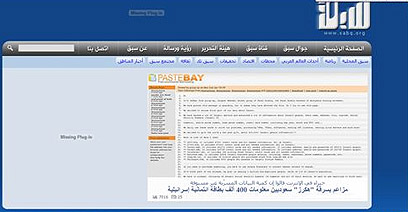
Saudi hacker warns he is in possession of one million Israeli credit card numbers

Saudi hacker warns he is in possession of one million Israeli credit card numbers - Haaretz Daily Newspaper | Israel News

American & British Likudniks: 'Free Syrian Army's visit to Washington was 'Not impressive!'

"... The 30 or so commanders led by Air Force Col. Riyad  al-Asaad, who control the Free Syrian Army from their  safe haven in Antakya, Turkey, have thus far declined  formal partnership with other opposition groups and  have even formed their own rival political apparatus,  the FSA Military Council, which seeks to topple the  regime, provide cover for civilian protestors, protect  public and private property and safeguard against  reprisal actions once the regime has fallen. The  Military Council has also announced its intention to  liaise directly with foreign governments in order to  build support and (most likely) secure direct financial  or material assistance. FSA representatives recently  travelled to Washington, D.C., to lobby the U.S. State  Department for support, but were rebuffed due to  their lack of organization and insufficient numbers..."

"Not brave enough to express it openly"

"...Samir Nashar told The Times on Saturday that most of his colleagues support foreign military action to oust Mr. Assad “but they might not be brave enough to express it openly.” ..."

In the KSA!

"In my 'country' there are those who are more angered by the sight of a Woman without Hijab than the sight a child without shoes!"

"The Deal" between the Egyptian military & the Brotherhood

I hate to agree (sigh) with Rick Santorum on this: Santorum on NBC's"Meet the Press":
Santorum: "The Muslim Brotherhood are Islamists. The Muslim Brotherhood are going to impose Sharia law."
Gregory: "They were popularly elected, I think, ...Isn't that what democracy is about?"
Santorum: "No!" 
"... Less certain, however, is how far the Islamists will go in confronting the ruling military council, whose 10 months in power have been marked by acts of repression that in many cases have exceeded those that took place during the 30 years that Hosni Mubarak ran the country before resigning last February. At each skirmish between the generals and protesters, influential Islamists have been slow to criticize the Supreme Council of the Armed Forces, leaving activists worried that the first elected body of post-Mubarak Egypt won't work hard enough to uproot the old order and lead a real democratic overhaul. In return for their relative passivity in the face of military abuses, the Islamists have been exempt from the harsh measures that have been visited on other political groups, the activists charge..."

Over 70 dead in Iraq bombings!

Series of blasts leaves scores dead in Iraq - Middle East - Al Jazeera English

1st installment: "We made some mistakes in our mission!"

"..."We are coming here for technical help and to see the experience the UN has, because this is the first time the Arab League is involved in sending monitors, and there are some mistakes," said Sheikh Hamad, quoted by KUNA. ..."

Wednesday, January 4, 2012

"I don't think the Syrian National Council has much leverage over the Free Syrian Army, & I don't think the Free Syrian Army has much leverage itself over what is happening on the ground,"

"...Based across Syria's northern border in Turkey, Asaad has been described by some observers as more of a figurehead than leader of the Free Syrian Army, which says it has over 15,000 military defectors in its ranks but whose true size, membership and capabilities remain cloaked in mystery.
"I'm not sure how much control the FSA has over militants in Syria," said London-based analyst Julien Barnes-Dacey. "Most of these groups are operating on localized autonomous basis."
On Tuesday Asaad said the rebel army would "take a decision which will surprise the regime and the whole world" within days. "What is most likely now is we will start a huge escalation of our operations," he said.
Burhan Ghalioun, head of the main opposition Syrian National Council has urged army defectors and insurgents to limit their operations to defending peaceful protests, saying it was "fundamental for the success of our revolution to preserve its peaceful character".
That tension between the armed and political wings (whoa, wings now?)of the uprising is matched by the gulf between an opposition in exile rallying international support and the protesters and rebels inside Syria who act largely independently, analysts say.
"I don't think the Syrian National Council has much leverage over the Free Syrian Army, and I don't think the Free Syrian Army has much leverage itself over what is happening on the ground," said Peter Harling, an analyst with the International Crisis Group who has spent several years in Damascus.He said the FSA was more of an umbrella for disparate fighters than a real centre of command.
"People see a source of legitimacy in this (FSA) label, but what you have is groups emerging on a very local level, mostly composed of civilians, joined by defectors. But it's local dynamics rather than national."
The divisions are one reason why Western powers who rushed to support Libyan rebels seeking to overthrow Muammar Gaddafi have been more cautious with the opposition and the FSA.
Ghalioun said unless the rebels reined in their operations Syria could slip deeper into conflict "which pits a free army and an official army against each other". But in recent weeks he has faced growing criticism, even from within the SNC, for not endorsing a more forceful policy against Assad.
A spokesman for the Free Syrian Army, Major Maher al-Naimi, said Ghalioun's comments reflected his ignorance of "military basis of the (Syrian) regime", and insisted the rebels would target anyone bearing arms against civilians...
FSA fighters say they are armed only with weapons they took with them when they defected, but authorities say they have seized shipments of weapons crossing into Syria from neighboring states.
The increasing violence has encouraged those protesters - a minority in the early months for the uprising - calling for foreign intervention against Assad."There's only a handful left in the SNC that don't want to move toward armed intervention," said one council member, who asked not to be named."...I'm against arming the Free Syrian Army. I see them as more harm than good, but that's it - it has become an armed revolution now."

Lockheed Martin goes to bat for oppressive Bahrain

"...As Ken Silverstein reported in Salon last month, the kingdom is stepping up its Washington lobbying efforts. Here’s the latest example, as far as I can piece together from lobbying disclosures filed by Bahrain’s “strategic communications” firm, D.C.-based Sanitas International.
On Nov. 30, the Washington Times published an Op-Ed under the headline “Bahrain, a vital U.S. ally: Backing protesters would betray a friend and harm American security.” It was written by Vice Adm. Charles Moore (retired). Moore was formerly commander of the Navy’s Bahrain-based Fifth Fleet. From 1998 to 2002, Moore notes in his Op-Ed, he “had the opportunity to develop a personal relationship with His Majesty King Hamad bin Isa Al Khalifa, Bahrain’s leader, as well as many senior officials in his government.” Moore passed through the revolving door and is now regional president for Lockheed Martin for the Middle East and Africa.... ... ... 
To sum up: Bahrain paid a Washington lobbying firm to get an independent-seeming Op-Ed published in an American newspaper and then touted the Op-Ed in its official news agency... 
In the past decade or so, Lockheed has done hundreds of millions of dollars of business with Bahrain, including selling the nation 10 F-16 jets, hundreds of extended-range rockets, tactical surface-to-surface missiles, and a ballistic missile defense radar system. The company has also had an $87 millioncontract to do tech support for the U.S. military in Bahrain and elsewhere. So it’s clearly in Lockheed’s interest to keep the U.S.-Bahrain relationship healthy, and the company appears to be working directly with the regime to accomplish that goal.
Lockheed spokeswoman Jennifer Whitlow told Salon in a statement that Moore’s views are his own:
As stated in the opinion piece, the views expressed by Mr. Moore are his own as an individual, not as a representative of Lockheed Martin, and are based on his experience as former U.S. Navy 5th Fleet Commander.
In fact, the piece does not state that Moore’s views are “his own as an individual”; he is identified as a Lockheed executive in his bio line...."

"Thousands of US soldiers to be deployed in Israel"

US commander visits Israel to finalize missile... JPost - Defense

"We will not recognize Israel under any circumstances; we are talking about an occupation entity & a criminal enemy,"

Egypt's Muslim Brotherhood plans to put treaty with Israel to a referendum - Haaretz Daily Newspaper | Israel News

Saudi Arabia ignores Tunisia's request to hand over Zine al-Abidine for trial

Tunisia says Saudi silent on requests to extradite ex-leader

Jeffrey Feltman to rescue the 'Arab League' Syria report ...

UPDATE: Arab League's ministerial committee 'postpones' its meeting on Syria until further notice, just as Jeff Feltman scrambles to Cairo! 
"...The US State Department said on Tuesday that Jeffrey Feltman, the assistant secretary of state for Near East Affairs, was to travel to Cairo for consultations with the Arab League about Syria.
"We have made clear that if the Arab League initiative is not implemented, the international community will have to consider new measures to compel a halt to the regime's violence against its own citizens,'' spokesman Jay Carney said on Tuesday. ..."

Tuesday, January 3, 2012

Remember the 'Fitzgerald-Hariri Report'?

 Reminiscent of  We know they're there but "we have seen them with our own eyes.”
... The report commented on the political polarization in Lebanon between those who blamed pro-Syrian government, and even Syria itself, for the murder, and those who accused "the enemies of Syria" of carrying out the crime in order to set Syria up. Peter Fitzgerald (a seemingly good intentioned, soft spoken old world investigator) was anything but innocent. His report emphasized that it although it was impossible to identify the party that killed Hariri, blamed the Syrians who had "influence that goes beyond the reasonable exercise of cooperative or neighborly relations," for being responsible for "the tensions" that characterized the political life in Lebanon prior to the assassination. Moreover, it blamed the Syrians for their "(interference) with the details of governance in Lebanon in a heavy-handed and inflexible manner." ...
Friday Lunch Club predicts that the Arab League final report will be something along these lines! However, all eyes are on the Gulf ...!!!!!!

"Arab states are fighting two wars. One is over the nature of future power in their capitals & the other is over which regional axis they will support".

"... Washington will most likely confront urgent Arab and Syrian opposition requests for direct involvement in Syria. Already, Ghalioun has called on the Security Council to adopt the Arab initiative; at the same time some Arab and Syrian opposition leaders have vocally called for a no-fly zone and NATO involvement to protect civilians.
But a word of caution. The danger of this kind of involvement lies in the grave and complex reality that Iran still considers the security of the Syrian regime as part of its own security, and that, while both Tehran and Damascus have been preparing for a conflict with United States since its invasion of Iraq in 2003, including supporting proxy forces in the region, Washington has thus far pursued policies more reactive in nature to regional developments. Washington should be careful about falling into the duplicitous trap of Middle Eastern politics.
Washington must act within the context that Syria is already in the throes of civil strife, which can only intensify and possibly spill over into Lebanon or Iraq, and that the Arab states are fighting two wars. One is over the nature of future power in their capitals and the other is over which regional axis they will support.
Washington should also disabuse itself of the notion that the terminally ill Syrian regime will collapse soon. The regime has life support from Iran, Iraq and Lebanon, and thrives on terror and Arab schisms. This makes any reactive or reflexive American involvement in Syria fraught with uncertainties and serious risks.
Washington's policies should focus now on expanding and organizing its cooperation with Turkey, Saudi Arabia and Qatar, which have deep interest in a change of power in Damascus; supporting the Free Syrian Army through Saudi Arabia and Turkey; strengthening sanctions against Syria in concert with regional and international allies, including placing sanctions on Sunni merchants closely associated with the regime.; maintaining and supporting a strong diplomatic presence in Iraq and Lebanon; seeking out Alawi and Christian political and military figures with the objective of reassuring them with the promise of political inclusion in the future of Syria.
Most importantly, Washington should not lead a campaign in Syria designed in the imperial corridors of the American capital itself."

""Gift to the world for the new year,"

"... Saudi web surfers expressed glee Tuesday over the credit card scheme which exposed the account details of tens of thousands of Israelis. "If I were a hacker I would wish for 800,000 credit cards to be leaked, not just 400,000," one Saudi talkbacker wrote. "It's allowed when it concerns Jews," others said.
On Monday, it was reported that Saudi hackers claimed to have leaked credit card and personal information of over 400,000 Israelis. The hackers called the cyber attack a "gift to the world for the new year," which they hoped "would hurt the Zionist pocket." The file was removed shortly after being posted...."

View from my (car's) Window!

"We Sunnis cannot reach a reconciliation with Maliki anymore!"

"... Once a champion for strong central government, Hashimi is now singing a different tune: “If Maliki continues to be the prime minister, my people [the Sunnis] are worried about their future in Iraq and thinking seriously about establishing their own [autonomous] regions.” But what Iraqis—and regional powers like Turkey—worry about is a darker scenario: a possible return to the sectarian violence that domi-nated the country for much of the past decade.Did the Americans leave too soon? “It’s not that they left too early,” Hashimi said. “In fact, they left too late. The problem is what they have left behind. The mission is not accomplished. They toppled the Saddam regime, but the real challenge is the second phase, establishing a state of law and independent institutions, and that has not been fulfilled.” Sectarian interests, corruption, terrorism, and Iranian influence continue to be power-ful factors in Iraq...."

"Of course, Iraq was just one of our invasions-turned-counterinsurgencies-turned-disasters. The other is still ongoing, may prove the greater debacle!"

"... As great as was the feat of building the infrastructure for a military occupation and war in Iraq, and then equipping and supplying a massive military force there year after year, it was nothing compared to what the U.S had to do in Afghanistan.  Someday, the decision to invade that country, occupy it, build more than 400 bases there, surge in an extra 60,000 or more troops, masses of contractors, CIA agents, diplomats, and other civilian officials, and then push a weak local government to grant Washington the right to remain more or less in perpetuity will be seen as the delusional actions of a Washington incapable of gauging the limits of its power in the world.
Talk about learning curves: having watched their country fail disastrously in a major war on the Asian mainland three decades earlier, America's leaders somehow convinced themselves that nothing was beyond the military prowess of the “sole superpower.”  So they sent more than 250,000 American troops (along with all those Burger Kings, Subways, and Cinnabons) into two land wars in Eurasia.  The result has been another chapter in a history of American defeat -- this time of a power that, despite its pretensions, was not only weaker than in the Vietnam era, but also far weaker than its leaders were capable of imagining....(Read the full report)"

BRZEZINSKI: "... Israel & the greater Middle East -- are today's geopolitical equivalents of nature's most endangered species!"

"... The leaders of the world's second-rank powers, among them India, Japan, Russia, and some European countries, are already assessing the potential impact of U.S. decline on their respective national interests. The Japanese, fearful of an assertive China dominating the Asian mainland, may be thinking of closer links with Europe. Leaders in India and Japan may be considering closer political and even military cooperation in case America falters and China rises. Russia, while perhaps engaging in wishful thinking (even schadenfreude) about America's uncertain prospects, will almost certainly have its eye on the independent states of the former Soviet Union. Europe, not yet cohesive, would likely be pulled in several directions: Germany and Italy toward Russia because of commercial interests, France and insecure Central Europe in favor of a politically tighter European Union, and Britain toward manipulating a balance within the EU while preserving its special relationship with a declining United States. Others may move more rapidly to carve out their own regional spheres: Turkey in the area of the old Ottoman Empire, Brazil in the Southern Hemisphere, and so forth. None of these countries, however, will have the requisite combination of economic, financial, technological, and military power even to consider inheriting America's leading role.
China, invariably mentioned as America's prospective successor, has an impressive imperial lineage and a strategic tradition of carefully calibrated patience, both of which have been critical to its overwhelmingly successful, several-thousand-year-long history. China thus prudently accepts the existing international system, even if it does not view the prevailing hierarchy as permanent. It recognizes that success depends not on the system's dramatic collapse but on its evolution toward a gradual redistribution of power. Moreover, the basic reality is that China is not yet ready to assume in full America's role in the world. Beijing's leaders themselves have repeatedly emphasized that on every important measure of development, wealth, and power, China will still be a modernizing and developing state several decades from now, significantly behind not only the United States but also Europe and Japan in the major per capita indices of modernity and national power. Accordingly, Chinese leaders have been restrained in laying any overt claims to global leadership.
At some stage, however, a more assertive Chinese nationalism could arise and damage China's international interests. A swaggering, nationalistic Beijing would unintentionally mobilize a powerful regional coalition against itself. None of China's key neighbors -- India, Japan, and Russia -- is ready to acknowledge China's entitlement to America's place on the global totem pole. They might even seek support from a waning America to offset an overly assertive China. The resulting regional scramble could become intense, especially given the similar nationalistic tendencies among China's neighbors. A phase of acute international tension in Asia could ensue. Asia of the 21st century could then begin to resemble Europe of the 20th century -- violent and bloodthirsty.
At the same time, the security of a number of weaker states located geographically next to major regional powers also depends on the international status quo reinforced by America's global preeminence -- and would be made significantly more vulnerable in proportion to America's decline. The states in that exposed position -- including Georgia, Taiwan, South Korea, Belarus, Ukraine, Afghanistan, Pakistan, Israel, and the greater Middle East -- are today's geopolitical equivalents of nature's most endangered species. Their fates are closely tied to the nature of the international environment left behind by a waning America, be it ordered and restrained or, much more likely, self-serving and expansionist.
A faltering United States could also find its strategic partnership with Mexico in jeopardy. America's economic resilience and political stability have so far mitigated many of the challenges posed by such sensitive neighborhood issues as economic dependence, immigration, and the narcotics trade. A decline in American power, however, would likely undermine the health and good judgment of the U.S. economic and political systems. A waning United States would likely be more nationalistic, more defensive about its national identity, more paranoid about its homeland security, and less willing to sacrifice resources for the sake of others' development. The worsening of relations between a declining America and an internally troubled Mexico could even give rise to a particularly ominous phenomenon: the emergence, as a major issue in nationalistically aroused Mexican politics, of territorial claims justified by history and ignited by cross-border incidents.
Another consequence of American decline could be a corrosion of the generally cooperative management of the global commons -- shared interests such as sea lanes, space, cyberspace, and the environment, whose protection is imperative to the long-term growth of the global economy and the continuation of basic geopolitical stability. In almost every case, the potential absence of a constructive and influential U.S. role would fatally undermine the essential communality of the global commons because the superiority and ubiquity of American power creates order where there would normally be conflict.
None of this will necessarily come to pass. Nor is the concern that America's decline would generate global insecurity, endanger some vulnerable states, and produce a more troubled North American neighborhood an argument for U.S. global supremacy. In fact, the strategic complexities of the world in the 21st century make such supremacy unattainable. But those dreaming today of America's collapse would probably come to regret it. And as the world after America would be increasingly complicated and chaotic, it is imperative that the United States pursue a new, timely strategic vision for its foreign policy -- or start bracing itself for a dangerous slide into global turmoil."

'...Soaring ...a potential threat to the struggling US, Iranian & global economies'

http://www.mcclatchydc.com/2012/01/03/134685/possible-showdown-with-iran-sends.html

The gloves are off but the US & Iran are just swinging

The gloves are off but the US and Iran are just swinging - The National

Former translator' at the UAE embassy final ultimatum to Bashar Assad: 'Leave Syria now!'

View from my Window!

'Montreal, Canada (vintage 2011')'

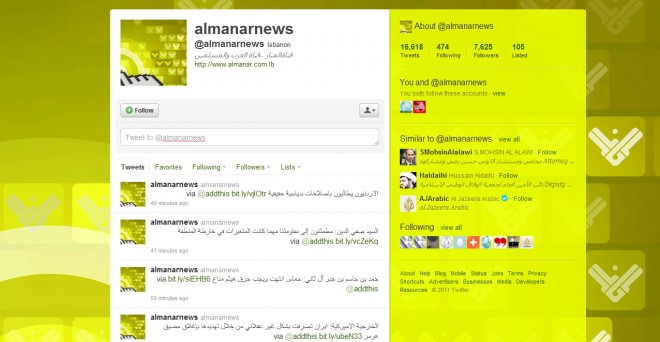
Twitter threatened with court over Hezbollah tweets

"...“Please be advised that providing social media and other associated services to terrorist groups is illegal and will expose Twitter, Inc. and its officers to both criminal prosecution and civil liability to American citizens and others victimized by terrorisms carried out by Hezbollah, ... ” Shurat HaDin’s letter said.
The lawsuit would target accounts such as @Almanarnews, which is run by a Hezbollah television station in Lebanon.
It adds to pressure on Twitter in the United States over tweeting by militant organisations. Joe Lieberman, chair of the Senate Homeland Security Committee, called on the firm this week to shut down accounts that support the Taliban.
Twitter reportedly rebuffed his call on grounds that the Taliban is not officially designated as Foreign Terrorist Organisation by the State Department. ..."

They still host & hold these!

Jordan hosts Israel-Palestinian talks - Middle East - Al Jazeera English

Those 'ungrateful' Libyans: "Qatar is weakening Libya!"

"...Qatar did much more than finance weapons purchases and provide battlefield training. With no access to money and facing legal difficulties in selling oil, the rebels' political body — known as the National Transitional Council (NTC) — could not pay Libyan salaries and fund the wide-ranging subsidies on everything from bread to gas, which grease the economy.... ...  In explaining that his country's aid was purely altruistic, the Qatari emir said he wanted "to ease the suffering of the Libyan brethren and to meet their humanitarian needs."But with Gaddafi dead and his regime a distant memory, many Libyans are now complaining that Qatari aid has come at a price. They say Qatar provided a narrow clique of Islamists with arms and money, giving them great leverage over the political process. "I think what they have done is basically support the Muslim Brotherhood," says former NTC Deputy Prime Minister Ali Tarhouni, referring to the Islamist organization that has won elections in Egypt and Tunisia. "They have brought armaments and they have given them to people that we don't know." Some Qatari officials have indeed exerted influence in Libyan politics. During deliberations to choose a new Cabinet in September, a senior Qatari official was seen huddled with the outgoing Defense Minister, allegedly trying to guide appointments to sensitive security positions.
NTC members complain that actions like these are undermining the fragile transition to democracy the NTC has promised. "Qatar is weakening Libya," says an NTC member who requested anonymity because he was speaking about a sensitive topic. "In funding the Islamists, they are upsetting the balance of politics and making it difficult for us to move forward. They need to stop their meddling." Senior military officials sidelined by Qatar's cronies are just as blunt. "If aid comes through the front door, we like Qatar," says General Khalifa Hiftar. "But if it comes through the window to certain people [and] bypassing official channels, we don't want Qatar."
But senior NTC officials scoff at the suggestion that Qatar is unduly influencing Libyan politicians and weakening the new government. "People say Qatar has an agenda. There is no proof of this," says NTC Vice Chairman Abd al-Hafiz Ghoga. "They just had a big role in the revolution."
Average Libyans, however, do not buy Ghoga's argument. Outside the courthouse in Benghazi, where the revolution began on Feb. 15, street peddlers hawk everything from key chains to bracelets emblazoned with the rebels' tricolor flag. For most of the revolution, they did a brisk trade in Qatari flags. But with the town abuzz about Qatar's meddling in Libyan affairs, vendors like Abdallah Mahmud have stopped selling Qatari products. "We fought to be free," he explained, "not so that new rulers from abroad will take away our freedom." It was a refrain seldom heard during the revolution. But with Libyan politicians taking an increasingly vocal stance against Qatar, the tiny Gulf emirate whose friendship Libya was proud of has become an obtrusive guest that many wish would leave."

"South Sudan, Israel's new ally"

"... Mr. Kiir acknowledged this contribution in Jerusalem, noting that “Israelhas always supported the South Sudanese people. Without you, we would not have arisen. You struggled alongside us in order to allow the establishment of South Sudan.” In reply, Mr. Peres recalled his presence in the early 1960s in Paris, when then-Prime Minister Levi Eshkol and he initiated Israel’s first-ever link with southern Sudanese leaders. Sudan’s civil war continued intermittently from 1956 until 2005......  in January 2011, when 98 percent voted for secession from Sudan, leading to the formation of the Republic of South Sudan six months later, an event hailed by Mr. Peres as “a milestone in the history of the Middle East.”
Israel’s long-term investment has paid off. South Sudan fits into a renewed periphery strategy (Read: potentially hostile to Arabs!) that includes Cyprus, Kurds, Berbers and, perhaps one day, a post-Islamist Iran. South Sudan offers access to natural resources, especially oil. Its role in Nile River water negotiations offers leverage vis-a-vis Egypt. Beyond practical benefits, the new republic represents an inspiring example of a non-Muslim population resisting Islamic imperialism through its integrity, persistence and dedication. In this sense, the birth of South Sudan echoes that of Israel.... A successful South Sudancould eventually become a regional power and a stalwart ally not just ofIsrael but of the West.."

"Why, exactly, would a nuclear Iran be so much worse than a non-nuclear Iran?"

"... Why, exactly, would a nuclear Iran be so much worse than a non-nuclear Iran? Bear with me here: Let's say Iran gets a nuclear weapon. What happens next? Would other states bandwagon? What would that bandwagoning behavior look like in real terms? (For the record, I have never heard any compelling answer to this question in travels around the region.)
Would other states seek nuclear weapons? How, exactly? Let's pick one example: Saudi Arabia. Why, first off, has Saudi Arabia not already begun a nuclear energy program? (And don't say "oil," because there is an opportunity cost to Gulf states using oil for their own energy rather than selling it on the open market for $100 a barrel.) Does Saudi Arabia have the technical expertise to start a nuclear program? If so, how long would it take them? Would Saudi Arabia instead buy a bomb? From where? From Pakistan, perhaps? Why would the Pakistanis sell one to them? Why might the Pakistanis not sell one to them? You can see where I am going here: once you start trying examine the second and third order effects and their various branches, it's tough to explain how, exactly, a nuclear Iran would be that much more dangerous than a non-nuclear Iran. I am not saying it would not be more dangerous -- I am saying it is very hard to explain howexactly, a nuclear Iran would be more dangerous. And I think those arguing for war with Iran have an obligation to sketch out those specifics to both policy makers and to the public.
On the flip side of the equation, what might be the adverse second and third order effects of a U.S. strike on Iran? I agree with Matt's critics that he gives us the best-case scenario. But how does the situation look if we work through the effects of a U.S. strike on Iran country-by-country? How might another war affect U.S. security and economic interests elsewhere in the region? How might such a war affect U.S. interests outside the region? How might Iran respond?
...."

Monday, January 2, 2012

Israel's support of Saudi Arabia

"... The F-15s being sold to the Saudis apparently will not be equipped with standoff systems – long-range missiles to be used against land and sea targets. The US has ensured that Israel will maintain air superiority in the region,... And if the US had not gone through with the deal, EU countries, or the Russians, who are less receptive to Israeli interests, might have filled the vacuum. By engaging with the Saudis, the US retains its influence.
But there is another reason Israel will most likely not oppose the deal. Riyadh and Jerusalem, while hardly allies, share a common enemy. The Islamic Republic is threatening to tip the delicate balance of power in the region ... regarding the Islamic Republic, the US, Israel and the Saudis seem to agree.
In fact, the Gulf States appear to be adamant about stopping Iran. United Arab Emirates’ ambassador to Washington, Yousef Al Otaiba, estimated publicly last year – before he backtracked under pressure – that bombing Iran was preferable to an Iranian bomb. Saudi Foreign Minister Prince Saud al-Faisal has said sanctions are not enough..."

'Arab League' head: "Syrian Army out of cities ...difficult to tell who was firing on whom"

(BBC)-"...He said the military had withdrawn heavy weapons from residential areas and was on the outskirts of cities, but the violence had not ended.
"There is gunfire. There must be a total halt to the gunfire," he said, quoted by AFP news agency, adding that it was difficult to tell who was firing on whom.Snipers were still on rooftops threatening civilians, he said...."

Sunday, January 1, 2012

Amal Saad-Ghorayeb dissects the Qatari poll

"..There are several flaws in the methodology. The sampling frame was YouGov's regional panel of 220 000 online respondents and therefore overrepresents internet users who are overwhelmingly young and urban. Secondly, the survey over-represents internet users who bothered to complete the survey--in other words people who feel strongly one way or another vis-a-vis the regime. There also seems to be an overinflated number of GCC respondents (the majority being Saudi) and few women respondents...I am sure if the sampling frame was a telephone directory for example, the results would have been skewed further in favour of Asad. And where on earth are all the questions they asked Syrians?...But the bottom line is, if the Qatar Foundation acknowledges this figure then we can safely assume it is higher...."