Friday, August 6, 2010

"Lebanon's great balancing act"

Rami Khouri in the IHT:
"Much of the speculation about whether Lebanon might be plunged into renewed strife revolves around the impact of the anticipated indictments by the Special Tribunal for Lebanon, which was established by the United Nations to hold accountable the murderers of former Prime Minister Rafik Hariri and 22 other people who were killed in February 2005.
The investigation has generated enough evidence for the tribunal to say that it will hand down indictments in the coming months. Beyond that, most of what is said about the investigation and the indictments — and their consequences — is speculation.
The immediate concern for Lebanon stems from expectations that the tribunal will indict individuals who are associated with Hezbollah, whether active officials or “rogue elements.” The Hezbollah leader Hassan Nasrallah has dismissed the anticipated indictments as part of a plot to diminish his movement’s standing. Some of his concerns are reasonable, such as questioning whether the investigation is tainted because of its heavy reliance on analyzing cellphone patterns when several Lebanese telephone employees have been arrested as spies for Israel. He also questions the relevance and credibility of some Arabs interviewed by the investigators who have changed their stories.
But the bigger question is about the political dimensions of the process, not its technical proficiency. ......
When the international tribunal was established some five years ago, many observers suspected that the assassinations might have been ordered by Damascus or had been carried out by “rogue elements” in the Syrian security services. The evidence from the indictments will clarify such speculation, but for now all potential suspects — Syria, Hezbollah, Israel, militant Islamists, criminal gangs, or anyone else — should be assumed innocent until proven guilty.
The significant tension that prevails pits two powerful forces against each other, with potentially momentous consequences for Lebanon and the Arab world. ......
On the other hand, there is a strong desire to maintain the current economic boom, and to avoid the renewed strife that might emanate from the political impact of the indictments if they accuse Hezbollah or Syrian parties.
How to balance two worthy imperatives — justice and stability — is Lebanon’s great challenge today. A huge dilemma for the country is that most of the levers that will drive this process are in the hands of outsiders, including Syria, Saudi Arabia, Iran, the United States, Israel and the Security Council. Events in Lebanon, as always, mirror wider tensions and regional and global deal-making.
If the indictments mark the end of the investigation and the start of courtroom trials, the statements by Nasrallah and the Syrian-Saudi visit last week mark the start of the political negotiations that will set the parameters for the tribunal’s work. It will be difficult but not impossible to conclude a negotiated understanding that holds the killers accountable and sends a strong message to anyone contemplating political murder in the future, while also preserving the calm that now prevails in Lebanon
.

UN,... Sorry, US pushes for UN inspections in Syria ...

In the WSJ:
"... Syria's alleged nuclear work has complicated an outreach campaign by President Barack Obama's administration, which seeks to build stronger relations with Mr. Assad's government in an effort to counter Iranian influence in the region.
U.S. officials said Syria's lack of cooperation with the IAEA poses a major threat to the global campaign to contain nuclear weapons. But Washington wants to make sure a special inspection is the best tool to gain Damascus's cooperation and to maintain international unity, they say......
The IAEA's director general, under U.N. guidelines, has the authority to call for a special inspection of suspect facilities in any member country feared to be violating its commitment not to pursue atomic weapons. If the country rejects the IAEA's request, the agency can refer the case to the U.N. Security Council as an act of noncompliance, potentially triggering sanctions.
"At some point, you do need to make a decision and find a way forward. That point is coming with Syria," said Glyn Davies, the U.S. ambassador to the IAEA...."

Thursday, August 5, 2010

"Did US sniper rifles donated to the Lebanese Army, kill Israelis?..."

“[Barak] I reiterate: In the place where the incident took place, the fence is tens of meters inside Israeli territory. Therefore, even if we cross the fence, we don’t get into Lebanese territory. It is all a provocation. And anyway, they didn’t fire on the tractor, they fired on the battalion commander and the deputy commander who were standing along with a few people in an IDF outpost on Israeli territory a few hundred meters away. To make the story short, it was grave. There is no need to elaborate: The Lebanese Army carried out a grave act, the Lebanese Army and the Lebanese Government are responsible for it. It’s part of the recently escalating acts of provocation.”

The point that immediately comes to mind and that the Defense Attache and the Pentagon folks in general must be scrambling on is: Did the LAF use sniper gear supplied by the US to kill the Israeli?

Remember that this was a point of extreme controversy after Nahr al-Barid because, according to some reports, the LAF was granted sniper rifles BUT they had to be returned after the conflict – which really pissed off some LAF folks. Some of the US press releases have, after that time, referred to the “same front line” weapons as US troops and one, if I remember correctly, did refer to sniper gear.

If the Israelis did indeed want to strike a good blow against LAF funding now winding its way to actual appropriation and transfer etc – well this incident is a perfect punctuation point…. Not that such a conspiracy would ever be thought of, much less executed….

"Cairo suffers the public opprobrium from its participation in the Gaza blockade, shows just how it views the threat from Hamas, Iran & Syria"

Ghitis forgets that in Mubarak's mind, Israel could scuttle Gamal's ascandence ... especially, if it chooses to sink him in Washington.
"... both Israel and Egypt have declared that the territory is under a naval blockade. Similarly, land crossings into Gaza are severely restricted by both governments. As an Arab country, Egypt finds it extremely awkward to act as a full participant in the embargo of Gaza, which is widely reviled throughout the Arab world......
The interaction between the Egyptian government and Hamas is a stiff-armed dance that threatens to break into a fist fight at any time. The two pretend they can pleasantly move together, but occasionally they step on each other's toes, sometimes on purpose. In fact, they would like nothing better than to strangle one another...
The links between Hamas and the Muslim Brotherhood are well-established. Egyptian intelligence reportedly believes that Hamas and the Brotherhood leadership maintain close contacts in Damascus, Syria and Gaza. The government of Egyptian President Hosni Mubarak fears that a strong Hamas in Gaza could aid the Brothers in Egypt, or become a base for planning and launching operations across the border.
Egypt also worries about Hamas' ties with Iran, Egypt's traditional Shiite rival and the source of much concern through the Arab world....
On the whole, Cairo manages to preserve the appearance of cordial relations with Hamas..... But in recent weeks, the animosity between Hamas and Cairo has made a rare public appearance........ a departure from the script.
Egypt has within its power to break the blockade of Gaza and to open the Raffah border crossing into the strip, allowing every product that Israel currently bans to enter. That might make it a hero to the proverbial Arab Street. The very fact that Cairo instead chooses to suffer the public opprobrium from its participation in the sanctions shows just how seriously it views the threat from Hamas, Iran, and other Islamist organizations. And the politics that dominate the small border between Gaza and Egypt is a mirror of the deep divisions, fears, and dangers lurking in the Middle East."

What is the name of the Lebanese officer who gave the order to fire on his country's enemies?

The UN relays to the Lebanese Army, Israel's request to "Reprimand the officer who gave the order to fire ..."
We say:
Reprimand the UN for their gile in relaying such a request from a criminal state!

HRes 1553 introduced : Green light for Israeli strike on Iran

Mind you, this is America's Congress!

"...The resolution is non-binding, but it is dazzling in its disregard for the possible negative consequences that would ensue for the hundreds of thousands of US military and diplomatic personnel currently serving in the Near East region. Even the Pentagon opposes any Israeli action against Iran, knowing that it would mean instant retaliation against US forces in Iraq and also in Afghanistan." Phil Giraldi

"Republicans in the US House of Representatives have introduced a measure that would green-light a possible Israeli bombing campaign against Iran.

Resolution 1553 provides explicit support for military strikes against Iran, stating that Congress backs Israel's use of 'all means necessary' against Iran, "including the use of military force," BBC Persian reported.

"Expressing support for the State of Israel’s right to defend Israeli sovereignty, to protect the lives and safety of the Israeli people, and to use all means necessary to confront and eliminate nuclear threats posed by the Islamic Republic of Iran, including the use of military force if no other peaceful solution can be found within reasonable time to protect against such an immediate and existential threat to the State of Israel."

"...As more Arab leaders come against Iran's nuclear program, more of their citizens come to support it...""

The UM poll ... Pretty significant. (and Obama's numbers way down with ordinary Arabs):
On Iran's potential nuclear weapons status, results show another dramatic shift in public opinion.

While the results vary from country to country, the weighted average across the six countries is telling: in 2009, only 29% of those polled said that Iran's acquisition of nuclear weapons would be "positive" for the Middle East; in 2010, 57% of those polled indicate that such an outcome would be "positive" for the Middle East.

"...We'll continue to ignore the Lebanese Army & its new brigade commander, who has the nerve to think that his job is to protect his country..."

GIDEON LEVY
, an Israeli ... For an opposite view turn to AnNAHAR:

"Those bastards, the Lebanese, changed the rules. Scandalous. Word is, they have a brigade commander who's determined to protect his country's sovereignty. Scandalous.

The explanation here was that he's "indoctrinating his troops" - only we're allowed to do that, of course - and that this was "the spirit of the commander" and that he's "close to Hezbollah." The nerve......

In Lebanon we made different rules: the fence is just a fence, we're allowed to cross it and do whatever we like on the other side, sometimes in sovereign Lebanese territory. We can routinely fly in Lebanese airspace and sometimes invade as well.

This area was under Israeli occupation for 18 years, without us ever acknowledging it. It was an occupation no less brutal than the one in the territories, but whitewashed well. "The security zone," we called it. So now, as well, we can do what we like.

But suddenly there was a change. How did our analysts put it? Recently there's been "abnormal firing" at Israeli aircraft. After all, order must be maintained: We're allowed to fly in Lebanese airspace, they are not permitted to shoot.

.... Maybe the Lebanese Army is more determined now to protect its country's sovereignty - that is not only its right, but its duty - and a Lebanese commander who sees the IDF operating across the fence might give an order to shoot, even unjustifiably.

Who better than the IDF knows the pattern of shooting at any real or imagined violation? Just ask the soldiers at the separation fence or guarding Gaza. But Israel arrogantly dismissed UNIFIL's request for a delay.

It's the same arrogance behind the demand that the U.S. and France stop arming the Lebanese military. Only our military is allowed to build up arms. After years in which Israel demanded that the Lebanese Army take responsibility for what is happening in southern Lebanon, it is now doing so and we've changed our tune. Why? Because it stopped behaving like Israel's subcontractor and is starting to act like the army of a sovereign state.

And that's forbidden, of course. After the guns fall silent, the cry goes up again here to strike another "heavy blow" against Lebanon to "deter" it - maybe some more of the destruction that was inflicted on Beirut's Dahiya neighborhood.

Three Lebanese killed, including a journalist, are not enough of a response to the killing of our battalion commander. We want more. Lebanon must learn a lesson, and we will teach it. And what about us? We don't have any lessons to learn. We'll continue to ignore UNIFIL, ignore the Lebanese Army and its new brigade commander, who has the nerve to think that his job is to protect his country's sovereignty."

Jumblatt: "The implementation of UNSC 1559 necessitated the killing of Rafic Hariri..."

...and NOT that 1559 led to the assassination, with all that is carried between the lines! Cataclysmic change!

VIPS to Obama: "We write to alert you to the likelihood that Israel will attack Iran as early as this month ..."

"We write to alert you to the likelihood that Israel will attack Iran as early as this month. This would likely lead to a wider war.

Israel’s leaders would calculate that once the battle is joined, it will be politically untenable for you to give anything less than unstinting support to Israel, no matter how the war started, and that U.S. troops and weaponry would flow freely. Wider war could eventually result in destruction of the state of Israel.

This can be stopped, but only if you move quickly to pre-empt an Israeli attack by publicly condemning such a move before it happens.

We believe that comments by senior American officials, you included, reflect misplaced trust in Israeli Prime Minister [Benjamin] Netanyahu.

Actually, the phrasing itself can be revealing, as when CIA Director Panetta implied cavalierly that Washington leaves it up to the Israelis to decide whether and when to attack Iran, and how much “room” to give to the diplomatic effort.

(continue/ here)

The King's summer vacation

FP/ MEC/ here

"... Abdullah likely wanted to use his trip to Beirut to repair his relationship with President Bashar al-Assad of Syria in order to make sure that the anticipated indictment of Hizballah operatives in the murder of former Lebanese Prime Minister Rafik al-Hariri does not blow up Lebanese politics. A return to violence in Lebanon would, in Abdallah's view, redound to the benefit of Iran, the containment of which is currently his central goal. He also wanted to strengthen Arab support for Iyad Allawi's campaign to form the next government in Iraq. Jordan and Egypt have long joined Saudi Arabia in supporting Allawi; more recently Syria seems to have joined the Arab front in favor of Allawi replacing current Iraqi Prime Minister Nouri al-Maliki.

His Beirut summit might have helped to settle down jittery Lebanese nerves, but those who see this meeting as the beginning of a new "Arab alignment of moderation" will be disappointed......... despite the Abdallah-Assad joint visit to Lebanon, the two leaders are still backing different and competing horses in Lebanese politics - Syria with Hizballah and Saudi Arabia with Saad al-Hariri and what is left of the March 14 movement. The ongoing domestic crises in Lebanon, Iraq, Palestine and Yemen are the central playing fields of the Saudi-Iranian contest for influence in the region. Syria seems to be leaning toward the Saudis on Iraq right now, but there is hardly Arab consensus on how these issues should be solved. While Saudi Arabia, Egypt and Jordan would be happy today to return to the state-centered paradigm of the 1970s, Syria's regional influence depends on its relations with non-state actors like Hizballah and Hamas, which continue to have its headquarters in Damascus. With Iraqi politics still a mess, Lebanon as factionalized as ever, the Palestinians split between Hamas and Fatah and Yemen pulled in numerous directions, all the Arab states find themselves playing in the domestic politics of their neighbors and frequently backing opposing parties.....

The recent hopes for a revival of the Arab solidarity of the 1970s are therefore destined to be dashed on all scores. King Abdallah is playing the long game with Syria, hoping over time to move it away from its alliance with Iran. (After failing in his earlier policy, in conjunction with the Bush Administration, of isolating and pressuring Assad.) But until there is a fundamental reassessment in Damascus about its regional role, Arab cooperation is bound to be a limited, issue-specific, and a short-term phenomenon. That means that no one should expect any significant all-Arab initiatives on the Arab-Israeli peace process any time soon. It also means that Iran will not face a unified Arab front in opposition to the expansion of its regional influence or to its nuclear ambitions."

“... To start shooting as they did is a very serious move by the Lebanese army...”

Have they shot at fellow Lebanese or Arabs, that would have been 'welcomed'?
JPOst interviews some members of (America's) Congress/ here
"... “It certainly is going to come up in our conversations in the Congress about the continued support of the Lebanese Army,” he said.
Klein was speaking by phone from Israel, where he happened to be visiting when the incident, which also left two Lebanese soldiers and a journalist dead, took place....
“If in fact it’s factually shown that this was a Lebanese government authorized action, I think a lot of members would be very concerned about continuing to provide military support to
Lebanon,” he said. “I certainly would be.”....
“Whenever there’s somebody who receives foreign aid of any kind from the United States who has a conflict with any of our close allies, especially in the Middle East, which is such a volatile region, you absolutely rethink US support,” a congressional staffer with the foreign operations subcommittee said....
“The question is, how high up does it go? Was it premeditated? Are the Lebanese soldiers going to be reprimanded?” he asked.
“If soldiers were out of line, that’s one thing. If it comes from the top, that’s another.”
But either way, the committee staffer pointed out that the realities of the Middle East would still likely result in some level of American aid directed to the Lebanese military.
“It doesn’t mean there’s going to be a certain reduction, because unfortunately for that region it’s the lesser of two evils.
We’d much rather work with the army than Hizbullah.”

Wednesday, August 4, 2010

FLASH/ stop the presses: "UN supports Israel over Lebanon!"

(The year 2000'. Actual Conversation on the Blue Line)
Madeline Albright to President Lahoud : "The Israelis pulled out, and we need you to ratify that so that we can proceed at the UN ..."
Lahoud: "but Mrs. Secretary, they have not ... I have an officer at the border who informs me that over a million sq. meters are still occupied..."
Albright: "... you sign off on the 'withdrawal... and I promise you, we'll deal with that later..."
Lahoud: "No, I will not ... Unless the withdrawal is complete, I will not allow it..."
Albright: " DO YOU KNOW WHO YOU'RE TALKING TO? I am the representative of the government of the USA!"
Lahoud: "And I am very tired (after 3:00AM) and I need to go to bed... Goodnight!"

Most of the territory was later evacuated prior to ratification, but the government of Lebanon signed off "with reservations."
"... In a statement on Wednesday, Unifil said its investigators were still on the ground and that inquiries were continuing. “Unifil established, however, that the trees being cut by the Israeli Army are located south of the Blue Line on the Israeli side,” it said.
Unifil added that in the area in question, the Lebanese government had “some reservations concerning the Blue Line,” which was demarcated by the United Nations when Israel withdrew its forces from Lebanon in 2000, “as did the Israeli government at some other locations.”...."

Iran gets S300 from Belarus ...

AP:
".. A semiofficial Iranian news agency says Iran has obtained four S-300 surface-to-air missiles despite Russia's refusal to deliver them.
The Fars news agency said Wednesday that Iran has obtained two missiles from Belarus and two others from another unspecified source.
Russia signed a contract in 2007 to sell the missiles to Iran but said in June that new U.N. Security Council sanctions against Tehran prevent delivery. The sale would have substantially boosted the country's defense capacities, raising Israeli fears it would tip the military balance in the Middle East."

STOP providing the Lebanese Army with "sophisticated" Cesnas & Vietnam-war-vintage hardware ...

"..."Countries are providing the Lebanese army with advanced weaponry for it to fight Hezbollah, and instead the Lebanese army is using the weapons to fire on IDF soldiers," a senior official in Jerusalem said on Tuesday..."

Like a fifth-grade bully, IDF returns to the 'tree' site ...

YNETnews:
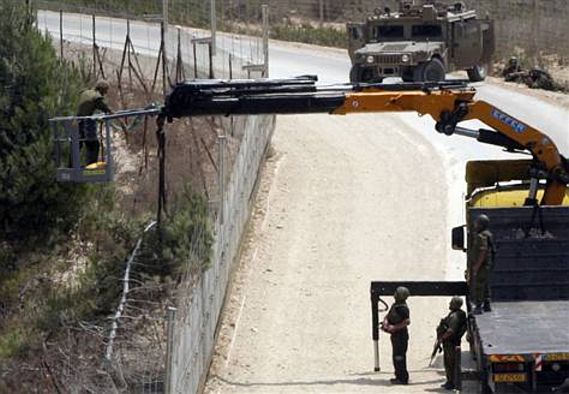
"...The IDF force ambushed on the Lebanon border Tuesday will return to the skirmish scene on Wednesday in order to complete its mission of clearing trees in an border-area. ...."These are legitimate, reasonable and necessary actions that will not be halted," a military source said. 
Meanwhile, the Lebanese army said it would respond to any new Israeli "aggression." ..."

Tuesday, August 3, 2010

Summer 06', Bolton to HBJ: "your efforts are needed tonight to stop the war in Lebanon...

HBJ: "but Mr.Ambassador, I thought the war would stop only if Hezbollah is either crushed, or surrenders its weapons!?"
Bolton: "well, our friends in Israel asked us to stop hostilities because their continuation would be a 'catastrophy',..."

Nasrallah: " I apologize for the 'political constraints' ... But that was today ... ,

...next time our sovereignty, or national army are aggressed, trust me when I say, we will cut Israel's hand!"

IDF Colonel killed: Dov Harari ...

"... One Israeli officer was killed during clashes between Israel and the Lebanese army along the border on Tuesday. 45-year-old Lt. Col. Dov Harari, from Netanya, was a reserves battalion commander in the engineering corps..."

Obama's "soft Saudi policy", surpassing Bush's...

DailyBeast:
"... In the next two months, Congress will be asked to give formal approval to a staggering new arms deal with Saudi Arabia. Valued at $30 billion, the deal includes selling the Saudis state-of-the-art missile technology, jets, ships, and helicopters. “Saudi is a key country for us and we continue to work hard,” Navy Vice Admiral Jeffrey Wieringa, director of the U.S. agency that oversees foreign military sales, said last month..........
The desert kingdom remains a draconian dictatorship that prohibits even the most basic of liberties. ..... Obama praised the dictator’s “wisdom and insights” and thanked him for his “good counsel.” Among the many issues discussed between the two leaders were combating extremism, Afghanistan, Pakistan, Iran, the peace process, Palestinian statehood, the global economic recovery, people-to-people contacts, educational programs, and commercial ties. Left out was the single most important issue: human rights...."  
 

The aggressIng colons of Palestine ... True to their colors

A 'tree' called a 'pretext'? Funny how no one is scared of the great Tsahal anymore ...People will measure the colon's army every day...
Reuters:
"..........."It started when the Israelis wanted to cut a tree down inside Lebanon. The Lebanese army fired warning shots at them and they responded by shelling," said a security source in Lebanon.....
United Nations peacekeepers appealed to both sides to exercise "maximum restraint" after the incident.
,,,,, Saad al-Hariri, (from his summer vacation) "denounced the Israeli violations of Lebanese sovereignty." His office said he also contacted Egyptian President Hosni Mubarak to discuss "ways to confront the Israeli aggression against the Lebanese army." (Minister of Defense of the Republic Of Lebanon, Elias Michel Murr, also on vacation, was incommunicado. Lebanon was in good hands!).... "Israel views the Lebanese government as responsible for this serious incident and is warning of the ramifications if the violations continue," the ministry said in a statement.
The Israeli military said its troops were fired upon while engaged in "routine activity" inside Israeli territory, between an Israeli security fence and a U.N.-drawn border line....... A security source said three Lebanese soldiers and a Lebanese journalist were killed and five people wounded.... Israeli artillery also fired at the village....... a high-ranking Israeli soldier was killed on the border. The Israeli military had no immediate comment........

Drums of War: Israel and the "Axis of Resistance"

Summary & Recommendations:
.... in the Israeli-Lebanese arena since the end of the 2006 war, ..... the political roots of the crisis remain unaddressed, the underlying dynamics are still explosive, and miscalculations cannot be ruled out. The only truly effective approach is one that would seek to resume – and conclude – meaningful Israeli-Syrian and Israeli-Lebanese peace talks. There is no other answer to the Hizbollah dilemma and, for now, few better ways to affect Tehran’s calculations. Short of such an initiative, deeper political involvement by the international community is needed to enhance communications between the parties, defuse tensions and avoid costly missteps.

Four years after the last war, the situation in the Levant is paradoxical. It is exceptionally quiet and uniquely dangerous, .... none of the parties can soberly contemplate the prospect of a conflict that would be uncontrolled, unprecedented and unscripted.

Should hostilities break out, Israel will want to hit hard and fast to avoid duplicating the 2006 scenario. It will be less likely than in the past to distinguish between Hizbollah and a Lebanese government of which the Shiite movement is an integral part and more likely to take aim at Syria – ......as tensions have risen, the so-called “axis of resistance” – Iran, Syria, Hamas and Hizbollah – has been busy intensifying security ties. Involvement by one in the event of attack against another no longer can be dismissed as idle speculation.....

Hizbollah’s enhanced political status in Lebanon is an additional inhibiting factor, discouraging it from initiatives that could imperil those gains. Israel’s current government – its reputation notwithstanding – appears less inclined at this point to take the risk twice taken by its more centrist predecessor of initiating hostilities, seeking to prove it can maintain stability and worried about a more hostile international environment. Despite voicing alarm at Hizbollah’s military growth, it has displayed restraint. U.S. President Barack Obama, likewise, far from the one-time dream of a new Middle East harboured by his predecessor, has no appetite for a conflagration that would jeopardise his peace efforts and attempts to restore U.S. credibility in the region. All of which explains why the border area has witnessed fewer violent incidents than at any time in decades.

But that is only the better half of the story......

It is not clear what would constitute a red line whose crossing by the Shiite movement would prompt Israeli military action,..... an underground war of espionage and assassinations has been raging, for now a substitute for more open confrontation.....

The key to unlocking this situation is – without neglecting the central Israeli-Palestinian track – to resume meaningful negotiations between Israel on the one hand and Syria and Lebanon on the other.... There is scant reason for optimism on the peace front, however.....

RECOMMENDATIONS

To the U.S. Government:

1. Intensify efforts, including at the presidential level, to re-launch Israeli-Syrian and, as a consequence, Israeli-Lebanese peace negotiations...

2. Initiate a high-level and sustained dialogue with Syria aimed at defining both a clear and credible pathway toward improved bilateral relations and a compelling regional role for Damascus in the aftermath of a peace agreement.

3. Press, in the context of resumed peace talks, Syria to halt weapons transfers to Hizbollah and Israel to cease actions in violation of Lebanese sovereignty..........

To the UN and the Governments of Israel and Lebanon:

6. Revive momentum toward implementation of Resolution 1701, focusing on the most immediately achievable goals, by:

a) pursuing discussions toward resolution of the status of Ghajar, under which Israel would withdraw from the northern (Lebanese) part, and UNIFIL would assume control, with a Lebanese army presence; and

b) using such discussions to initiate talks on conditions necessary for attaining a formal ceasefire.

To UNIFIL troop contributing countries, particularly those in Europe:

7. Reaffirm commitments to maintain the current level of troop contributions.

8. Pursue a policy of active patrolling, in order to prevent any overt Hizbollah presence in its area of responsibility, while conducting outreach efforts to the civilian population.

9. Investigate, publicly condemn and take appropriate action against .. attempts to resupply Hizbollah and Israeli violations of Lebanese sovereignty......"

"Mr. President, I erred..."

Monday, August 2, 2010

Beinart's "Hateful Ground Zero Hypocrisy"...

In the DailyBeast:
"...Had the ADL genuinely tried to apply its universalistic mandate to the Jewish state, it would have become something like the Association for Civil Rights in Israel (ACRI) or B’Tselem (full disclosure: I’m on B’Tselem’s American board): Israeli human rights organizations that struggle against all forms of bigotry, and thus end up spending a lot of time defending Muslims and Christian Palestinians against discrimination by Jews. But the ADL hasn’t done that. Instead it has become, in essence, two organizations. In the United States, it still links the struggle against anti-Semitism to the struggle against bigotry against non-Jews. In Israel, by contrast, it largely pretends that government-sponsored bigotry against non-Jews does not exist. When Arizona passes a law that encourages police to harass Latinos, the ADL expresses outrage. But when Israel builds 170 kilometers of roads in the West Bank for the convenience of Jewish settlers, from which Palestinians are wholly or partially banned, the ADL takes out advertisements declaring, “The Problem Isn’t Settlements.”...
For a long time now, the ADL seems to have assumed that it could exempt Israel from the principles in its charter and yet remain just as faithful to that charter inside the United States. But now the chickens are coming back home to America to roost. The ADL’s rationale for opposing the Ground Zero mosque is that “building an Islamic Center in the shadow of the World Trade Center will cause some victims more pain—unnecessarily—and that is not right.”
Huh?
What if white victims of African-American crime protested the building of a black church in their neighborhood? Or gentile victims of Bernie Madoff protested the building of a synagogue? Would the ADL for one second suggest that sensitivity toward people victimized by members of a certain religion or race justifies discriminating against other, completely innocent, members of that religion or race? Of course not. But when it comes to Muslims, the standards are different. They are different in Israel, and now, it is clear, they are different in the United States, too.
Indifference to the rights and dignity of Palestinians is a cancer eating away at the moral pretensions of the American Jewish establishment. Last Friday, in the case of the ADL, we learned just how far that cancer has spread."

"...the 'event' to begin (less probably ) at Hezbollah's initiative or (more likely ) at Israel's undertaking... "

Haaretz:
"... Whether it's a war or merely a campaign, Kurtzer urges preparation for the next event, which in his opinion could begin (less probably ) at Hezbollah's initiative or (more likely ) at Israel's undertaking - a decision to be made vis-a-vis Iran.
Israel will lie in wait for an opportunity to strike in Lebanon, or at training camps and missile storage sites in Syria earmarked for Hezbollah. The operation will hurt Hezbollah's rocket capabilities, thus denying Iran a 'second-strike' capability, in case Israel decides to hit its nuclear facilities.
Kurtzer doubts the Obama administration's ability to dissuade Israel or Hezbollah from attacking. Washington has no negotiation channel with Hezbollah, a terror organization and partner to Lebanon's government, and has nothing effective to convey through such a channel. Israel could perhaps be tempted with military equipment or "some other strategic enhancement as an incentive for not going to war," Kurtzer writes.
But pressure on Israel, including a threat to initiate or support a Security Council resolution against it, would encounter firm political resistance and be futile.
Kurtzer says the Americans will not receive early and sufficient warning of the IDF's preparations for a strike. The alternatives he proposes include renewing the Israel-Lebanon Monitoring Group - which held meetings of Israeli, Lebanese and UNIFIL officers - to supervise the understandings following Operation Grapes of Wrath. (A similar framework is used today for meetings of IDF and Northern Command officers with senior Lebanese and UNIFIL officers ).
Kurtzer suggests American encouragement for a limited preemptive Israeli strike against military targets, rather than infrastructure and government targets, as a substitute to a wider military operation. If this option is chosen the administration must make the limits and limitations of such an operation very clear to Israel, because Jerusalem tends to interpret U.S. ambiguity as supporting its own views, Kurtzer says.
Even a restricted IDF operation in Lebanon or against Hezbollah targets in Syria holds risks, Kurtzer says. It would freeze the peace negotiations and spur Syria to assist anti-American organizations in Iraq. But it could also weaken Hezbollah and break the standstill in the Palestinian or Syrian channel with the help of an American initiative.
Too large and fast an achievement would increase Israel's appetite for widening the military operation beyond its original objectives, says Kurtzer. Early failures on the battlefield, however, would drive Israel to continue the hostilities until the battle turns in their favor. In both cases there would be substantial civilian casualties. Hence, Kurtzer says, the United States should generate a cease-fire within a diplomatic context, with an optimal but not maximal IDF success highlighted.
Most important, he says, is to authorize the American ambassadors in Tel Aviv, Beirut and Damascus in advance "to intervene immediately and at the highest level to forestall escalation arising from incidents on the border," because the hours and first days after the outbreak of war or campaign are the most crucial (and due to the time differences, Washington sleeps when Tel Aviv decides to attack ).
Once in five years, on average, a major event takes place on the Israel-Lebanon front. Four years have passed since 2006. Kurtzer's memorandum indicates there are people trying to figure out two moves in advance. Unfortunately, none of them is sitting has a decision-making role in the Benjamin Netanyahu/Ehud Barak government."

Rockets fired at Jordan & Israel from Egypt...

Haaretz:
"Five rockets were fired toward the Red Sea port city of Eilat and its Jordanian neighbor of Aqaba just before 8 A.M. on Monday. Four people were wounded in Aqaba, at least one seriously. There were no casualties in Eilat.
Two of the rockets apparently struck the Red Sea, another exploded in an open area near Eilat, and the other two hit central Aqaba
Jordanian Communications Minister Nabil Al-Sharif confirmed that a Grad rocket hit a main street in Aqaba and said he was certain that the salvo had not been launched from within Jordanian territory.
Another Jordanian source said that the rocket exploded in the city's hotel district."The Grad rocket landed in a public street near a major five star hotel and caused four injuries, with three persons lightly wounded and the other casualty in serious condition," the source added.
The Jordanian source, asked where the rocket had been launched, told Reuters without elaborating: "It came from the west."
Eilat District Port Commander Moshe Cohen said that while it was too early to know where the rocket had been fired from, "it is reasonable to assume that it came from the southern area," referring to Egypt's Sinai Peninsula...."

Walid Jumblatt visits President Emile Lahoud, this week. ...

Sunday, August 1, 2010

"Hezbollah is not easy to infiltrate..."

LATimes/ here

"..... Israel apparently trying to infiltrate and Hezbollah, with help from the Lebanese government, trying to thwart it. "Hezbollah is not a easy target" to infiltrate, said Ephraim Kam, an Israeli intelligence expert. "The organization is not a big one. It is very compartmentalized and tough to penetrate. Also, it is an ideological-religious one, always tougher to penetrate."

Lebanese claim they have scored many victories in countering the intelligence efforts, arresting dozens of alleged spies in the last two years. Still, Israel believes it is winning the battle.

“The impression is that even after these recent cases, and in light of the intelligence Israel appears to have, the extent and scope of the Israeli infiltration of Lebanon is far better than that of Hezbollah in Israel,” Amos Harel, a reporter for the daily Haaretz, told Babylon & Beyond.

Lebanon's claimed intelligence successes also show the extent of Israeli infiltration of the country. Recruited spies included government and army officials as well as phone company officials and car dealers who slap tracking devices on vehicles they sell.

But they were all pretty small-time.

"These weren’t James Bond-type of agents, not great assassins or deep moles," said Ronen Bergman, an Israeli journalist who is the author of the "Secret War with Iran" and an upcoming book about Mossad. "None of them belonged to Hezbollah, or even close."....

......Hezbollah's abilities are mostly in the north, trying to spy on telephone and radio communications systems. They've rarely recruited a big fish as a spy; perhaps an occasional noncommissioned officer or cop, but mostly Arab Israelis who don't have good access to top-shelf intel.

Still, warns Gad Shimron, author of "Mossad Exodus" and a former Israeli spy, "Never make light of the enemy.

"The fact that a senior Hezbollah spy has never been caught in Israel doesn’t mean there is none, only that none have been caught," Shimron said.

Saudi Arabia & UAE ban 'certain' Blackberry functions

BBC:
"The United Arab Emirates is to block sending emails, accessing the internet, and delivering instant messages to other Blackberry handsets.
Saudi Arabia is to prevent the use of the Blackberry to Blackberry instant messaging service.
Both nations are unhappy that they are unable to monitor such communications via the handsets..."

"Blood-sucking terrorist Hamas ... Israel & NATO exercises..."

Fisk in the Independent:
"The death of five Israeli servicemen in a helicopter crash in Romania this week raised scarcely a headline.
There was a Nato-Israeli exercise in progress. Well, that's OK then. Now imagine the death of five Hamas fighters in a helicopter crash in Romania this week. We'd still be investigating this extraordinary phenomenon. Now mark you, I'm not comparing Israel and Hamas. Israel is the country that justifiably slaughtered more than 1,300 Palestinians in Gaza 19 months ago – more than 300 of them children – while the vicious, blood-sucking and terrorist Hamas killed 13 Israelis (three of them soldiers who actually shot each other by mistake).
But there is one parallel. Judge Richard Goldstone, the eminent Jewish South African judge, decided in his 575-page UN inquiry into the Gaza bloodbath that both sides had committed war crimes – he was, of course, quite rightly called "evil" by all kinds of justifiably outraged supporters of Israel in the US, his excellent report rejected by seven EU governments – and so a question presents itself. What is Nato doing when it plays war games with an army accused of war crimes?..."

What Afghan war?

SWOOP:
The speed with which the Wikileaks episode entered and then disappeared from the public discourse illustrates how little the Afghan war resonates with American voters – despite rising casualties. The foreign policy elite quickly adopted the Administration's contention, first, that the documents contained little that was new and, second, that certain revelations might endanger US and Afghan lives. US officials moved quickly to deny that the leaks raised any doubts about US confidence in Pakistan or the Karzai government. The early suggestion voiced by Senator John Kerry, Chairman of the Foreign Relations Committee, that the leaks might lead to a wide souring of public opinion against the war proved wide of the mark. The immigration issue in Arizona soon drowned out the Wikileaks story.
For the moment, the war lags far behind the economy as a political priority. Behind the scenes, however, a potentially far-reaching debate is underway about defense spending. Over the past weeks, top Pentagon officials, including Secretary Gates, have met with CEOs from the defense industry to discuss potential savings in the Pentagon’s weapon procurement program. At the same time, an independent panel has reported that this budget is badly under-resourced. It points to the rising capabilities of the Chinese military as a rationale to keep US defense spending high. As we have reported consistently, US policy toward China is plagued by unresolved tensions between economic and geostrategic factors. No immediate resolution is in sight. However, based on the fierce Chinese reaction to remarks on July 22nd by Secretary of State Clinton at the ASEAN regional conference proposing international dispute mediation in the South China Sea, we see the China “threat” playing an increasing role in US defense planning. Pentagon officials have spoken to us about unreported “incidents” involving US and Chinese naval vessels in international waters off the Chinese coast. We still believe that the US need for Chinese cooperation over a wide range of economic and foreign policy issues will balance military tensions, but the issue will require careful watching in the coming months.