Wednesday, May 5, 2010

Iran accepts Brazil mediation to revive atom deal

Reuters/ here
".... "In a telephone conversation with his Venezuelan counterpart, Ahmadinejad agreed in principle to Brazil's mediation over the nuclear fuel deal," Fars said, quoting a statement issued by Ahmadinejad's office........Brazil says it favors reviving a mooted compromise in which Iran could export its uranium to another country in return for nuclear fuel Iran says it needs to keep the Tehran reactor running.

It was not clear whether Ahmadinejad had agreed for the fuel swap to take place in a third country. If so, it will be a major shift in Iran's stance against the idea...."

Tuesday, May 4, 2010

Hezbollah of 2006 is different from Hezbollah of 2010 in terms its military capabilities ...which have developed significantly

YNETnews/ here
"... Baidatz on Tuesday briefed the Knesset's Foreign Affairs and Defense Committee that "today, Hezbollah has an arsenal of thousands of rockets of all types and ranges, including long-range solid-fuel rockets and more precise rockets."
He added, "The long-range missiles in Hezbollah's possession enable them to fix their launch areas deep inside Lebanon, and they cover longer, larger ranges than what we have come across in the past. Hezbollah of 2006 is different from Hezbollah of 2010 in terms its military capabilities, which have developed significantly.
"Hezbollah is in a tense spot between two different identities: Its commitment to Jihad and Iran, and on the other hand, its political considerations in Lebanon and the needs of the Shiite community. Therefore, it has quietly selected its current course of action. The MI believes it is not interested in another wide-scare confrontation with Israel, it fears it, but is preparing for it. The organization still publicly vows to carry out terror attacks against Israel."..."


"The Syria-US relationship is likely to remain chilly for some time ..."

The GUARDIAN/ here

"Hopes of a rapprochement between the US and Syria have again been dashed by Washington's decision to renew, for another year, the economic sanctions Bashar al-Assad had hoped would end.

The Syrian president can hardly have been surprised. In recent weeks there has been little evidence of the "outstretched hand" Barack Obama proffered when he came to office. Nor has Damascus ticked the main boxes on Washington's wishlist. Not only has Assad failed to distance himself from Iran or loosen ties with Hamas and Hezbollah, he has also flaunted these alliances, hosting a summit with Mahmoud Ahmadinejad and Hassan Nasrallah....

Arabs will see the missile episode as a prelude to Obama's sanctions decision, and blame Israel. But the US president did note progress in one key area: a decrease in Syrian support for foreign fighters crossing into Iraq – traffic that, at its height, helped maintain al-Qaida suicide bombings on Shia targets.......... if Syria still poses an "unusual and extraordinary threat to the national security, foreign policy, and economy of the United States" – in Obama's words – and prospects remain slim for peace talks between Syria and Israel, the signs are that the slowly thawing relationship between Washington and Damascus will remain chilly for some time.

"...Delicate time for US-Pakistan ties..."

In the CABLE/ here

".... Nearly two years after the unhappy exit of Pervez Musharraf, the former Army chief and president, U.S.-Pakistani relationship is still very much a military- and intelligence-based interaction, with the key figures on the U.S. side being Joint Chiefs Chairman Adm. Mike Mullen, National Security Advisor Jim Jones, and CIA Director Leon Panetta. On the Pakistani side, all roads go through Musharraf's successor as Army chief of staff, Gen. Ashfaq Parvez Kayani, who was given red-carpet treatment when he came to Washington for the March talks.

Kayani is increasingly seen as both an interlocutor for U.S. officials as well as a constructive link between the Pakistani military structure and the civilian government led by President Asif Ali Zardari, who has been steadily losing power to Prime Minister Syed Yousaf Raza Gilani. Meanwhile, the day-to-day relationship is still managed in Washington by Amb. Husain Haqqani, who despite being a Zardari ally, doesn't seem to be going anywhere any time soon.

And the relationship is getting very close attention from senior Obama administration officials, with a flurry of high-level visits there in recent weeks. On the sidelines of the strategic dialogue, there was a private session that involved Secretary of State Hillary Clinton, Defense Secretary Robert Gates, and Mullen. From the Pakistani side, only Kayani, Foreign Minister Shah Mehmood Qureshi, and Defense Minister Chaudhry Ahmed Mukhtar attended.

That's where the new agreement on military and intelligence cooperation was discussed. Here is a readout that Sourabh Gupta, a senior researcher with Samuels International Associates (SIA), published in the Nelson Report, a daily Washington insider's newsletter published by SIA's Chris Nelson. Our sources say this readout is "almost exactly right."

Key Pakistani political demands: Non-negotiable requirement for friendly successor regime in Kabul; significant downgrading of Indian presence and influence in Afghanistan, including New Delhi's training of Afghan military; preference for extended-term American presence in Afghanistan/strategic neighborhood, notwithstanding drawdown of forces next year.

Secondary set of political-military demands: faster delivery of upgraded weapons package; expedited payment for outstanding dues related to AfPak support operations and assistance with civil infrastructure rebuilding in frontier territories; U.S. to lay-off from Islamabad's nuclear program (given latter's need to ramp-up fissile material production in absence of bestowal of India-equivalent civil nuclear deal); U.S. to intensify diplomatic effort to facilitate productive Islamabad-New Delhi dialogue on 'core' issues - Kashmir and water (upper riparian/lower riparian) issues.

Key U.S. demands: Islamabad to re-direct primary counter-insurgency energies against key Islamist groups based/operating out of North Waziristan (Al Qaeda, Afghan Taliban Haqqani network, local talibanized tribal warlords); unfettered drone strikes in N. Waziristan/other tribal territories to continue; expanded CIA intel. operations/listening posts in Pakistani cities - Islamabad to subsequently allow access to Taliban leaders arrested by way of real-time communication intercepts; Islamabad to rein-in larger infrastructure of jihad that it has casually tolerated, even supported. "

Gupta goes on to say that Islamabad is also arguing for a seat at the table for any discussions about a successor regime in Kabul and that if the current U.S. ground offensive in Afghanistan doesn't produce results, the momentum will shift back to the Pakistani Army and intelligence services, which could upset the balance of the current U.S.-Pakistan negotiations."

"... The time has come to stop pretending..."

Arens (Moshe,), in Haaretz/ here
"... The Netanyahu government has chosen to act as if nothing has changed, and that the occasional signs of displeasure coming from Washington can be appeased by minor or temporary Israeli concessions. The result seems to be the opposite. The Israeli government is seen in Washington as disingenuous and attempting to outsmart the White House.
The time has come to stop pretending. Whatever chance that may exist to conduct productive negotiations with Abbas is being hampered by the demands being made on Israel by Washington. They only provide excuses for Abbas to refuse to enter serious negotiations until these demands are met. He cannot be expected to be less of a Palestinian than U.S. President Barack Obama. While objective difficulties exist in any case because of Hamas’ control of Gaza and Abbas’ tenuous position in Judea and Samaria..."

The Saudis inquire: "Syria & Iran…who is deceiving who?"

From the 'free & objective' minds of Asharq al Awsat/ here You may at the end ask, what was the point in this Saudi editorial...

Iranian First Vice President Mohamed Reza Rahimi threatened Israel in the event of it attacking Syria or Lebanon. Speaking from Damascus, the Iranian Vice President said that "to those thinking of attacking Syria or Lebanon…this time we will cut your legs off to the same extent of your attack." The question that must be asked here is; must the Syrians first test this and experience war with Israel in order to confirm Iran's credibility? Before answering this we must first look at a funny story that deals with this.

Whilst former US President Bill Clinton was exerting intense efforts to achieve peace between Syria and Israel, one of the optimists remarking on comments made by Clinton asserted that peace between Damascus and Tel Aviv was close to being achieved. Renowned [Arab] writer Ali Salem responded to this by saying that this was "impossible." The optimist answered saying "Do you think that you understand politics more than Clinton?" The writer responded saying "No, I do not understand politics as much as Clinton, but I do understand stalling tactics more than him!" Of course peace was not achieved. I agree with what the writer Ali Salem said, and let me add that what the Iranian First Vice President Rahimi is saying with regards to Iran defending Syria, this is nothing more than playing a trick or selling an illusion.

Iran did not fire one shot or missile at Israel when the Israelis were running wild through Lebanon in 2006, even after Hassan Nasrallah came out saying that it is up to those who love Lebanon to put an end to this war. Iran also did not fire any missiles at Israel on the day that Israel attacked the Gaza Strip, and in fact the Iranians were warned of the consequences of intervening [in this war] on the grounds that Iran does not share a border with Israel, and this was despite Tehran's continual boasts about its missile capabilities. I also do not think that anybody needs reminding that Iran opened its airspace to the Americans during their most recent invasion of Iraq. This is no secret, and the Iranian President has issued statements in the past complaining that the Americans were failing to acknowledge the assistance that they were providing them in Iraq and Afghanistan!

So after all of this, will the Syrians believe the words of the Iranian First Vice President and allow Tehran to deceive them? I don't think so! Damascus is also assuredly a master in the art of "stalling tactics" which is something that is prevalent in our region, where policies are unclear and where there is a lack of credibility. Therefore Damascus – where the Iranian First Vice President was speaking from about economic integration between Iran and Syria – is the same Damascus that advised [Arab League Secretary-General] Amr Moussa to be patient with regards to the idea of forming an alliance of [Palestine's] neighboring states, and it is the same Damascus that today welcomes Turkey, and in fact the two countries concluded joint military maneuvers just a few days ago. Syrian Assistant Vice President [Hassan Turkmani] said that "Syria and Turkey are seeking to build closer relations and cooperation in all fields ahead of eventually forming a new regional bloc…built upon shared ties, history, and geography." We also find Damascus willing to negotiate with Israel, and attacking the Arabs who support linking this negotiation with the Palestinian – Israeli negotiations. Therefore the US Secretary of State was right when she said that the statements being issued by Syria could mean war or peace! Therefore today we must pose a question that was asked previously, and was the title of my 27 February 2010 article, namely "Syria and Iran…who is deceiving who?"

'Engaging' Syria: President Obama renews sanctions

AFP/ here

"... Mr. Obama said in a message to Congress renewing the sanctions, first imposed by President George W. Bush in 2004, that the Syrian government had made “some progress” in suppressing the infiltration of foreign fighters into Iraq. But he added that Syria’s “continuing support for terrorist organizations and pursuit of weapons of mass destruction and missile programs, continue to pose an unusual and extraordinary threat to the national security, foreign policy and economy of the United States.”

Monday, May 3, 2010

Egypt & Israel's ... 'Security' is complementing ...

From OxFan [excerpts]
".... Israel regards Egypt as an important partner, and their strategic and security cooperation is at its highest in years. Nevertheless, there are also points of tension, especially stemming from Israeli perceptions of Egyptian public opinion.
In the absence of full 'normalisation' in Israeli-Egyptian relations, Israel has become accustomed to a minimalistic interpretation of peace. Acknowledging limits on relations, it makes the most of military cooperation and a certain level of strategic partnership.
..... Israel regards Cairo's role as important and complementary to its own interests, since both states share security interests vis-a-vis the Gaza strip and regional stability; and Egypt maintains significant, if declining, regional influence. ..... Israel considers Cairo's influence on Hamas to have declined ...to Israel's benefit: during its December 2008-January 2009 offensive in Gaza, Egypt stood against Hamas, and it is currently building a wall along its border with Gaza. These policies provoke domestic dissent, but pro-Gaza Egyptian activism faces zero-tolerance security measures....
Israeli-Egyptian security cooperation includes information sharing and border control, particularly concerning smuggling of weapons, people and dual-use goods that may be used to manufacture arms. There is a joint military committee that meets regularly, although urgent issues, such as Israel-Hamas negotiations, are dealt with cooperatively by the highest political and security figures.
Despite some disillusionment with Hamas, the Egyptian public maintains a strong sense of solidarity with the Palestinians as a whole. Israel has become used to state policies and social trends influenced by this:
  • Individuals who wish to visit Israel must attend security investigations before and after travelling.
  • Hala Mustafa, a political analyst at state daily al-Ahram, was publicly chastised after the Israeli ambassador visited her office in September. Other journalists have been criticised, or even banned from writing, for researching in Israel or with Israelis.
  • The actor, Amr Waked, was threatened with boycott in September after working with an Israeli actor in a UK television production, and Ahmed Abdalla, director of the Egyptian film 'Heliopolis', boycotted the Toronto International Film Festival last year in protest against its inclusion of Israeli films. In March, a film festival at Cairo's French Cultural Centre was pressured to remove an Israeli film from its schedule.
  • Professional syndicates threaten to revoke the licences of members who have any contact with Israelis.
Israel has viewed with caution the apparent 'Islamisation' of Egyptian society .....
However, the MB has faced a harsh crackdown in recent months in the run-up to parliamentary elections in June and November. Approximately 5,000 are in administrative detention. Senior members are unable to leave the country and are closely monitored. In light of this control, the 'Islamisation' of Egyptian society at present poses little threat to Israel. However, Israeli leaders view these developments as potential long-term security concerns.
Israel perceives Egypt's public as largely unconcerned with Iran's rising influence. However, tension in state-level Egyptian-Iranian relations is reassuring for Israel, which sees Cairo as key to balancing Iran's power, and a partner in challenging what it sees as a 'radical' axis comprising Iran, Syria and Hizbollah. Though there is no joint policy towards Iran, bilateral meetings stress the shared importance of the Iranian issue. ........ Although Egypt is wary of Iran's ambitions, it is keen to use the issue to pressure Israel on its own nuclear programme, and will reiterate its call for a region free of nuclear weapons at the UN NPT conference beginning today.
Given state-level security cooperation and anti-Israeli public sentiment in Egypt, Israel places great importance on continuity when the next president takes power. The two most likely candidates, Mubarak's son, Gamal, or military chief Omar Suleiman, represent for Israel a continuation of the current establishment...."

Lebanon's Publications' Court: Jail for Fares Khashan & Johnny Abdo in President Emile Lahoud 'libel'...

... and LBP 50 Millions in fine slapped on the Hariri rag 'Al Mustaqbal'....This is an oddly timed, though welcomed ruling. The lawsuit itself was not brought by President Lahoud, but was brought by 'Public Rights'. Moreover, the sudden reactivation of the lawsuit AND the verdict are NOTEWORTHY! Reminder: Johnny Abdo & Fares Khashan are both either in Paris or 'incommunicado' ...

"Needed: A long-range strategy for dealing with a nuclear Iran & not box ourselves into war..."

Bruce Riedel in the Daily Star/ here
"... President Barack Obama wisely tried to engage the regime; that effort has failed to attract Iran to talk seriously. Now we are looking at sanctions. Few expect those to change the regime in the foreseeable future or to persuade it to give up its pursuit of a nuclear weapons capability. For years, the US has kept the option of a possible military strike against Iran’s nuclear facilities “on the table.” As an option however, it should not become a self-fulfilling prophecy. We need instead to develop a long-range strategy for dealing with a nuclear Iran and not box ourselves into war.
Retaining the threat of a military strike is seen as increasing American bargaining leverage. Not only does it supposedly intimidate Iran, but it may help Washington persuade other countries to tighten and enforce official sanctions. The US can argue that sanctions are preferable to military force, but that sanctions will only work if all cooperate.
The strike option, however, lacks credibility. The US is already engaged in two massive and unpopular military campaigns in the region, with almost a quarter of a million troops deployed. Given Iran’s ability to retaliate for a strike against it by making the wars in Iraq and Afghanistan much worse for us, it is simply not credible that the US would use force in the foreseeable future. A third war in the region between the US and Iran, with a spillover into Lebanon and maybe Gaza, would be a disaster for US interests.
And the technical reality remains: neither Israel nor the US can slow Iran very long from its pursuit of a bomb, even with a massive strike....
There are dangers to an open-ended threat of force approach. Saying we will not tolerate a nuclear Iran and will use force to prevent it can become a self-fulfilling prophecy and box in decisions. There is a better way: sanctions, deterrence and containment....
What’s more, Iran has already proven its willingness to wage proxy and terror wars against the US and Israel prior to having nuclear arms; it is doubtful a small nuclear arsenal would offer it many more options than it has already employed...."

Sunday, May 2, 2010

"...No evidence of a Taliban connection to a car bomb defused in New York's Times Square..."

Main Image
Reuters/ here

"... The Taliban in Pakistan said it planted the crude device made of propane, gasoline and fireworks to avenge the killing in April of al Qaeda's two top leaders in Iraq as well as U.S. interference in Muslim countries. But New York Police Commissioner Raymond Kelly said there was "no evidence" to support the Taliban's claim and no way of knowing right now whether there were links to Islamist groups or to a domestic cause in the United States..."

Washington's silence about Israel's nuclear arsenal, will apparently "go beyond" that position...

The WSJ/ here

The U.S. is negotiating with Egypt a proposal to make the Middle East a region free of nuclear weapons, as the U.S. seeks to prevent Iran from derailing a monthlong U.N. conference on nuclear nonproliferation that begins Monday.

U.S. officials familiar with the move call it an important step in assuring countries that Washington—criticized by some for its silence about Israel's undeclared nuclear arsenalwill equitably address weapons proliferation across the region, as Iran seeks to shift focus away from its own nuclear program. Washington also reassured Israel it won't foist a nuclear-free zone on the region until all parties agree to it and significant progress has been made on Mideast peace.

The U.N. conference on the Nuclear Non-Proliferation Treaty, which is held every five years, is expected to begin with a bang Monday with an address by Iranian President Mahmoud Ahmadinejad. Secretary of State Hillary Clinton will follow the Iranian leader in the afternoon......

"We've made a proposal to them [Egypt] that goes beyond what the U.S. has been willing to do before," said the senior U.S. official involved in the nuclear diplomacy. U.S. officials stressed, however, that they didn't believe that would happen without first achieving major advances in Arab-Israeli peace talks. .....The diplomacy could raise new tensions between President Barack Obama and Israeli Prime Minister Benjamin Netanyahu if Washington is seen backing away from its commitment to Israel. Israel has voiced concerns that the U.N. conference could turn into an international forum to corner Israel. Mr. Netanyahu backed out of a nuclear-security conference in Washington in March due to such concerns...."

'Arab Bank' enforces Gaza blockade

AsiaPulse/ here

"... The employees said they were informed that the decision was made due to the Israeli blockade. Israel has tightened the blockade on the Gaza Strip since Islamic Hamas movement seized control of it by force.... A senior Arab Bank employee, who spoke in condition of anonymity, told Xinhua that the decision of sacking 70 percent of the bank's employees in Gaza was made by the Arab Bank's central administration based in Jordan, adding that the employees received attractive offers to quit their posts...."


Saturday, May 1, 2010

"...It has to be demonstrated that Israel cannot now & in the future, destroy the retaliatory capability of Hizballah..."

In SST/ here

mo,

thank you for that most interesting explanation of why Hizballah may indeed, as Nicolas Noe suggested in Asia Times last month 'believe that the next war can and should be the last one between Israel and its enemies.'

What you write, however, has the effect of further inflaming a suspicion which has been growing steadily stronger in me over the past weeks -- that the situation in the Middle East is rather like a smouldering volcano. It may not erupt, but could well do so, and if it did, the eruption might come suddenly and unexpectedly, generating a conflict which could escalate out of control, possibly with totally catastrophic results.

And the likelihood of catastrophe is, I think, greatly increased by the fact that many people are living in a fool's paradise, and do not grasp quite how dangerous the situation

A key part of the background here I take to be the change in Israeli attitudes described in the seminal 2008 Middle East Policy article 'Abandoning the Iron Wall: Israel and the "Middle Eastern Muck"' by Ian Lustick.

(See http://www.polisci.upenn.edu/faculty/faculty-articles&papers/Lustick_MEP_2008.pdf.)

The fundamental change whose implications Lustick explores in this paper is the effective abandonment over the last few years of the 'Iron Wall' conception, which Jabotinsky set out in 1925, and which was the basis of Israeli policy until recently. In essence, this conception involved bludgeoning the Arabs into accepting that Israel could not be destroyed, as a prelude to negotiated accommodations.

What has now replaced this, Lustick argues, is an image of Israel as an isolated outpost of Western civilisation, in an Arab/Muslim world with which no accommodation is possible. And this change opens up all kinds of possibilities for catastrophe.

According to Lustick, Israelis are 'coming to see the Middle East as a whole the way they came to see Lebanon in the 1980s.' A 'natural feature of this overall outlook,' he writes, is:

'an image of the Arab/Muslim world, and the Palestinians in particular, as irrational, brutal and violent, imbued with intractably anti-Semitic hatreds fortified by deeply anti-Western, Muslim-fundamentalist fanaticism.'

This is relevant to the point made -- very fairly -- by Fred and 'different clue', that all kinds of other factors are involved in the increasing propensity of Israelis to emigrate, besides the growing military capabilities of Hizballah and Israel.

While that is clearly so, the evidence presented by Lustick suggests that apprehensions about the security situation are an increasingly important motivation in causing Israelis to think their future may lie elsewhere. And this is, surely, not surprising. For implicit in this view of Israel as an isolated frontier post in a 'civilisational war' is an obvious question as to whether it makes sense to stay there. Why live on Hadrian's Wall, when one could live in Rome -- or Seville, or indeed Londonium, as it once was called?

A further effect of this image of the 'Arab/Muslim world' as 'irrational, brutal and violent', obviously, is to make the increasing military capabilities of Hizballah and Iran look yet more threatening than they would otherwise seem. It may indeed be that, as 'different clue' suggests, if the Israelis decided 'to think very slowly and clearly' they could live with these.

But if one sees the possessors of these capabilities in the terms in which Lustick suggests that Israelis see the whole 'Arab/Muslim world', then the threat does indeed come to seem 'existential' -- and the collapse into the all-too-easy and catastrophic analogy with genocidal aspirations of Nazi Germans follows.

What further follows is that even a perfectly 'rational' Israeli strategist may be right in perceiving the threat from Hizballah rockets and possible Iranian nuclear weapons as 'existential' -- because if people believe it to be so, it becomes so.

In a kind of vicious circle, the maximalist definition of Israeli security requirements which results further diminishes the possibility of the kind of grudging acceptance of the presence of a Zionist 'settler state' from the 'Arab/Muslim world' which the 'Iron Wall' conception made the basis of Israeli strategy.

So the route down which Israel has chosen to go makes it, from Nasrallah's point of view, too dangerous -- and perhaps also too sheerly insulting -- to be accorded even grudging acceptance. And at the same time, it has also opened up the possibility of a perfectly 'rational' strategy to exploit the fears of Israelis to cause the state to self-destruct.

However, it seems to me that both their dramatic successes against Israel, and the fact that these do make it eminently possible to conceive of a strategy which will cause the settler state to self-destruct, may be inducing in Hizballah a combination alike of hubris and exaggerated -- or perhaps it would be better to say misdirected -- fear..." (continue/ here)

Odd perspective: "Arab states will join the Iranian camp"

ussaudi.jpg
In the super pro-Israel magazine, Commentary/ here
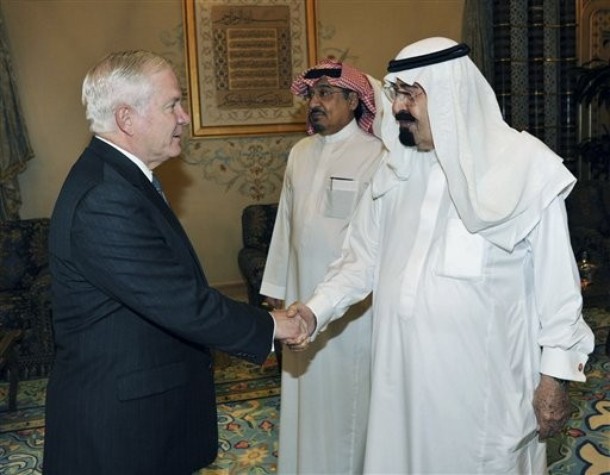
"... The prospect of a shift in Saudi Arabia’s allegiance ought to alarm even the Obama administration. Saudi Arabia is not only one of America’s main oil suppliers; it’s also the country Washington relies on to keep world oil markets stable — both by restraining fellow OPEC members from radical production cuts and by upping its own production to compensate for temporary shortfalls elsewhere.
Granted, Riyadh is motivated partly by self-interest: unlike some of its OPEC colleagues, it understands that keeping oil prices too high for too long would do more to spur alternative-energy development than any amount of global-warming hysteria. And since its economy depends on oil exports, encouraging alternative energy is the last thing it wants to do.
Nevertheless, the fact remains that Saudi Arabia has been generally effective as stabilizer-in-chief of world oil markets and has no plausible replacement in this role. And since the U.S. economy remains highly oil-dependent, a Saudi shift into Iran’s camp would effectively put America’s economy at the mercy of the mullahs in Tehran..."