Monday, October 26, 2009

"I will quit..."

Palestinian President Mahmoud Abbas (L) is displeased with U.S. President Barack Obama's 'capitulation' to Israel on the settlements issue. (AP)
Haaretz/ here
"Palestinian President Mahmoud Abbas told the White House that he intends to resign his post, Channel 10 reported on Monday.......that he sees no chance of advancing the peace process with Prime Minister Benjamin Netanyahu in power.
Channel 10 also reported that Abbas communicated to the White House his disappointment in the administration's "capitulation" to Jerusalem on the issue of West Bank settlement construction....
..... Abbas told the White House that the Palestinian Authority's initial decision to defer a vote on the Goldstone Report at the United Nations Human Rights Council was politically damaging. ....
According to Channel 10, Abbas also told the Americans that he sees no possibility that Fatah, can reach a reconciliation agreement with Hamas, the Islamist group which ousted Fatah in the Gaza Strip...."

did Tareq Ibn Ziad say: "Oh my warriors, whither would you flee? Behind you is the chickpea, before you, the enemy"?

"... not just the military..."

Politico, here

"..... John Kerry said the U.S. should not provide more troops for Afghanistan without three conditions being met: “First, are there enough reliable Afghan forces to partner with American troops—and eventually to take over responsibility for security?," he said. “The second question to ask is, are there local leaders we can partner with? We must be able to identify and cooperate with tribal, district and provincial leaders who command the authority to help deliver services and restore Afghans’ faith in their own government.”

“Third, is the civilian side ready to follow swiftly with development aid that brings tangible benefits to the local population?" he said. (Deputy Secretary of State Jack Lew, incidentally, briefed this morning on efforts to boost the civilian response in Afghanistan. He said there are currently over 600 US civilians on the ground in Afghanistan (up from around 300 at the beginning of the year), working in 52 locations around the country. State has another 280 in the queue, and hopes to get up to close to 1000 by the end of the year.)

Other excerpts from Kerry's remarks:

... In recent weeks, politics has reduced an extraordinarily complex country and mission to a simple, headline-ready “yes or no” on troop numbers. That debate is completely at odds with reality. What we need, above all, what our troops deserve-- and what we haven’t had-- is a comprehensive strategy, military and civilian combined.
I am convinced from my conversations with General Stanley McChrystal that he understands the necessity of conducting a smart counterinsurgency in a limited geographic area. But I believe his current plan reaches too far, too fast. We do not yet have the critical guarantees of governance and development capacity. I also have serious concerns about the ability to produce effective Afghan forces to partner with, so we can ensure that when our troops make heroic sacrifices, the benefits to the Afghans are clear and sustainable.
Under the right circumstances, if we can be confident that military efforts can be sustained and built upon, then I would support the President should he decide to send some additional troops to regain the initiative. Let me be clear: Absent an urgent strategic imperative, we need a valid assessment by the President and other appropriate civilian authorities – not just the military -- that those three conditions will be met before we consider sending more soldiers and Marines to clear new areas...."

"'Iran is our friend"

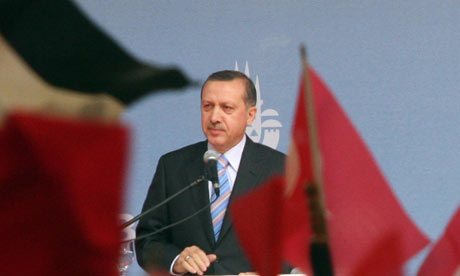
Turkish Prime Minister Recep Tayyip Erdogan speaks
In the Guardian, here

" .... Mahmoud Ahmadinejad, Iran's radical president whose fiery rhetoric has made him a bête noire of the west? "There is no doubt he is our friend," said Erdogan, Turkey's prime minister for the last six years. "As a friend so far we have very good relations and have had no difficulty at all."

What about Nicolas Sarkozy, president of France, who has led European opposition to Turkey's bid to join the EU and, coincidentally, adopted a belligerent tone towards Iran's nuclear programme? Not a friend?

"Among leaders in Europe there are those who have prejudices against Turkey, like France and Germany. Previously under Mr Chirac, we had excellent relations [with France] and he was very positive towards Turkey. But during the time of Mr Sarkozy, this is not the case. It is an unfair attitude. The European Union is violating its own rules. "Being in the European Union we would be building bridges between the 1.5bn people of Muslim world to the non-Muslim world. They have to see this. If they ignore it, it brings weakness to the EU."

Friendly towards a religious theocratic Iran, covetous and increasingly resentful of a secular but maddeningly dismissive Europe: it seems the perfect summary of Turkey's east-west dichotomy....

Continue, here

Iran may ship 'part' of its uranium abroad

AP/ here

"... Monday's comments by Manouchehr Mottaki is the first official indication that Tehran may at least partly agree to a U.N.-drafted plan to ship much of Iran's uranium to Russia for further enrichment. Mottaki said Iran is weighing between the U.N.-drafted plan or buying its own enriched uranium. In either case, Iran would continue to enrich its own uranium as well, he said."

"Israeli hawks recognize that the US commitment to Israel matters in a non-rhetorical way..."

jaysusln3.gif
LG&M, here
" .... Recounting recent meetings with Israeli national security officials, Indyk said that “the Israelis were upset at the way that Bush had offended Russia with missile defense” in Eastern Europe. The Israelis, like many Americans and most of the rest of the world, saw the deployment of untested missile defense technology in Poland and the Czech Republic as needlessly provocative of Russia, whose support is seen as necessary for any effort to bring Iran’s nuclear program under control.
Speaking about President Obama’s engagement policy, Indyk said “The key to this strategy has always been Russia,” because of their close relationship with the Iranians, ......
President Obama’s diplomacy “is about trying to concert the international community into a solid block against the Iranian nuclear program such that the Iranians would see that it is not in their interest to pursue nuclear weapons.” Indyk said “That is what is happening now.”
There are some interesting observations to be made here regarding interdependence of commitments. Neoconservatives are HUGE on reputation; a reputation for weakness means that the terrorists will destroy us, while a reputation for strength means that they'll cower in their dark caves until they undergo conversion and emerge as fierce advocates of Reaganomics. Indeed, neoconservatives elevate this conception of reputation above all other diplomatic considerations, such that any move that takes into account the genuine foreign policy concerns of Russia, China, or Iran in fact indicates weakness, and thus should be avoided......
For American neocons, the pro-Israel logic worked as followed: If the United States demonstrated an irrational commitment to a useless system just to piss off Russia, then it would indicate that the US would pay high costs to do irrational things in support of Israel. If we failed to push forward with the missile system, then our commitment to expensive, irrational programs would be in question, Israeli "will" would fracture, and the Jordanians would push the Israelis into the sea, or something. As all commitments are interdependent, the North Koreans would soon conquer Japan, Turkey would capitulate to Tehran and work to restore the Caliphate, Brazil would elect Hugo Chavez as God Emperor, and Washington State would secede and join Canada.
Of course, real Israelis have to actually live in Israel, and they saw the world a bit differently. Israeli hawks recognize that the US commitment to Israel matters in a non-rhetorical way. The defense system in Poland had no practical, real world impact on Israeli security. Moreover, Israel actually needs to deal with Russia;.... It turns out, rather, that neither the Poles nor the Israelis care overmuch about the other; rhetorical support for the neocon vision of liberty/missile defense/bunker busting/awesomeness/sexy/democracy/whiskey collapses in the face of real world material interest. In the end, it's almost as if our allies value material and institutional commitments to their defense more than they value a nebulous American reputation for "toughness".

General Casey: " ...size & duration of McChrystal's commitment could break the all-volunteer Army..."

R Haddick in FP/ here
"Left unmentioned in all the discussion of America's interests in Afghanistan are several risks that Gen.Stanley McChrystal's request for 40,000 additional soldiers, if implemented, would create. McChrystal is asking for a permanent escalation in Afghanistan that would commit U.S. ground forces to a larger open-ended effort. Gen. George Casey, the Army chief of staff, fears that the size and duration of this commitment could eventually break the all-volunteer Army. One strategic risk is that the United States would not have enough ready ground forces for another sustained contingency elsewhere. Finally, the funding that is diverted to sustaining ground-force intensive operations in Iraq and Afghanistan could be creating risks in the space, air, and naval dimensions that will unpleasantly appear in the next decade and beyond.

The Bush administration's surge in Iraq was a strategic gamble. The increase from 15 to 20 brigades in Iraq tapped out the last of America's ground combat power. In addition, the required deployment schedule -- 15 months in combat followed by 12 months back home -- was considered a temporary, emergency measure. It was for this reason that the Iraq "surge" was a temporary measure -- it was not feasible to indefinitely sustain 20 brigades in Iraq.

In these terms, McChrystal's troop request is not a surge but an escalation. McChrystal's initial assessment does not define a discrete time period during which he would need the additional troops -- the request is open-ended.

In May, prior to the Obama administration's latest review of Afghan policy and McChrystal's report, Casey declared the current deployment practice of "12 months deployed, 12 months home "unsustainable. The Army now considers a routine of 12 months deployed, 24 months home sustainable in the long run. The Army believes it can implement this routine if it limits its commitment to Afghanistan and Iraq to no more than 10 brigades.........McChrystal's 40,000-soldier increase would bring the U.S. brigade count in Afghanistan to at least 11 and probably more......."

'We'll continue spying on Lebanon'

Ravid in Haaretz, here
" ........but informed the UN that collecting intelligence in southern Lebanon will continue as long as the government in Beirut is not in full control of its territory. 
Last Wednesday, a tripartite meeting was held at the UNIFIL base near the Rosh Hanikra border crossing between representatives of Israel, Lebanon and the UN........
The UNIFIL commander and the Lebanese officer asked for details on the listening equipment. The UN officers said that the equipment appeared to have been put in place during the August 2006 Second Lebanon War, but the Lebanese officer insisted that the equipment appeared to be more up-to-date. "It seems that something new was put in place recently," the Lebanese representative argued. 
The western diplomat said that Hayman did not deny that the equipment was Israeli listening devices, and did not respond directly to the questions asked by his interlocutors. However, he did stress that Israel will make use of its intelligence gathering capabilities so long as Hezbollah pose a threat. "Israel will continue to use all means necessary to defend its citizens," Hayman was quoted as saying......
"In view of all this we do not consider this instance [of listening devices] as an Israeli violation of Resolution 1701,"...."

Sunday, October 25, 2009

Hezbollah, more active in taming the Shia' clans' "criminal activities"...


'Reach Out & Touch Someone': ... "In recent years, however, they have only gone after the killer himself. It has become more personal,"

" .... The "gentleman's agreement", drawn up earlier this month, marked a first step in clan efforts to do away with their reputation as outlaws who have long ruled supreme in the remote arid plain of the northern Bekaa, a Hezbollah stronghold traditionally ignored by successive Lebanese governments.

"Our customs date to pre-Islamic times and dictate that each family is responsible for the security of its members," said Moflih Allaw, a member of one of the most powerful clans in Hermel and whose relative was involved in the recent killing....

Hezbollah, which draws grassroots support from the clans and has for the most part turned a blind eye to their criminal activities, in recent years has also become more active in trying to tame them.

"Before, when someone got killed, the vendetta would target any member of the opposing clan regardless of whether he was involved or not," a local Hezbollah official who did not wish to be identified told AFP. "In recent years, however, they have only gone after the killer himself. It has become more personal," he added..... The vendettas typically are over land and women..... 

"The pact recently agreed is part of this slow historic transition that is weakening the clans," Labaki said. "Those intervening in the clan affairs are increasingly religious leaders or major parties -- meaning the higher Shiite council, Hezbollah or (its ally) Amal -- rather than tribal leaders. "Before, conflicts were dealt with in a traditional way, through blood money," Labaki added. "Today you have parties such as Hezbollah and Amal trying to accelerate the integration of the clans within the larger community."

Jumblatt's 'deep political conviction': We Need Syria's Arabism!

'Wahhab, Jumblatt & son Timur and Sheikh Al Sayegh ...'
".... The SSNP-PSP reconciliation was attended by Jumblatt’s son, Timur.
“I am not making this statement to please the Syrians after Syria’s withdrawal from Lebanon but based on deep political convictions,” Jumblatt said......
Jumblatt also stressed the importance of abiding by the truce agreement with Israel and the rejection of normalization of ties as stated in the Taif Accord. 
“The most important clause of the Taif Accord is that we agreed to a truce with Israel meaning a frozen war,” Jumblatt said, adding that “only [someone who is] delusional or a conspirer would believe in reaching a settlement with Israel.” 
Jumblatt added that his party, side by side with the SSNP, managed to abolish all attempts to tie Lebanon to the Israeli-Western axis. For his part, Hardane underlined the importance of preserving Mount Lebanon unity as the corner stone of the country’s unity. 
“The SSNP would pursue its struggle to establish a united nonsectarian state based on the national principles supported by President Michel Sleiman,” Hardane said."

"A bit of dithering might have been in order before we went into Iraq in pursuit of non-existent weapons of mass destruction"

In ABC-News' "This Week" George Will provided an unlikely defense of the Obama administration for what former Vice President Dick Cheney criticized as “dithering” on the Afghanistan troop decision.  Will said on the Roundtable that a “bit of dithering might have been in order”  before the Bush administration decided to go to war in Iraq.  John Podesta suggested that a report on Afghanistan giving to the incoming Obama administration by outgoing Bush officials was hastily prepared and only worked on for about an hour.  Not quite the pottery barn rule, but Laura Ingraham says the Obama administration now owns the Afghanistan problem...
Watch, here

Failure of the "Surge" + the "rent-a-sheikh" program + an acceptance of the intra-shia struggle for political power,...

Petraeus
SST, here

"... The "Surge" + the "rent an Iraqi sheikh" program + an acceptance of the intra-shia struggle for political power, these were the ingredients in reducing the level of violence in Iraq.  None of that soved the essential political problem in the country.

That situation could have continued indefinitely but American naivete and belief in the nonsense of nation-state building have led us to walk away from our Sunni clients and now they are angry at what they see as betrayal.  Are the abna al-'iraq (Sons of Iraq) directly involved or are they just sitting on their hands?  Does it matterpl"  

Suicide bombs kill 132 in Baghdad

Photo
Reuters, here

"Two suicide bombs tore through Baghdad on Sunday, killing 132 people, wounding more than 500 ......

The two blasts shredded buildings and smoke billowed from the area near the Tigris River. The first bomb targeted the Justice Ministry and the second, minutes later, was aimed at the nearby provincial government building, police said.

Prime Minister Nuri al-Maliki's office said that the bombs were meant to sow chaos in Iraq similar to attacks on August 19 against the finance and foreign ministries, and were aimed at stopping a parliamentary election in January.....

The attacks raise doubts about the Iraqi forces' ability to take over overall security from U.S. soldiers who pulled out of Iraqi city centers in June ahead of a complete withdrawal from the country by the end of 2011."

Saturday, October 24, 2009

Lebanon's never-ending "critical crossroads"...


Naharnet, here
"MP Boutros Harb described the period which Lebanon is passing through as critical and dangerous (yawn..) and said that Lebanon is facing crossroads where either the state's regime survives or it collapses together with law and order.
Harb considered that gathering parties in a cabinet without any harmony is not an act of national unity but rather of national conflict given that it congregates contradictions.
Harb was being interviewed by the Voice of Lebanon radio where he said that overlooking the obstacle of appointing elections losers was not merely for the higher interest of Lebanon only but rather for avoiding strife and saving the country.
"The greatest fear lies in the fact that every time we face a problem we try to solve it through a compromise that may not be in conjunction with our political system and Constitution," said Harb, giving examples about "what happened after May 7 incidents and Doha Accord that set rules contradicting with the principles of the democratic regime, among them talking about a share for the president or the opposition joining the government,".

Saudi Arabia: "Geopolitical risks rising alarmingly..."


Khaleej Times, here
"Geopolitical risk is rising alarmingly for Saudi Arabia in the autumn of 2009. The civil war in Yemen has escalated into a national security nightmare for Riyadh. Hezbollah has once again checkmated Saudi ally Saad Hariri, the Prime Minister designate of Lebanon.
The US, mired in recession and Obama’s health care reform, plans to withdraw troops from Iraq, exhibits no real enthusiasm to pressure Israel to halt its settlements or forge a credible military deterrent against Iran’s nuclear programme. Saudi Arabia distrusts the ruling cliques in both Baghdad and Damascus. Meanwhile, Saudi Arabia has faced setbacks in the international oil, money and banking markets that will force Riyadh to roll back its traditional cheque book diplomacy, the fabled “riyal politick”.  
The civil war in Yemen has fast replaced Iraq and Lebanon as the high stakes focus of Saudi diplomacy. ....... Yet the Yemeni government now faces a full-scale civil war in its northern Saada province with a Zaidi Shia tribal revolt that seeks secession. Yemen, like Iraq and Lebanon, has emerged as a de facto proxy battlefield for Saudi Arabia in its struggle against Iran for strategic preeminence in the Islamic world.
The Yemeni government has formally accused the Iranian government and Muqtada Al Sadr’s Jaaish Mehdi militia of supplying cash and weapons to the rebels. Iranian state media, in turn, has alleged that the Saudi Arabian air force participated in air strikes against the rebels.
Overt Saudi military intervention in the Yemen civil war, as in the 1960’s, is not unthinkable if President Saleh’s government fails to destroy the rebel militias. It is not coincidence that Yemen has also replaced Afghanistan as the global epicenter of Al Qaeda terrorist attacks against the kingdom..... The kingdom’s risk calculus in Yemen is fast turning into a domestic and border security nightmare. Iraq has once again emerged as a major geopolitical threat to Saudi Arabia now that Barack Obama has decided to accelerate the withdrawal of 130,000 American troops. Saudi Arabia distrusts Prime Minister Nouri Al Maliki’s Daiwa Party, whose ideological progenitor was the same Iranian Revolutionary Guards (Pasdaran) that once fomented riots, bombings and subversion in Saudi Arabia’s eastern province in the 1980’s. The prospects of a precipitate American withdrawal and a sectarian civil war in Iraq is a national security threat for Riyadh.
The Saudis have historic relationships with the tribal confederations of Anbar and Diyala provinces, the seat of both insurgent ex-Baathists and Al Qaeda’s franchise in Mesopotamia. The Iraqi government clearly does not want an American or Saudi diplomatic rapprochement with Syria, the diplomatic fault line of the Arab world. 
Saudi diplomacy has been frustrated in Lebanon and Palestine, no less than in Iraq. Similarly, a political vacuum in Lebanon is entirely inimical to Saudi Arabian interests.......convinced that Syria and Iran will use Hezbollah’s status as a quasi-sovereign militia. .....The election of the far right Likud politician Benjamin Netanyahu has frozen Saudi-inspired progress on an Israeli-Palestinian peace settlement ever since King Abdullah floated his historic peace plan in 2002.... 
Lastly, international oil and financial markets have suddenly turned riskier for Saudi Arabia. Russia has overtaken Saudi Arabia as the largest oil producer in the world. The Kremlin took advantage of a classic free ride after Saudi Arabia engineered a 4.2 million barrel price cut, the biggest in the history of OPEC. The kingdom can no longer hope to attract the $500 billion in foreign investments and credit into its six economic free zones because of the global recession. The UAE withdrew from the GCC monetary union. The $16 billion owed to international banking syndicates by two feuding Saudi conglomerates (Saad, Al Gosaibi Groups) can well trigger another credit crunch in Saudi banking.
The collapse of the dollar since March decimates Saudi Arabia’s offshore wealth invested in US Treasury bills, a $400 billion hoard exceeded by only China and Japan. Saudi Arabia will post its first budget deficit since the oil crash of the late 1990’s. Saudi Arabia’s role as a financial superpower is correlated with its power and influence in the geopolitics of the Arab and Islamic world. Riyal-politick is no longer feasible on a lavish scale for Riyadh. The kingdom faces an autumn of risks."

"Shadowland"

Syria Damascus
National Geographic looks at Syria, here
"... The Assad regime hasn't stayed in power for nearly 40 years by playing nice. It has survived a tough neighborhood—bordered by Iraq, Israel, Jordan, Lebanon, and Turkey—by a combination of guile and cozying up to more powerful countries, first the Soviet Union and now Iran. In a state of war with Israel since 1948, Syria provides material support to the Islamist groups of Hezbollah and Hamas; it's also determined to reclaim the Golan Heights, a Syrian plateau captured by Israel in 1967. Relations with the United States, rarely good, turned particularly dire after the 2003 U.S. invasion of Iraq, when George W. Bush, citing Syria's opposition to the war and support for Iraqi insurgents, threatened regime change in Damascus and demonized Syria's young president as a Middle Eastern prince of darkness.....
Continue, here"

Seymour Hersh: 'Military Is Waging War Against The White House'

The Huffington Post, here

"In addition to the wars in Iraq and Afghanistan, the United States military is also fighting a war against the Obama administration at the White House, Seymour Hersh said in a little-noted speech at Duke University on October 13. The military is "in a war against the White House -- and they feel they have Obama boxed in," he said.

Hersh, a Pulitzer-prize winning investigative journalist who exposed the My Lai massacre in Vietnam and the Abu Ghraib scandal in Iraq, sees an undercurrent of racism in the Pentagon's dealings with the White House. "They think he's weak and the wrong color. Yes, there's racism in the Pentagon. We may not like to think that, but it's true and we all know it."

As Neil Offen writes in the Durham Herald Sun:

"A lot of people in the Pentagon would like to see him get into trouble," he said. By leaking information that the commanding officer in Afghanistan, Gen. Stanley McChrystal, says the war would be lost without an additional 40,000 American troops, top brass have put Obama in a no-win situation, Hersh contended.


"If he gives them the extra troops they're asking for, he loses politically," Hersh said. "And if he doesn't give them the troops, he also loses politically."

Hersh considers the worsening situation in Afghanistan and Pakistan as the principal test of the Obama presidency, which will require the cooperation of the top military brass. Obama must face up to the military, Hersh said. "He's either going to let the Pentagon run him or he has to run the Pentagon." If he doesn't, according to Hersh, "this stuff is going to be the ruin of his presidency."

Friday, October 23, 2009

"... secure enough to wipe off the map any fantasy-league roster of neighboring Islamic regimes you care to name"


Danger Room, here

"...... This week, the United States and Israel kicked off a major air-defense exercise that will test scenarios including coordinated missile barrages launched from Iran or from Syria, as well as shorter-range rocket attacks by Hezbollah or Hamas. The exercise, Juniper Cobra, is part of a series of biannual war games that dates back to 2001, but it’s worth watching closely for several reasons.

First, there’s politics. Brig. Gen. Doron Gavish, commander of the Israel Air Force’s Air Defense Division, said in a press conference that the exercise was not related to Iran’s continued missile tests and enrichment of nuclear fuel. “It is a carefully designed exercise that has been taking place for years.” But Ha’aretz describes the drill as preparation for a faceoff with Iran.

Case in point: Juniper Cobra includes a major civil-defense exercise that will test readiness against a catastrophic missile strike against an Israeli city. As part of the contingent of 1,000 U.S. troops taking part in the exercise, the Ohio Army National Guard’s Chemical, Biological, Radiological, Nuclear and high-yield Explosive Enhanced Response Force will take part; the Guardsmen have been training with the Israeli Home Front Command as part of the exercise.

Some of the Obama administration’s favored missile-stoppers will also be deployed for the  exercise, including the Army’s Terminal High Altitude Area Defense (THAAD) and the Navy’s Standard Missile-3(SM-3), part of the sea-based Aegis Ballistic Missile Defense. .......

......... the exercise looks to be a pre-test of Iron Dome, a system being developed to provide defense against the short-range rockets like those fired by Hezbollah at northern Israel during the 2006 Israel-Lebanon war or the Qassams fired by Hamas from Gaza. While not fully operational, Iron Dome is also supposed to be integrated into the drill.

Writing at Esquire, Tom Barnett teases out the implications for Israel. ........“Not only will Israel remain on the map following a potential first strike, it’ll have second-strike capabilities secure enough to wipe off the map any fantasy-league roster of neighboring Islamic regimes you care to name.”