AP, here
".....Moving the yellowcake faced numerous hurdles........"
Saturday, July 5, 2008


Lebanon’s Palestinian ghetto redesigned
Le Monde Diplomatique-How to secure the organic architecture of exile
Lebanon proposes to rebuild Nahr al-Bared, the Palestinian city-camp near Tripoli pulverised in a long siege last year in an attempt to kill Sunni militants holed up there. The new, as yet only imagined, town is intended to preserve the memories of the old, yet return the area to the control of Lebanon.
Lebanon proposes to rebuild Nahr al-Bared, the Palestinian city-camp near Tripoli pulverised in a long siege last year in an attempt to kill Sunni militants holed up there. The new, as yet only imagined, town is intended to preserve the memories of the old, yet return the area to the control of Lebanon.
By Don Duncan
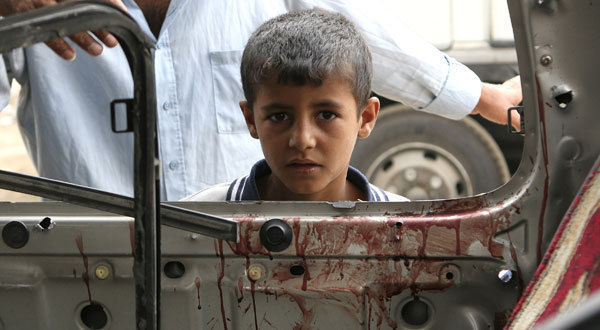
Some time before 2007 Fatah al-Islam, an extremist Sunni group tied to al-Qaida, made up of fighters from all over the Middle East, began to hole itself up in Nahr al-Bared Palestinian refugee camp outside the northern Lebanon city of Tripoli. After incidents with security forces in Tripoli, the group attacked an army outpost near the camp, killing 27 men on 20 May 2007. The Lebanese state then shelled the camp for three months, reducing it to rubble, and killed the militants. After the shelling stopped in September, the smoke cleared to reveal a camp and people once relegated to the periphery of the Lebanese political stage, suddenly at the centre of the country’s struggle to regain hold of its national security.
As reported by Fidaa Itani (1), the Nahr al-Bared conflict made it clear that Lebanon was vulnerable to extremist militant cells and that its army was too weak to handle such a threat. It was also proof of significant al-Qaida activity in Lebanon, a key US ally in the Middle East.
Nahr al-Bared was 600 densely packed acres by the Mediterranean coast, a few kilometres north of Tripoli. A conglomeration of buildings, people and businesses, it dominated the area and supplied Lebanese villages in the surrounding hills. In the 1950s and 1960s, Palestinian merchants packed their wares on donkeys and sold them up in the villages around. They drew the villagers down to the camp, which became economically and socially integrated, unlike the 11 other Palestinian camps. It was a Palestinian city, but in Lebanon.
Now the camp lies silent and in rubble. Its residents, displaced to other camps, see a chaos of shattered history, a puzzle they are eager to return to and solve. The government sees an opportunity to gain some control of the Palestinians (who may be about 10% of the population) and of their camps, considered dangerous, lawless and a liability.
IRAN: “The time for negotiating from the condescending position of inequality has come to an end,”
In the NYTimes, here
“We intend to study the Iranian response,” said Gordon D. Johndroe, deputy White House press secretary, in a statement. He said the United States would discuss the letter with the five other governments — Britain, France, Germany, Russia and China — “before responding formally.”
Friday, July 4, 2008
Iran Nuclear Deal Response Expected today...
In the NYTimes, here
"...Iran's chief nuclear negotiator was quoted as telling the European Union's top diplomat: "The Islamic Republic of Iran's response to the letter by the foreign ministers of the six countries ... will be given today." State radio said Saeed Jalili, the chief nuclear negotiator, spoke to EU foreign policy chief Javie Solana by telephone and that they agreed to hold further talks later this month...."
Is it over for America in the Middle East?
A series, in MESH, here
"...Mark T. Kimmitt :: The era of Pax Americana in the Middle East is over? One has a hard time suggesting that such an era ever existed..."
"Martin Kramer :: America’s era in the Middle East has only just begun...."
"Walter Laqueur :: End of an era? This is not entirely wrong but a typical journalistic exaggeration ..."
"Robert J. Lieber :: The proposition that “The American era in the Middle East has ended” is part of a larger declinist argument. The United States does face serious problems at home and abroad, but there is an unmistakable echo of the past in current arguments..."
"Aaron David Miller :: The notion of an American era in the Middle East has always been an illusion, certainly if that implies American dominance over a region that, since the end of World War Two, has become too complex, too dysfunctional and too ornery ever to be controlled or shaped by a single outside power..."
"Robert Satloff :: Cheer up, America, the doomsayers are wrong: America’s moment in the Middle East is not about to go the way of Britain’s, at least not anytime soon...."
(and more)
Why the US military has doubts about attacking Iran ...
In the US Navy Monthly ["Proceedings"] ... and Amir Oren in Haaretz, here
"....This unpredictable adversary (Iran) could be provoked by an isolated, and perhaps seemingly unimportant, event. Deploying land-based defensive assets is a necessary option, but it is costly and time-consuming....
Iran's regime is not about to fall, so the media are recycling already-familiar details about Israeli and American intentions to take action against it, while adding a little color of their own. The real news is swallowed up in the melee. One such bit of news, largely ignored, was provided at a June 10 briefing to Pentagon correspondents, given on a U.S. Air Force plane en route to Washington.
The person giving the briefing was Defense Secretary Robert Gates, who is opposed to a U.S. attack on Iran. Under the guise of making a formal announcement, Gates stated that he had asked a group of advisers - retired generals and respectable civilians with high security clearance - to prepare updated files to assist in the transition in about 200 days from the administration of George W. Bush to that of his successor: John McCain or Barack Obama...."
The person giving the briefing was Defense Secretary Robert Gates, who is opposed to a U.S. attack on Iran. Under the guise of making a formal announcement, Gates stated that he had asked a group of advisers - retired generals and respectable civilians with high security clearance - to prepare updated files to assist in the transition in about 200 days from the administration of George W. Bush to that of his successor: John McCain or Barack Obama...."

Le texte transmis à «Libération» par Ali Akbar Velayati
Ali Akbar Velayati, right-hand man of Iran's Supreme Leader Ali Khamenei... has this letter in LIBERATION, here
"....The main message? Don't listen to the rantings of that Ahmadinejad fellow -- the supreme leader is called "supreme" for a reason. "Khamenei's not necessarily the micromanager, but he's the macromanager, so all important issues go by him," Sadjadpour said. Why proclaim this in a French newspaper? The backstory here is fascinating. Last year, French President Nicolas Sarkozy reached out to Khamenei in the hopes of reaching a breakthrough in the stalled nuclear negotiations. Velayati was to be dispatched to Paris to lay the groundwork for a possible meeting between Sarkozy and Khamenei ...." (from FP/Blog.)

Thursday, July 3, 2008
Iran detains Saudi boats near nuclear plant
"...Iran said on Thursday that it has seized four Saudi fishing vessels crewed by Indian nationals in territorial waters near its first nuclear power plant, the Fars news agency reported..."
 | |
How many missiles will be fired from Iran, Syria, Lebanon in the next war?
Melman in Haaretz, here
"...On the basis of the precedent of the Gulf War, Ben Eliahu estimates that in the next war, Syria and Iran might launch between 250 and 300 long-range missiles at Israel (Shihab and Scud missiles) and another 5,000 short-range missiles (mainly from Lebanon). .."
Frank von Hippel: "... Ritter's attack on Albright, while incendiary, is almost completely without substance..."
[In the comment section, by Prof. Von Hippel]
"Scott Ritter’s attack on David Albright, “The Nuclear Expert Who Never Was,” suggests that only those who have spent years on the “inside” or have some other official credential are true experts. He is wrong.
Ritter is correct that Albright’s expertise does not stem from either his participation in IAEA inspections or a PhD in nuclear physics. You can’t get the kind of expertise that Albright has developed that easily. Albright started to work on nuclear-proliferation issues as a researcher in Princeton University’s Program on Science and Global Security. He ultimately established his own NGO, the Institute on Science and International Security (ISIS).
One measure of Albright’s expertise is the invaluable and authoritative book, Plutonium and Highly Enriched Uranium 1996: World Inventories Capabilities and Policies (Stockholm International Peace Research Institute and Oxford University Press, 1997). Albright was the lead author both alphabetically and in terms of his contributions. As an academic, I would be proud to be a co-author. Indeed, Albright’s two co-authors are senior professors at distinguished universities in the U.K. and Netherlands.
Albright was not interested in an academic career, however. He decided that it was more important to inform the public debate over nonproliferation – initially through his excellent articles in the Bulletin of the Atomic Scientists and then, as journalists began to beat their way to his door, directly through releases to the media.
Albright pioneered the use of commercial satellite images to provide independent information on nuclear-related construction in countries of proliferation concern. The ISIS book, Solving the North Korean Nuclear Puzzle that he co-edited with Kevin O’Neill in 2000, is still the most authoritative published work on the subject.
As Albright became more visible and trusted as an independent expert, insiders with important information began to come to him for help to get their story out. Some governmental experts who disagreed with the CIA claim that the aluminum tubes that Iraq was importing were for manufacturing centrifuges came to Albright, for example, at a critical time in the U.S. debate over Iraq’s supposedly resurgent nuclear-weapons program.
Albright is also obviously well respected in the IAEA. He is always the first outsider I know to get a copy of the latest IAEA report on the results of its inspections in Iran. This gives him a chance to make a quick analysis to inform the media on the significance of the new findings. I am glad that the media has this alternative to whatever spin the Administration decides to apply.
Albright’s role has its risks. In a confusing situation, he does not have the luxury of being able to sit on a result for months as is possible in academia. As a result, he has made some mistakes — as we all have. But there is no doubt that the communities of academics, NGOs and journalists who have come to depend upon his analyses are much better off with his guidance than we would be without it. Indeed, in 2006, the American Physical Society, the professional society of American physicists, gave Albright its Joseph A. Burton Forum Award. The citation was “For his tireless and productive efforts to slow the transfer of nuclear weapons technology. He brings a unique combination of deep understanding, objectivity, and effectiveness to this vexed area.”
I don’t know what set Scott Ritter off but his attack on Albright, while incendiary, is almost completely without substance. There is virtually no discussion of specific issues where he believes Albright was mistaken. Ritter is way off base."
Frank von Hippel, Professor of Public and International Affairs, Princeton University
Co-chair International Panel on Fissile Materials
Former Assistant Director for National Security, White House Office on Science and Technology Policy, 1993-1994
Lebanon: Controlling Food Prices
From OBG, here
"...Although Lebanon has large tracts of fertile land and higher than average rainfall for the region, it remains unable to take full advantage of its agriculture sector. Perhaps the underlying reasons for Lebanon's failure to capitalise on its agricultural potential are a combination of failed export reforms, reliance on imports and state subsidies to supply domestic needs.."
IRAN: "...5+1 adjust to reality that Iran acquired centrifuges "cannot be reversed"....
At War&Piece, Gary Sick "former Iran hand in the Ford, Carter, Reagan White Houses, reads the Iranian tea leaves": (here)
"... This offer by Iran does not come out of the blue. Despite the US instinctive reaction that Iran rejected the Solana offer, it was quite clear from the start that Iran was giving it serious consideration...
one thing that seems to have changed is what appears to me to be a fairly clear signal from the 5+1 negotiators that they are willing to contemplate the reality that Iran has acquired centrifuge technology, that there is probably little that can be done to reverse that entirely, and so the objective has perhaps subtly changed to consideration of how to stop the process before it gets worse and to contain it, if possible....."
Phase I :" No NEW Centrifuges = No new Sanctions!..."
Also from Laura Rosen this very interesting correspondence with Bijan Khajehpour, chairman of the Atieh Group, a group of consulting firms in Iran, [with his permission]:
"The 5+1 proposal to Iran proposes a "pre-negotiation" phase at which stage there would be a "freeze for freeze", i.e. Iran would not add any new centrifuges and the 5+1 would not introduce any new sanctions. In this phase, Iran would negotiate with 5+1 minus the US to prepare the grounds for full-fledged negotiations which would then include the US. In this phase, Iran can also comment on the agenda of the negotiations and introduce new topics (eg. Tehran could insist that the issue of an uranium enrichment consortium on Iranian soil be discussed with high priority). Iran can also focus on the "commonalities of the two proposals" as Dr. Mottaki has underlined a few times. Once the two sides agree to enter full-fledged negotiations including the US at the table, then Iran will have to suspend enrichment and the 5+1 will lift the existing UN sanctions.
All signs are that Iran will accept the 5+1 package with 1 important change, i.e. Iran will insist that the deadline for the pre-negotiation phase (i.e. 6 weeks) be adjusted. The important element for Tehran is that negotiations can start without suspension being their prerequisite.
Tehran has said a number of times that suspension cannot be a precondition, but it could be a result of negotiations. If the period of the pre-negotiations is extended, then Tehran and 5+1 could agree on a period of suspension in return for the lifting of sanctions which would pave the grounds for more intense negotiations on the other aspects in the two proposals."
Subscribe to:
Posts (Atom)