Thursday, October 28, 2010


US to 'offer' Iran a 'stricter' deal than the one it already rejected!
"...the conditions on Tehran would be even more onerous than a deal that the country’s supreme leader, Ayatollah Ali Khamenei, rejected last year...... many officials suspect that this latest initiative is likely to fail. But they say that it fulfills President Obama’s promise to keep negotiating even while the pressure of sanctions increases. ..."
Wednesday, October 27, 2010
Mullah Omar's 'Peace Plan'...

"... America's 17 intelligence agencies have spent more than half-a-trillion dollars - more than $500,000,000,000 - since Sept. 11, 2001, most of it on the global war on terror, and the Obama administration still believes that if Taliban supreme Mullah Mohammed Omar were to return to power in Kabul, al Qaeda would be back, too - "in a heartbeat." And this despite much evidence to the contrary.......
UPI consultant Ammar Turabi, a Pakistan-born American, and this reporter, sat cross-legged on the carpeted mud floor of Mullah Omar's spartan adobe house on the west end of Kandahar and listened to the reclusive war leader's list of complaints about Osama bin Laden. The world's most wanted terrorist - and the scion of a wealthy Saudi family - was expelled from Sudan under Western pressure in 1996 and decided to return to the country of his wartime exploits against the Soviet Union. Mullah Omar, still consolidating his civil war victory, was paid handsomely by bin Laden, who then began setting up terrorist training camps. But it soon became apparent that bin Laden was overplaying his hand....
Mullah Omar and his immediate entourage made clear to Mr. Turabi, a multilinguist, and me that any fatwa issued by bin Laden declaring jihad, or holy war, was "null and void." He explained that bin Laden hadn't completed his 12 years of mandatory Koranic studies to qualify for the position of mufti...... The one-eyed, 6-foot-6-inch, five-times-wounded guerrilla leader against the Soviet occupation, made clear to us the Taliban regime would like to "resolve or dissolve" the bin Laden issue. In return, he expected the United States to establish a dialogue to work out an acceptable solution that would lead to "an easing and then lifting of United Nations sanctions that are strangling and killing the people of the emirate." Afghanistan, according to Mullah Omar's entourage, has suggested to the United States via the U.S. Embassy in Islamabad, that international "monitors" keep bin Laden under observation pending a resolution of the case, "but so far we have received no reply.".....
It would be interesting to know whether President Obama ever read what Mullah Omar had to say three months before Sept. 11. In his interview with Mr. Zakaria on Sunday, it became clear Mr. Holbrooke hadn't. Unknown, too, is the Saudi link with Mullah Omar. Mr. Holbrooke, the diplomatic magician who engineered the 1995 Dayton Peace Accords, ending the Bosnia war, knows from personal experience nothing was possible without the hated Serbian dictator Slobodan Milosevic. This time, exchange Dayton for Riyadh, Saudi Arabia, and the late Milosevic for Mullah Omar. Add Pakistan and remove Afghan President Hamid Karzai. And you may get a peace deal that would enable 44 nations involved in Afghanistan to go home.
This was a direct message to this reporter from Mullah Omar...."
Feltman was "furious but restrained"...

'Wielding the real power in Iraq & Lebanon...'
"...But the frequent contacts between Iran and Saudi Arabia are not over the big arms deal or Iran's nuclear plans. The two countries have concluded that they need to reach an agreement on two other issues regarding their sphere of influence in the region: Iraq and Lebanon.
Regarding Lebanon, Iran is trying to persuade Saudi Arabia to help stop the work of the special international tribunal investigating the assassination of former Lebanese Prime Minister Rafik Hariri. This would prevent the collapse of the Lebanese regime. While Iran is worried about Hezbollah's status, it also doesn't want Lebanon to collapse or fall into another civil war, whose results cannot be ensured.
In this respect, Tehran doesn't have to make too great an effort to get Riyadh's support. This became clear last week to Jeffrey Feltman, the U.S. Assistant Secretary of State for Near Eastern Affairs and a former U.S. ambassador to Beirut, when he visited Riyadh. During his meeting with King Abdullah, the monarch tried to figure out America's position if the international court's work were stopped. Arab sources say Feltman was "furious but restrained," and made it clear to the king that Washington was determined to support the tribunal. With all due respect to the American insistence, if the client that is supposed to pay Washington $60 billion decides it's vital to halt the tribunal's work, it won't make do with consulting the Americans. It will throw its full weight behind the efforts. Meanwhile, the indictment the tribunal is due to publish is not expected before February.
After all, what is happening in Lebanon - and Saudi Arabia can't be accused of not supporting the establishment of the tribunal - is not isolated from other regional issues that involve the Saudis and Iran. Riyadh, which paid millions of dollars in Ayad Allawi's election campaign in Iraq, is aware that his chances of being elected prime minister are diminishing. The aid last time helped Allawi win two seats more in parliament than his rival, outgoing Prime Minister Nouri al-Maliki. Meanwhile, in the past two weeks, Maliki has visited Syria, Turkey, Iran and Egypt in an attempt to garner support. He is trying to persuade Iraq's neighbors that he is worthy of being prime minister again. But that's not enough. To win, he has to convince his rivals at home to forgo their aspirations of being Iraqi prime minister and join him.
Tehran understands that it can't get the Iraqi prime minister it was hoping for, Ibrahim al-Jaafari. But it has "convinced" the influential Iraqi religious leader, Muqtada al-Sadr, who is living in Iran until completing religious studies there, to support Maliki. Maliki is not exactly Iran's dream prime minister, especially considering that he accused Tehran and Damascus of terrorist involvement.... Nevertheless, even with Sadr's support, Maliki will not be able to set up a coalition without getting at least one other bloc to support him, either the Kurds or Allawi. That's why Iran needs Saudi Arabia's help to try to persuade its proteges in Iraq, especially Allawi, to join such a coalition or at least not work against it.
For its part, Saudi Arabia is not prepared to give Iran gifts, but it also doesn't want to lose all influence in Iraq. In Iraq as in Lebanon, Saudi Arabia realizes it's in a relatively inferior position vis-a-vis Iran; all it can do in these countries is to prevent Tehran from wielding exclusive influence. This is what the discussion between Saudi Arabia and Iran is now focusing on: deliberations during which Riyadh will try to divide its sphere of influence in Iraq and Lebanon with Iran.
One significant element is missing from these moves - the United States. Washington seeks to promote the process at the international tribunal on the Lebanese issue, blame Hezbollah for the Hariri assassination, see Allawi as Iraqi prime minister and block Iran's influence in the region. ....... it seems the Americans are aiming too high. The real game is in the hands of local forces that are sketching the strategic map, which will be presented to Washington as a fait accompli. ..."
Tuesday, October 26, 2010
UNIQUE Confidential Report: "Hezbollah acquires missiles, and delivers them, from point A to point B, by 'trucks'..."

"... En janvier dernier, une alerte clignota sur les écrans radar des services de renseignements américains. Le transfert de 26 missiles M-6002 était repéré quelque part entre Damas et la frontière syro-libanaise. De fabrication syrienne, ces engins balistiques d'une portée d'environ 250 km auraient été livrés au Hezbollah libanais, pour lui permettre de frapper Israël en profondeur. «De source indépendante, nous n'avons pas eu confirmation de ce transfert hautement sensible de missiles à technologie iranienne, qui se déclinent en versions guidées et non guidées», affirme un militaire français, proche du dossier. En revanche, peu après, des informations parvenaient à Paris sur la chaîne d'approvisionnement en armes du Hezbollah, c'est-à-dire l'un des pans les plus secrets de son fonctionnement. Allié de l'Iran et de la Syrie, le Parti de Dieu dispose de trois structures logistiques dédiées au transport de ses armes - 40.000 roquettes environ - et de ses personnels - plus de dix mille combattants - selon une note «Confidentiel défense», que nous avons consultée. La première est l'unité 108, celle qui a vraisemblablement «pris en compte» les missiles M-6002. Son «bureau principal» est à Damas. L'unité 108 est chargée d'assurer le transport des armes et des munitions .... non loin de la capitale syrienne, et près d'Adra, juste à côté de l'aéroport de Damas - proximité bien utile quand on sait que la plupart des armes viennent d'Iran par avion. Les sites de réserve se trouvent, eux, dans la région d'Alep, de Homs et de Tartous, toujours en Syrie... l'unité 112 est chargée de la distribution des armes fournies par l'unité 108 ... Les convoyages se font par camions... Pour passer incognito, les chauffeurs jouent sur l'anarchie des plaques minéralogiques au Liban.... Une chose est sûre: face aux menaces de Tsahal, la Syrie et l'Iran se sont rapprochés. L'implication iranienne dans le projet syrien du M-6002 est désormais «avérée». Il y a quelques mois, on en était encore au stade des essais en vol. Et aujourd'hui? «On ne peut exclure que des vecteurs fabriqués à titre de modèle en Iran aient été fournis à la Syrie», ajoute l'expert précité. En contrepartie, Téhéran pourrait avoir demandé à Damas la mise à disposition de plusieurs exemplaires du M-600 au Parti de Dieu, en prévision d'un éventuel conflit avec Israël....."
"Christians are leaving"

"... In the centre of the rebuilt Beirut, the massive old Maronite Cathedral of St George stands beside the even larger mass of the new Mohammad al-Amin mosque. The mosque's minarets tower over the cathedral, but the Maronites were built a spanking new archbishop's house between the two buildings as compensation. Yet every day, the two calls to prayer – the clanging of church bells and the wailing of the muezzin – beat an infernal percussion across the city. Both bells and wails are tape recordings, but they have been turned up to the highest decibel pitch to outdo each other, louder than an aircraft's roar, almost as crazed as the nightclub music from Gemmayzeh across the square. But the Christians are leaving.
Across the Middle East, it is the same story of despairing – sometimes frightened – Christian minorities, and of an exodus that reaches almost Biblical proportions. Almost half of Iraq's Christians have fled their country since the first Gulf War in 1991, most of them after the 2004 invasion – a weird tribute to the self-proclaimed Christian faith of the two Bush presidents who went to war with Iraq – and stand now at 550,000, scarcely 3 per cent of the population. More than half of Lebanon's Christians now live outside their country. Once a majority, the nation's one and a half million Christians, most of them Maronite Catholics, comprise perhaps 35 per cent of the Lebanese. Egypt's Coptic Christians – there are at most around eight million – now represent less than 10 per cent of the population.
This is, however, not so much a flight of fear, more a chronicle of a death foretold. Christians are being outbred by the majority Muslim populations in their countries and they are almost hopelessly divided.
Americans, so obsessed by the myths of East-West "clashes of civilisation" since 11 September 2001, often seem to regard Christianity as a "Western" rather than an Eastern religion, neatly separating the Middle East roots of their own religion from the lands of Islam. That in itself is a loss of faith...."
Would a Beaten Obama Attack Iran?
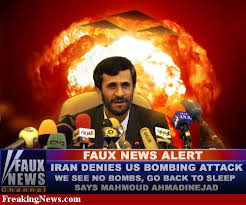
"... There is little to be done in Iraq at the moment except delay the withdrawal of forces, which adds little to his political position. Obama could attempt to force an Israeli-Palestinian settlement, but that would require Hamas to change its position, which is unlikely, or that Israel make massive concessions, which it doesn't think it has to do. The problem with Israel and the Palestinians is that peace talks, such as those under Clinton at Camp David, have a nasty tendency to end in chaos.....
This leaves the obvious choice: Iran. Iran is the one issue on which the president could galvanize public opinion..... If Obama were to use foreign policy to enhance his political standing through decisive action, and achieve some positive results in relations with foreign governments, the one place he could do it would be Iran. The issue is what he might have to do and what the risks would be. Nothing could, after all, hurt him more than an aggressive stance against Iran that failed to achieve its goals or turned into a military disaster for the United States. ..... Obama has avoided overt military action against Iran, so a confrontation with Iran would require a deliberate shift in the U.S. stance, which would require a justification.
The most obvious justification would be to claim that Iran is about to construct a nuclear device. Whether or not this is true would be immaterial....
An attack on Iran would not be an invasion, nor would it be a short war. Like Yugoslavia in 1999, it would be an extended air war lasting an unknown number of months.... It would strengthen the Iranian regime (as aerial bombing usually does) by rallying the Iranian public to its side against the aggression. If the campaign were successful, the Iranian regime would be stronger politically, at least for a while, but eviscerated militarily. A successful campaign would ease the U.S. withdrawal from Iraq, calm the Saudis and demonstrate to the Europeans American capability and will. It would also cause the Russians and Chinese to become very thoughtful....
We have argued that a negotiation with Iran in the order of President Richard Nixon's reversal on China would be a lower-risk solution to the nuclear problem than the military option. But for Obama, this is politically difficult to do. Had Bush done this, he would have had the ideological credentials to deal with Iran, as Nixon had the ideological credentials to deal with China. But Obama does not. Negotiating an agreement with Iran in the wake of an electoral rout would open the floodgates to condemnation of Obama as an appeaser. In losing power, he loses the option for negotiation unless he is content to be a one-term president.....
I am saying that, at this moment in history, given the domestic gridlock that appears to be in the offing, a shift to a foreign policy emphasis makes sense, Obama needs to be seen as an effective commander in chief and Iran is the logical target....."
"... It is quite likely that the Iraqi government is going to ask for an extension of our deployed presence..."
"...In his remarks, Crocker downplayed Iran's role in Iraq, and he suggested that when the dust clears in the formation of a new government in Iraq that Baghdad would come to the United States to ask for an extension of the US military presence beyond the end of 2011. ..... Crocker said that it is "quite likely that the Iraqi government is going to ask for an extension of our deployed presence."
He also predicted that Prime Minister Maliki would return to that office, atop a broad-based government that would include Shiites, Sunnis and Kurds. He outlined innumerable problems that Iraq faces—a refugee crisis, Arab-Kurd tensions, countless disputed internal boundaries, the leftover forces of the Sons of Iraq (the old sahwa or Awakening movement)—but he expressed optimism that Iraq will deal with each of these. And he called the United States the "indispensable outside power" that can "help to broker compromises." The notion that Maliki, who has recently established an alliance with Muqtada al-Sadr, can form a government that might include Sadr but exclude former Prime Minister Allawi and his Iraqiya bloc recently set off alarm bells in Washington. ....... it's likely that the Kurds, who hold the balance of power, will refuse to back Maliki unless the prime minister cuts a deal with Allawi, too, undermining Sadr's clout. The Kurds, though mostly pro-American, are heavily influenced by Iran, too, and are caught in the middle.
After the spoke, I interviewed Crocker. When I asked about the Maliki-Sadr pact, he said: "The Sadr-Maliki relationship is fundamentally difficult and unstable. It fell apart once before. We'll see how long it lasts this time. I'm not overly concerned about the Sadr-Maliki alliance." I asked Crocker about Iran's role. "Iran is going to try to control or dominate affairs in Iraq," he said. "But Iranian influence is self-limiting. The harder they push, the more resistance they get." ..... So far, unlike during the Bush administration, the Obama administration has chosen not to engage Iran over Iraq diplomatically. When he was ambassador, Crocker held a series of meetings with Iran's then-ambassador in Baghdad, a senior official of the Revolutionary Guard, to discuss US-Iran cooperation. When I asked Crocker about whether the resumption of such a dialogue might be useful now, he expressed some reservations. "The Obama administration has rightly said that it would agree to discuss a range of issues with Iran," said Crocker. But he said that Washington must be very careful about any effort that might make it look like Washington and Tehran were talking about Iraq's future without Baghdad's consent. "The Iraqis are very sensitive to that," he said. True enough. (Also, the Gulf Arabs, especially Saudi Arabia, are paranoid about better relations between the United States and Iran, since they think it might come at their expense.). ..."
الأسد : الحريري هو المناسب جداً لهذه المرحلة...

وكان الرئيس السوري يتحدث الى «الحياة» التي حملت إليه أسئلة عن موقف بلاده من التطورات في العراق ولبنان وفلسطين، وعلاقات سورية العربية والإقليمية والدولية. وأعرب الأسد عن قناعته بأن رئيس الوزراء اللبناني سعد الحريري هو «الشخص المناسب جداً لهذه المرحلة الصعبة»... وهو قادر على تجاوز الوضع الحالي في لبنان. ونفى وجود مشكلة مع الحريري أو جفاء، مؤكداً ان أبواب دمشق مفتوحة أمامه ساعة يشاء. وجدّد الحديث عن «كيمياء» بينهما، لافتاً الى ان العلاقات بين الدول تبنى عبر المؤسسات وهي «تسير في شكل جيد، وسقفها هو العلاقة اللبنانية - اللبنانية». وقال الرئيس السوري إن القوى اللبنانية التي التقاها في الأسابيع القليلة الماضية لم تطرح موضوع تغيير الحكومة، داعياً الى التمسك بالحوار لحل المشاكل. وأضاف: «القوة دائماً تجلب المزيد من الدمار والخراب على الجميع». وذكر ان ليست لدى سورية معلومات عن موعد صدور القرار الظني في ما يتعلق بالمحكمة الخاصة بقضية اغتيال رئيس الوزراء اللبناني الراحل رفيق الحريري، وأن المحكمة شأن لبناني، قائلاً: «تطرح قوى لبنانية أن كلمة قرار ظنّي، تكون عادة في جريمة عادية، أما في جريمة وطنية في بلد منقسم طائفياً، فالقرار الظني يدمر بلداً. أي إذا كان الهدف هو اتهام أشخاص، فلماذا لا يُبنى الاتهام على أدلة وليس على ظن. أنت بحاجة إلى أدلة. فهذا هو الطرح الذي نسمعه من القوى اللبنانية، وهو طرح مقنِع». وأبدى ارتياحه الى العلاقة مع رئيس الحزب التقدمي الاشتراكي النائب وليد جنبلاط، وقال :»رجع وليد الذي كنا نعرفه منذ زمن». ووصف علاقته بالعماد ميشال عون بأنها «جيدة».
Dennis Ross talks Iran, Israel with AIPAC
"... Dennis Ross, Obama's Special Assistant and NSC Senior Director on the Central Region (Near East/South Asia), spoke about the administration's Iran policy before the American Israel Public Affairs Committee national summit in Hollywood Florida Monday, .......Ross used the last few minutes of his remarks to discuss Israel and the Middle East peace efforts with which he is increasingly engaged, and to vigorously defend what he called the Obama administration's unprecedented level of security cooperaton with Israel.... "Frankly, this degree of coordination is unprecedented," Ross said of current U.S.-Israeli security coordination. "I have participated in these types of discussions for the last 30 years, and they have never been as intense or focused, reflecting the serious cooperation that we have today with Israel." ...
The first step in this process was making an unmistakable offer of engagement to the Iranians to show their government ...... Iran’s own behavior over the past two years, however, has demonstrated that it prefers defiance and secrecy to transparency and peace.... And in the Middle East, Iran continues to rely on tactics of intimidation and coercion to gain influence, a pattern clearly on display during President Ahmadinejad’s provocative recent visit to Lebanon and through Iran’s ongoing support for Hizballah.... And of course, with strong encouragement from AIPAC, Congress amplified all of these measures by passing the Comprehensive Iran Sanctions, ..... The point here is that the pressure on Iran only continues to grow..... Sanctions, like engagement, were always intended as a tool, not as an end to themselves. ...... should Iran continue its defiance, despite its growing isolation and the damage to its economy, its leaders should listen carefully to President Obama who has said many times, “we are determined to prevent Iran from acquiring nuclear weapons.”....."
Monday, October 25, 2010
"Hariri thought we were with Hezbollah because of the Saudis ... then he discovered this was untrue ..."

"... The situation in Lebanon will continue like this; politicians tend to exaggerate things...", Qatari Emir Sheikh Hamad bin Khalifa al-Thani said, when asked whether he was worried over the circumstances in Lebanon..... "If they (the Lebanese) have the good intentions and the willingness, and they require us to mediate, of course we will." Asked about the Lebanese divisions over the Special Tribunal for Lebanon, the emir of Qatar said: "We have to wait and see. It's hard to answer now… It's really hard to answer now. The only thing is: are the Lebanese ready for more bloodshed and for pulling the Arabs with them?" Sheikh Hamad noted that there is "a feeling in the Arab world that Israel is trying to do something to … engage the Lebanese inside Lebanon, turn them against each other." Asked about the Doha Agreement Qatar brokered in 2008 following the infamous May 7 clashes, the emir noted that "the March 14 forces, the (Premier Saad) Hariri bloc, thought we are with Hizbullah because in the past we had differences with the Saudis. "But then they discovered that this was not true and they came here to Qatar and we succeeded in solving their problem."
Shin Bet asks Knesset to extend order that allows detention of Palestinians without a hearing ...
"... The law technically applies to all arrests in Israel and the West Bank but in practice is applied almost exclusively to Palestinian detainees...."
DISCOVERY: "Abbas believes 'settlments' are a unilateral step by Israel..."

"Settlements are a unilateral step taken by Israel, .... Is there anything clearer than settlements and invasions and roadblocks and all that has been done on Palestinian land? .... Netanyahu should not lecture the Palestinians about a step they might take in the future, "which is to resort to the United Nations."
Ankara: "The US using NATO to protect ...Israel"
"... According to a report published Monday in the Turkish newspaper Today's Zaman, Ankara has sought and reportedly received explicit assurances from the U.S. that intelligence gathered using the missile shield's sensors will not be shared with Israel.
American officials have not been shy about fingering Israel's enemy, Iran, as the major reason for deploying the system, citing Iranian threats to Europe. But the article in Today's Zaman was rife with skepticism, pointing out that as a non-member, Israel is not eligible for protection from the North Atlantic Treaty Organization. "In fact, given the unpredictability of the security situation across the globe, it is possible that the missile defense system could even be used against Israel some day in the future," the article said. "NATO is an organization that operates on the principle of collective defense and an attack on an ally is considered an attack on the entire alliance."
It wouldn't be the first time that the U.Ss. was torn between its allegiance to NATO and its historic friendship with Israel. When Israeli forces stormed a Turkish aid ship off Gaza in June, resulting in the death of nine Turkish activists, Turkey threatened to invoke the NATO Treaty, which could have obligated the U.S. to become involved militarily...."
Sy Hersh: "The Online Threat"

"... Many long-standing allies of the United States have been deeply engaged in cyber espionage for decades. A retired four-star Navy admiral, who spent much of his career in signals intelligence, said that Russia, France, Israel, and Taiwan conduct the most cyber espionage against the U.S. “I’ve looked at the extraordinary amount of Russian and Chinese cyber activity,” he told me, “and I am hard put to it to sort out how much is planning for warfare and how much is for economic purposes.”
Mossad-me? Mossad-me-not?
Resorting to sensationalism & feats of impeccable operations are signs that the Israeli services are not only "mediocre" (as per a former Director of the DIA) but quite affected by the long series of failures, some of which are comical. If that was a clandestine operation, it was surely one by American assets or associates.
"...La responsabilité du Mossad, les services secrets israéliens, est de nouveau envisagée. D'autres analystes parlent d'un raid aérien. Mais, comme il est d'usage dans la guerre de l'ombre que se livrent israéliens et iraniens, personne n'a évidemment revendiqué quoi que ce soit. Quels qu'en soient les responsables, cette dernière série d'explosions dans l'une des installations les plus secrètes et les mieux protégées d'Iran, est un coup sérieux porté à Téhéran. Elle affaiblit les capacités de riposte à longue portée de l'Iran dans l'éventualité d'une attaque contre ses sites nucléaires. ..."
Subscribe to:
Posts (Atom)