"... Petraeus, McChrystal and Mullen must be very pleased with themselves today. This generation of flag officers has now reached a level of power in which they completely dominated this policy decision making process and got everything that they wanted.
The numbers? The Army general staff is already "fudging" the numbers. It is easy to hold people in various "paper" categories in which they seem to not be "in country" but really are there. There will be a lot more of that. In the end the actual number of Army soldiers in Afghanistan will come close to McChrystal's original request.
The withdrawal? The generals reckon that they can "manage" that decision as they did this one.
Basically, the generals and their allies "rolled" Obama on this one. They reckon that they can do it again, because he is weak willed and they are not. The generals also reckon that they can manage public opinion over time. I doubt it.
The generals do not seem to understand just how bad the economic situation of the United States really is. That is strange since so many of them end up in corporate board rooms after retirement.
The situation continues to be dominated by the phony "world war" atmosphere that has been generated on the basis of the "existential threat" posed by the onrushing juggernaut of the wold wide threat of the re-establishment of a CALIPHATE!!! (That was irony.) In fact, the actual annoying threat of the takfiri jihadis should be dealt with on the basis of police, intelligence and and SOF efforts.
The situation begins to seem a lot like Milo Minderbinder's "airline" in the novel, "Catch 22." In the book, Minderbinder shipped produce and other goods that were in short supply around the Mediterranean theater of war using military aircraft. Even the enemy participated in the scheme and everyone "got well." There is now so much money flowing into Afghanistan that everyone who touches it risks corruption, not just the Afghans. The generals are enjoying more significance, power and perquisites than most of them will ever know again. We are paying off the Taliban to keep our lines of supply open.
This has become a self-licking ice cream cone. War without end, amen.
Obama? He will have to be the camel that walks through the eye of the needle. Hillary Clinton? Her devotion to team membership is excessive." PL
Wednesday, December 2, 2009
Petraeus, McChrystal & Mullen are pleased: They have now reached a level of power, dominated decision making & got everything they wanted


Pentagon 'hopes' troop surge will "buy time for Afghan forces..."

"... In recent years, the Taliban has gained the advantage in the fight for Afghanistan. “It’s important we get an initial infusion of forces, to help reverse this momentum quickly,” Nicholson says.
“So it’s a quick counterpunch?” I ask.
“It’s think that’s a way to look at it,” he answers. “We’re gonna buy space and time. Space meaning by physically securing the population. And then as quickly as we can, produce Afghan - capable Afghan - security units - [who then] take over those security roles from us.”
David Sedney, a deputy assistant secretary of defense, also used the “counterpunch” term, but says “it’s probably a little more than that… In the past, we’ve been slow to react and reacted with too little. The objective here is to get ahead.”...
It won’t be easy. Top American commander Gen. Stanley McCrhystal reportedly asked for as many as 10,000 new U.S. trainers; he’ll get only about half of that. What’s more, Afghanistan’s government is famously corrupt. What good is a well-trained Afghan Army, if its top leaders can’t be trusted?"
(admiring) AEI's Danielle Pletka: "... it could be Bush speaking...”
" ... Obama seemed to take for granted that the unpopular, confusing war will never again be a cherished national cause. He argued for a stringent, grudging, and time-limited military commitment to Afghanistan, dropping all discussion of human rights and civilian nation-building.The policy was largely imposed upon him from outside, and an intense three-month review produced no short cuts or discoveries that were not visible three months ago. Instead, a politically and practically hemmed-in president carefully steered between the generals and their Republican allies demanding a rapid, large deployment to Afghanistan, and leaders of his own, increasingly restive party, who heard Obama explain that sending more troops was actually a step toward bringing more home.Though Obama’s policy found support from hawkish Republicans who also backed President George W. Bush’s aggressive actions overseas, his philosophy was a clearly stated, limited realism that became the consensus position of the Democratic Party in the wake of Bush’s grand adventures and moralizing rhetoric.......The relatively brief, 34-minute speech was narrow, defined as much by its gaps as by its content. Absent were the words “win” and “victory.”.....Obama also found himself once again on the defensive as part of one of the oldest dynamics in American politics, as a Democratic president being attacked as weak on national security, and in particularly for “dithering” through a long policy review, in the words of former Vice President Dick Cheney.“Let me be clear: there has never been an option before me that called for troop deployments before 2010, so there has been no delay or denial of resources necessary for the conduct of the war,” Obama said.....Obama entered the speech with a keen understanding of the limits of American tolerance for the Afghan war, with public support for his policy dropping to 35% in the most recent Gallup Poll......... if the rhetoric – promises of withdrawal and of a tough new stance toward the Afghan government – was calculated to assuage Democrats, the promised action drew quite measured praise from Republicans and their hawkish allies.“The President has made the right decision to embrace a counterinsurgency strategy for Afghanistan and to resource it properly,” said Senator John McCain of Arizona, the GOP’s 2008 presidential candidate, adding that “what I do not support, and what concerns me greatly, is the president’s decision to set an arbitrary date to begin withdrawing U.S. forces from Afghanistan.”That Republican praise took notably unfamiliar forms. Danielle Pletka, a vice president at the conservative American Enterprise Institute, remarked admiringly early in the speech that it “could be Bush speaking.”“I was very encouraged, because there were a lot of people close to the president arguing for him to do the wrong thing,” Pletka said after the speech. “I am worried about the 18 month deadline ..."
'It's 1938, and Iran Is Germany'

"Iran's leaders continue to reject compromises over their nuclear program and are rebuffing the IAEA. The West is likely to respond with tighter sanctions, but that is unlikely to satisfy Israel, which has attack plans already drawn up....The results probably pleased Israeli Prime Benjamin Netanyahu, because they reflected the way he thinks. Although the premier is not yet prepared to deploy Israeli fighter jets to conduct targeted air strikes on Iran's nuclear facilities, the military has plans at the ready.
Netanyahu has said often enough that he will never accept an Iranian nuclear bomb. He doesn't believe Iranian President Mahmoud Ahmadinejad when he insists that Iran's nuclear program is intended solely for civilian purposes. But he does take Ahmadinejad -- a notorious Holocaust denier -- at his word when he repeatedly threatens to wipe out Israel. Netanyahu draws parallels between Europe's appeasement of Hitler and the current situation. "It's 1938, and Iran is Germany," he says. This time, however, says Netanyahu, the Jews will not allow themselves to be the "sacrificial lamb." .......
Meridor says that his counterparts in the US government are reporting a sharp increase in the level of concern among Iran's moderate Arab neighbors. "Ninety percent of the conversations between the United States and countries like Egypt and Saudi Arabia now revolve around Iran, while 10 percent relate to the Israeli-Palestinian conflict," he says........
Just a Year Away from the Bomb?
Behind the scenes in Vienna, there are grave concerns over news that Iran could be well on its way to developing a Shahab-3 midrange missile that could be upgraded to carry nuclear weapons and could reach Tel Aviv. Iranian scientists are believed to have successfully simulated the detonation of a nuclear warhead. Detonation is one of the most technologically challenging problems in the construction of this type of nuclear weapon. Experts believe that it could take Iran as little as a year to acquire the expertise and a sufficient quantity of highly enriched uranium to build a real nuclear warhead. (Now, this is what we call irrefutable evidence to use for selling a new war!)...
But to what extent is this leadership now capable of taking action? Will it accommodate the global community in the nuclear conflict, or does the regime see confrontation with the West as its opportunity to survive?......
A key reason for the Iranian politicians' self-confidence is that they do not believe that Israel would truly risk an attack on Iran. US experts also warn against the bombing of Iran's nuclear facilities. David Albright, head of the Washington think tank ISIS, believes that a "surgical strike" against the nuclear facilities would be completely impossible. ...... The Israelis, on the other hand, believe that Iran is merely playing for time. The Mossad, Israel's intelligence agency, has long had its capacities directed at Iran .....
"The West approves UN sanctions by day and trades with Tehran by night, and Ahmadinejad takes advantage of this ambivalence," Israeli Trade Minister Binyamin Ben-Eliezer told SPIEGEL. Ben-Eliezer, a retired general, believes optimistically that Iran can be stopped, but that this would require a total embargo: "Nothing can be allowed in or out." ... "The regime in Iran is not irrational," says Intelligence Minister Dan Meridor. According to Meridor, only if possessing the bomb jeopardizes the regime's survival, will Ahmadinejad decide against building the weapon...."
Tuesday, December 1, 2009
30,000 more troops ... 'In', quick ... 'Out', quicker...

"... This review is now complete. And as Commander-in-Chief, I have determined that it is in our vital national interest to send an additional 30,000 U.S. troops to Afghanistan. After 18 months, our troops will begin to come home.....I do not make this decision lightly. I opposed the war in Iraq precisely because I believe that we must exercise restraint in the use of military force, and always consider the long-term consequences of our actions. We have been at war for eight years, at enormous cost in lives and resources. Years of debate over Iraq and terrorism have left our unity on national security issues in tatters, and created a highly polarized and partisan backdrop for this effort. And having just experienced the worst economic crisis since the Great Depression, the American people are understandably focused on rebuilding our economy and putting people to work here at home. ....So no – I do not make this decision lightly. I make this decision because I am convinced that our security is at stake in Afghanistan and Pakistan. This is the epicenter of the violent extremism practiced by al Qaeda. It is from here that we were attacked on 9/11, and it is from here that new attacks are being plotted as I speak. This is no idle danger; no hypothetical threat. In the last few months alone, we have apprehended extremists within our borders who were sent here from the border region of Afghanistan and Pakistan to commit new acts of terror. This danger will only grow if the region slides backwards, and al Qaeda can operate with impunity. We must keep the pressure on al Qaeda, and to do that, we must increase the stability and capacity of our partners in the region.....The 30,000 additional troops that I am announcing tonight will deploy in the first part of 2010 – the fastest pace possible – so that they can target the insurgency and secure key population centers.....This effort must be based on performance. The days of providing a blank check are over. President Karzai’s inauguration speech sent the right message about moving in a new direction. And going forward, we will be clear about what we expect from those who receive our assistance. We will support Afghan Ministries, Governors, and local leaders that combat corruption and deliver for the people. We expect those who are ineffective or corrupt to be held accountable. And we will also focus our assistance in areas – such as agriculture – that can make an immediate impact in the lives of the Afghan people..............Finally, there are those who oppose identifying a timeframe for our transition to Afghan responsibility. Indeed, some call for a more dramatic and open-ended escalation of our war effort – one that would commit us to a nation building project of up to a decade. I reject this course because it sets goals that are beyond what we can achieve at a reasonable cost, and what we need to achieve to secure our interests. Furthermore, the absence of a timeframe for transition would deny us any sense of urgency in working with the Afghan government. It must be clear that Afghans will have to take responsibility for their security, and that America has no interest in fighting an endless war in Afghanistan....
As President, I refuse to set goals that go beyond our responsibility, our means, our or interests. And I must weigh all of the challenges that our nation faces. I do not have the luxury of committing to just one. Indeed, I am mindful of the words of President Eisenhower, who – in discussing our national security – said, "Each proposal must be weighed in the light of a broader consideration: the need to maintain balance in and among national programs.”
Over the past several years, we have lost that balance, and failed to appreciate the connection between our national security and our economy. In the wake of an economic crisis, too many of our friends and neighbors are out of work and struggle to pay the bills, and too many Americans are worried about the future facing our children. ...."

"... a lack of understanding... "
"... Dubai's ruler Sheikh Mohammed bin Rashid al-Maktoum, who is also the United Arab Emirates' vice president, prime minister and defense minister, said the global reaction had shown "a lack of understanding." "We have the determination and will power to face all challenges, including the ill-intentioned media challenges," Sheikh Mohammed said, according to a statement from his office.
Sheikh Khalifa bin Zayed al-Nahayan, president of the UAE and ruler of Abu Dhabi, said the UAE economy was showing signs of gradual growth in the fourth quarter.....
In London, ratings agency Moody's said it estimated the Dubai government and its related entities carried $100 billion of debt, above the market estimate of around $80 billion. Moody's also said ports operator DP World and Jebel Ali Free Zone had approximately $10 billion in debt...."

"Washington Can Give An Israeli Attack On Iran The Red Light"
" ..... Conventional wisdom in Washington reads that the United States has little influence over Israel, particularly on the issue of Iran's nuclear program, since Israel maintains that it is an existential threat. Washington has utilized the perception of Israeli immunity to international pleas to pressure China to rebuke Tehran. According to the Washington Post, National Security Council officials recently traveled to Beijing and used the Israeli card to get the Chinese on board....

It is questionable that the Chinese were moved by the notion that Israel cannot be influenced by the international community on this issue. Mindful of the strength of US-Israeli relations, it is hardly convincing that Washington cannot influence Israel's actions towards Iran.Indeed, there is an important precedent in which Washington successfully prevented Israel from taking military action even when Israel itself had been attacked. ....... the George H. W. Bush administration carefully assembled a coalition of states under the UN flag and defeated the Iraqi army and restored Kuwait's ruling family, the House of Sabah. The Bush senior administration saw particular value in ensuring that the international coalition contained numerous Arab states. But to get the Arab's to join a war alongside the US and against another Arab power, Israel needed to be kept out of the coalition.This turned out to be a tricky issue, particularly when Saddam Hussein hurled thirty-four Scud missiles at Tel Aviv and other Israeli cities, in an obvious attempt to lure Israel into the war. Then-National Security Advisor, General Brent Scowcroft, told me in an interview that the United States told Israel "in the strongest possible words" that it needed to keep itself out of the Iraq operation because Israeli retaliation would cause the collapse of Washington's alliance against Iraq.For the government of Prime Minister Yitzhak Shamir, this was a very tough decision. Saddam's missile attacks damaged Israel's public morale; the country's otherwise lively and noisy capital quickly turned into a ghost town. Bush sent Undersecretary of State Lawrence Eagleburger to Israel to assure Israeli leaders that the United States was doing all it could to destroy the Iraqi missile launchers.But neither the Israel Defense Forces nor the Ministry of Defense was convinced. Instead, a feeling prevailed among Israel's leaders that Washington was untrustworthy and that it could not be relied upon when it came to Israel's existence. Bad blood was created between Israel and the United States, according to Efraim Halevi, the former head of the Mossad. Washington's protection of Israel was ineffective, and the image that Israel was relying on the United States for protection was hard to stomach for ordinary Israelis. Shamir's decision to accommodate the Americans was extremely unpopular, because it was believed that it "would cause irreparable damage to Israel's deterrent capabilities," Halevi told me. To make matters worse, people around Shamir felt that the United States did not reward Israel for, in their view, effectively enabling the coalition to remain intact by refusing to retaliate against Iraq.Just as Israeli retaliation against Iraq in 1991 would have been devastating for the US, an Israeli preventive attack against Iran today would spell disaster for US national security.In July 2008, Admiral Mike Mullen, the Chairman of the American Joint Chiefs of Staff, warned against any Israeli military action against Iran, saying that the Middle East would become "more unstable" and that it would put US forces under much stress,... A year later, Mullen's line was echoed by Secretary of Defense Robert Gates, who warned that a military attack would only be a "temporary solution."...Beyond the impact an Israeli attack on Iran would have on US national security, the first casualty of war with Iran would be the Iranian pro-democracy movement. Having shown great courage in challenging the Ahmadinejad government, the last thing Iran's pro-democracy activists need is for Iran to get embroiled in a military confrontation with Israel and the US. Their struggle for democracy will be infinitely more difficult in the midst of war.Should diplomacy with Iran fail, and should Israel seek to attack Iran, America will have plenty of reasons to prevent such a disaster from taking place. And history shows that contrary to conventional wisdom, Washington has the ability to prevent Israel from taking actions that would endanger America."
"... decide between accepting an Iranian nuclear bomb or bombing Iran"

"...... The success of such sanctions centers on restriction of Iranian imports of refined petroleum depends on the degree of economic hardship and whether it threatens the regime’s hold on the population; economic impact depends on whether Iran’s refined petroleum suppliers participate in sanctions........
Unilateral options for the United States to restrict such imports are limited because Washington already prohibits U.S. persons from conducting business with Iran, particularly in the oil and gas sector; it is doubtful that import denial via naval blockade is among options on the table at this time for the Obama administration, although there is sentiment on Capitol Hill for blockade.
Unilateral steps short of blockade will have only a marginal impact. The Iran Sanctions Enabling Act of 2009, which passed the House and Senate during mid-October, would allow state and local governments to divest from companies doing business with Iran’s petroleum and natural gas sector. But divestment is unlikely to compel corporations to cut ties with Iran.....
That said, the toughly-worded resolution of November 27 reportedly “had unusual backing from Russia and China, broadening the message of international displeasure with Iran that is frequently voiced in the West.” Beijing is apparently sensitive to the argument that without support for tough diplomatic stance against Tehran (perhaps including another round of sanctions), Israel is likely to take military action that would interfere with Chinese supplies from Iran. The jury, however, is out whether China would vote for sanctions that target Iran’s economy.
The United State has reportedly persuaded the UAE and Saudi Arabia to surge oil exports to China in the event Iran cuts off oil exports in retaliation for Chinese participation in gasoline restrictions. Given Saudi dedication to oil price stability, however, it is unlikely any surge in oil exports will be large enough to make up for China’s loss of Iran as Beijing’s number two supplier of oil.
Even if some of Iran’s international suppliers were recruited to stop selling gasoline to Tehran, the Iranian regime has options to plug any supply gap. For one thing, the IRGC is heavily involved in smuggling goods, oil and gasoline included.
Venezuela has signed a deal with Tehran to supply 20,000 bbl/d of gasoline, which would help plug any shortfall created by sanctions. If Russia so wished, it has enough excess refining capacity to plug the gasoline gap. And though there is always cause for skepticism about Iran’s technical-industrial prowess in the petroleum sector, Iran’s expansion of refining capacity to make the country self-sufficient in gasoline production could be in place by 2012, making import restrictions irrelevant: Any sanctions storm will only need to be weathered for about two years.
(CONCLUSION) Given the Iranian regime’s continued refusal to surrender its nuclear programs in response to economic incentives and threats—what Iranian President Ahmadinejad has characterized as “chocolate in exchange for gold”—gasoline sanctions are unlikely to have enough impact to cause a strategic rethinking in Tehran.
(when you just thought he was through...) This is not to say they should not be tried, because any economic pressure, even if it not decisive, is welcome....... Because of the low likelihood of success of another round of sanctions, the breakdown in nuclear talks, and the absence of a regime-change alternative focusing on the Iranian opposition, the West is moving toward having to decide between accepting an Iranian nuclear bomb or bombing Iran."
"... the simultaneous weakening of the "southern tier" - Saudi Arabia & Egypt ... can be most clearly seen in Lebanon today"
"While America has been absorbed by the Afghan election imbroglio, a less-noticed event slid into place in the Middle East. It is less dramatic than President Hamid Karzai's near removal; but this event tilts the strategic balance: Turkey finally shrugged off its United States straight-jacket; stared-past any beckoning European Union membership; and has fixed its eyes toward its former Ottoman Asian and Middle Eastern neighbors.Turkey did not make this shift merely to snub the West; but it does reflect Turkey's discomfort and frustration with US and EU policy - as well as resonate more closely with the Islamic renaissance that has been taking place within Turkey.This "release" of Turkish policy towards a new direction - if successful - can be as significant as the destruction of Iraq and the implosion of Soviet power was, 20 years ago, in "releasing" Iran to emerge as one of the pre-eminent powers in the region.In the past months, a spate of new agreements have been signed by Turkey with Iraq, Iran, Syria and Armenia, which suggest not just a nascent commonality of political vision with Iraq, Iran and Syria, but more importantly, it reflects a joint economic interest - the northern tier of Middle East states are in line to become the principal suppliers of natural gas to Europe - thus displacing Russia as the dominant purveyor of gas to central Europe. In short, the prospective Nabucco gas pipeline to central Europe may gradually eclipse the energy primacy of Saudi oil.What is mainly symbolic in the prospective passing of the baton of energy "kingpin" - at least for Europe - from Saudi Arabia to the "northern tier", however, is given substance, rather than symbolic form, in the simultaneous weakening of the "southern tier" - Saudi Arabia and Egypt - both of which have become partially incapacitated by their respective succession crises and domestic preoccupations.The weakening of the "southern tier" comes at a sensitive time. The region sees the drift of power from erstwhile US allies, Egypt and Saudi Arabia towards the northern tier, and, as is the way in the Middle East, is starting to readjust to the new power reality.This can be most clearly seen in Lebanon today, in the growing procession of former US allies and critics of the Syrian government, making their pilgrimage to Damascus. The message is not lost on others in the region either.The US administration sees these changes too. It additionally knows - as writers on the elsewhere have made clear - that any sanctions on Iran over its nuclear program ultimately will fail. They will fail not only because Russia and China will not play ball but precisely because the much touted "moderate alliance of pro-Western Arab states" is looking increasingly to be a paper tiger: the "moderates" are not seriously going to confront Iran and its allies.Hopes by those, such as John Hannah, writing on foreignpolicy.com, that the Saudi bombing of the Houthi rebels in Yemen would mobilize a sectarian Sunni hostility towards Shi'ite Iran have not been realized. On the contrary, the Saudis' action has been clearly seen in the region for what it is - a partisan and tribal intervention in another state's internal conflict.But if sanctions on Iran are widely acknowledged - at least in private within the US administration - as destined to fail, this must be provoking some interesting self-questioning within the White House: The US is in the process now of withdrawal from Iraq, it is looking for the exit in Afghanistan and the Israeli-Palestinian conflict is getting messier. None of these events seems likely to become particularly glorious episodes for the administration.It is not hard to imagine White House Chief of Staff Rahm Emmanuel and White House senior adviser David Axelrod asking themselves, "why the president should want to risk another perceived failure" - as sanctions on Iran surely will be. "Why", they may ask, "do sanctions and open ourselves to persistent Republican jeering at their inevitable failure and then ultimately force us to have to ask ... well, what do we do next, Mr President"?"Worse, will we," they may ask, "be going into mid-term congressional elections with the Republicans raising that old Vietnam taunt that the ‘US Army did not lose in Vietnam - it was the politicians who stabbed the military in the back' but with that same mantra now being used by our political enemies to depict Iraq and Afghanistan as failures of political nerve? Do we want to go into the midterm elections with failing Iran sanctions hanging like an albatross around our necks too?"No doubt in this discussion one of the White House staffers will point out that, in the case of Iraq, sanctions were indeed pursued, despite the likelihood of their failure, but for one reason only: to entice the Europeans on board; to go through the diplomatic motions - so that the Europeans would have no choice but to accept the consequences of their failure. But this does not apply in the case of Iran, the officials might point out: Britain and France, and to a lesser extent Germany, are, on this issue, more committed to "imploding" the Iranian state - by "soft" war, if not by "hot" war - than is Washington - so what would be the purpose of sanctions now?We do not know the outcome to this hypothetical debate. We do not yet know that negotiations with Iran will fail; although it seems that the debate within the administration seems to be hardening against the idea of Iran retaining any enrichment capacity. If this does become the administration's position, then failure of negotiations is assured. Iran will not abjure its right to a nuclear fuel cycle for power generation - even at the risk of war. This is the essence of the dilemma: if sanctions seem likely to lead to nothing more than Republican sniping and taunts of weakness, how does the president display "toughness" on Iran - against the backdrop of withdrawal from Iraq, Afghanistan and abstention on the Israeli-Palestinian political process?It is clear that Israel must be reading the region in the same fashion. Israelis are acutely sensitive to US politics, and the Israeli media already express understanding for the acute dilemma that will face the US president if sanctions do not succeed in persuading Iran to abandon all enrichment (the Israeli objective). How might Israel see the way to help President Barack Obama resolve this dilemma - given the improbability that Israel will be given any "green light" to attack Iran directly, with all the consequences that such military action might entail for US interests in the region?A recent article by the veteran and well-connected Israeli columnist, Alex Fishman, in the Hebrew language newspaper, Yediot Ahronoth, perhaps offers some insights into how Israelis may be speculating about such issues when he warns about "the approaching December winds”. These winds, Fishman tells us, will bring more and new revelations - not about Iran's nuclear ambitions - but about Syria's nuclear projects: the departure of Mohamed ElBaradei from the chair at the International Atomic Energy Agency (IAEA), he states, will open the door to new IAEA demands to inspect two suspected nuclear sites in Syria.Fishman notes that, following the surfacing last month in Germany of stories that Israeli special forces had been on the ground covertly in Syria, no one should be surprised if more evidence and photographs of the nuclear reactor, destroyed by Israeli air attack in September 2007, come to dominate the headlines in the Western press this December.The "star" turn in this prospective public relations campaign is to be evidence proving a direct Iranian nuclear connection and finance for Syria's alleged nuclear project.Fishman suggests that it suits "Israel's internal as well as foreign PR efforts" for the time being to play along with talk of peace between Israel and Syria; but that both the December campaign against Syria's alleged Iranian nuclear cooperation in the Western press, and the playing along with the Syrian peace track "are directly linked to negotiations" that the US is conducting with Iran. Fishman concludes that these could end in confrontation with Iran - "and also lead to a military strike", in which case, "whomsoever is in the Iranian camp will also get a pounding" - a reference to Syria.Does this piece truly reflect Israeli thinking? We do not know; but Fishman certainly is well connected. Does the Israeli security establishment really conceive that the road to military action against Iran passes through Damascus? For those who recall the tacit support given by Europe and the US to Israel's 2007 surprise military attack on Syria, Fishman's scenario is not as unlikely as it may seem.That earlier episode could easily have escalated to a wider war. More likely is that this is but one of a number of "game changing" scenarios that Israel is considering, but which ultimately all have Iran as the "end game".In the past, Israel's political parties of the right had a reputation for conceiving unconventional military actions, which sought to transform and invert the political paradigm of that time. Such actions did not always wait on, or seek, a US "green light". There was not direct collusion with the US. Israeli leaders looked more to the direction of the political wind in Washington. It was viewed by Israelis historically as finding a creative way to help a US president "get to yes" - to borrow Obama's own phraseology - by creating the public support and momentum to let a US president feel pulled forward by sentiment from a need to "hold Israel back".Is a new scandal of Iranian nuclear malfeasance and proliferation into Syria to serve as the pretext? Will a repeat of the 2007 air strikes on Syria lead to a wider conflict? Does the Israeli leadership think to ease Obama out of his Iran dilemma, by using the supposed "provocation" of a "Syrian-Iranian nuclear partnership" for a widening conflict? Perhaps we should we should beware these December "winds"? "


Hey Fuad Ajami: Even WINEP begs to differ with you on settlments!

"The Obama diplomacy had made a settlement freeze its starting point, when this was precisely the wrong place to begin. Israel has given up settlements before at the altar of peace—recall the historical accommodation with Egypt a quarter century ago. The right course would have set the question of settlements aside as it took up the broader challenge of radicalism in the region—the menace and swagger of Iran, the arsenal of Hamas and Hezbollah, the refusal of the Arab order of power to embrace in broad daylight the cause of peace with Israel.
"... On the other hand, trust goes both ways. Israel does not emphasize the fact that it never implemented the West Bank understanding of 2003 that it now declares to be key. Moreover, the Obama administration resented comments by Foreign Minister Avigdor Lieberman after the United States agreed to compromise with Israel over settlements that Washington interpreted as gloating. Obama was surprised by the announcement of new construction in the Jerusalem neighborhood of Gilo since it came just a week after a rare tete-a-tete with Netanyahu. Netanyahu insists that he is transparent but was also surprised by the Israeli bureaucratic move from below ..."
Israel 'sternly' warns EU against recognizing east Jerusalem as the Palestinian capital ...
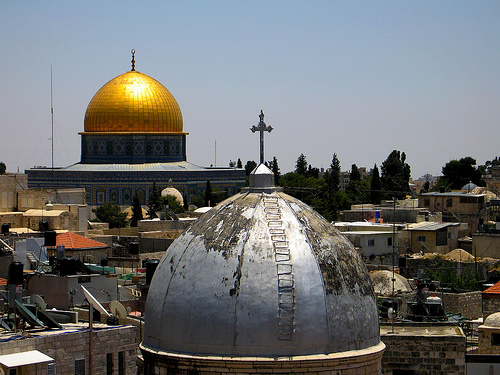
" ... The warning came as Jewish settlers in the West Bank confronted government inspectors sent to enforce a ban on new construction on territory Palestinians claim for a future state. No major violence was reported, but the images could boost the efforts of Netanyahu to portray himself as amenable to international demands for curtailing settlements.
Sweden, the current EU president, is floating an initiative to recognize east Jerusalem as the Palestinian capital. The Israeli daily Haaretz reported Tuesday that Sweden will seek approval at an EU meeting in Brussels next week.
In Stockholm, officials declined to confirm the proposal. But diplomats in Brussels said privately that Sweden has put the issue up for a debate by the EU governments. Although the proposal is unlikely to pass, Israel's Foreign Ministry issued a strongly worded statement urging the EU not to proceed...."
"I do not see much hope for the future if we have the same diplomacy pursued by America and then Karzai reacting to it."
"U.S. President Barack Obama is sending more troops to Afghanistan to win the war, but if the plan is going to work, his administration needs to fix its relationship with President Hamid Karzai....
Western countries lament what they describe as the rampant corruption and ineffectiveness of Karzai's government, and his alliances with former warlords to shore up political power...... For his part, Karzai accuses the West of doing too little in the past to prevent civilian casualties, stoking corruption by mismanaging billions of dollars in aid, and bullying him to sideline warlords without understanding political realities.
....... if the two sides are to work together in an ever bigger war against Taliban militants, they are both going to have to work harder to get along....
Shukriya Barakzai, a woman parliamentarian, said the failure of Kabul and the White House to stop trading accusations would embolden not only the Taliban, but also Washington's regional rivals such as Iran, China and Russia..."
US tax dollars go to those who obstruct "Middle East Peace" ...

"... The Task Force to Save the Nation and the Land, the organization that offered every soldier refusing to evacuate a settlement, and the Kfir Brigade soldiers who publicly demonstrated their opposition to evacuation, NIS 1,000 for every day they spend in military prison, is a registered non-profit organization and has a license to operate. ...Like many of the extreme right-wing organizations receiving money from U.S. supporters, the funding for the group enjoys tax-free status. Peace groups and Palestinians have complained to U.S. authorities, but there has been no change in the status of the organizations supporting the right wing..."