Monday, August 18, 2008

After Egypt, ... Siniora seeks Iraqi Petrol at reduced prices...

In Al Hayat, here
".....This visit follows on that of King Abdullah II of Jordan, which involved a similar request. The rise in oil prices (which are still high compared to only a couple of years ago) has given Prime Minister Nuri Al-Maliki sudden clout in the region. It is clear what Jordan and Lebanon want from him. The question is, what does he want from them? So far the quid pro quos are not being reported, unless it is just greater recognition and re-integration into the Arab political system. For instance, Saudi Arabia still declines to let al-Maliki visit Riyadh, apparently because of his enmity toward the Sunni Arab Awakening Councils, which are in part a Saudi project. Seniora and his backer Saad Hariri are close to Saudi Arabia and presumably will be intermediaries for al-Maliki in back channel communications to the Kingdom." (Cole)
عمر سليمان يتحدّث إلى الرئيس فؤاد السنيورة في الاسكندرية أوّل من أمس (عمر دلش ــ رويترز)
(Siniora 'chatting' with Chief of Egyptian Intelligence, O Sleiman)
Professor Cole forgot to mention that Hariri's last visit did not go well: He visited Sistani on the heels of the collapse of the praetorian branch (lol) of his Future Movement, and told Sistani that the seat of Shia'a leadership was in Najaf and not Qom ... I don't know who advises the prodigy, but they totally forgot to mention that Sistani is a HUGE FAN of Iran. The meeting was promptly dismissed!

"Implications of the Russo-Georgian War for the Middle East and the Gulf littoral"

Special INEGMA Report on Russia-Georgia Conflict Impact on ME Region.

THE RUSSO-GEORGIAN WAR AND GEOPOLITICAL IMPLICATIONS FOR THE GULF LITTORAL

Dr. Theodore Karasik
Director of Research and Development
INEGMA - Institute for Near East and Gulf Military Analysis
The August 2008 Russo-Georgian war is much more than about Moscow's claims to South Ossetia or Abkhazia. There are broad regional implications that affect the Middle East and the Gulf littoral in particular.
Background & Developments
South Ossetian separatists, supported by Moscow, escalated their machine gun and mortar fire attacks against neighboring Georgian villages last week. In response, Georgia attacked the separatist capital South Ossetian Tskhinvali with artillery to suppress fire. Tskhinvali suffered severe damage, thus providing the pretext for Moscow's invasion of Georgia. Russians in Abkhazia are also fighting the Georgians.
As Russia responded with overwhelming force, Prime Minister Vladimir Putin flew from the Beijing Olympics to Vladikavkaz, taking control of the military operations. Putin sidelined his successor, Russian President Dmitry Medvedev, thereby leaving no doubt as to who is in charge. Medvedev's role is to handle the international diplomatic front which seems to be not on the table. Under Putin's orders, the 58th Russian Army of the North Caucasus Military District rolled into South Ossetia, reinforced by the 76th Airborne "Pskov" Division. Cossacks from the neighboring Russian territories moved in to combat the Georgians as well.
The Black Sea Fleet is blockading Georgia from the sea, while Russian ballistic missiles and its air force are attacking Georgian military bases and cities including Tbilisi International Airport .What Russia is trying to do-and looking like she may succeed- is to establish a pro-Russian regime in Georgia that will also bring the strategic Baku-Tbilisi-Ceyhan oil pipeline and the Baku-Erzurum (Turkey) gas pipeline under Moscow's control.
Impact on Israel
More importantly and with immense strategic implications, Russia is also trying to send Israel a clear message that Tel Aviv's military support for Tbilisi in organizing, training and equipping Georgia's army will no longer be tolerated. Private Israeli security firms and retired military officials are actively involved in Georgian security. In addition, Israel's interest in Caspian oil and gas pipelines is growing and Moscow seeks to stop this activity at this time. Intense negotiations about current and future pipelines between Israel, Turkey, Georgia, Turkmenistan, and Azerbaijan are tied to receiving oil at the terminal at Ashkelon and on to the Red Sea port of Eilat. Finally, Russia is sending a clear message that Moscow will not tolerate American influence in Georgia nor Tbilisi's interests –supported by the pro-U.S. Georgian President Mikhal Saakashvili--in joining NATO. Overall, the military crisis will push Moscow to punish Israel for its assistance to Georgia, and challenge the U.S. to do more than voice rhetoric.

Impact on Arab Gulf States, Iran
In the Gulf, there are several broad implications. First is the impact of the war on Gulf investment in the Caucasus and in Russia. The Russian damage to Ras al Khaimah's investment plan in Georgia is troublesome. The Ras Al Khaimah Government has recently invested in the Georgian port of Poti where its real estate development arm Rakeen is developing a free zone. Rakeen is also developing some mixed-use projects near capital Tbilisi. The company has three projects in Georgia - Tiblisi Heights and Uptown Tiblisi - with a total value of Dh7.3 billion, while a third is being planned. However, Ras Al Khaimah's other major investment did not remain unhurt. The Georgian harbor Poti, which is majority owned by the Ras Al Khaimah Investment Authority (Rakia), was badly damaged in Russian air raids. In April 2008, Georgia sold a 51 per cent stake in the Poti port area to Rakia to develop a free economic zone (FEZ) in a 49-year management concession, and to manage a new port terminal. The creation of FEZ, to be developed by Rakeen, was officially inaugurated by Georgian President Mikhail Saakashvili April 15 2008. Previously the trend in Russo-GCC relations focused on strengthening the "north-south" economic corridor between the two regions; this linkage may now be in jeopardy if more Gulf investment goes up in smoke.
The second implication is the growing military presence in both Gulf waters and the Mediterranean Sea by the West and Russia that cannot be separated from the Russo-Georgian conflict. There is an unprecedented build-up of American, French, British and Canadian naval and air assets-the most since the 2003 invasion of Iraq-that are to be in place shortly for a partial naval blockade of Iran. Three U.S. strike forces are en route to the Gulf namely the USS Theodore Roosevelt, the USS Ronald Reagan and the USS Iwo Jima. Already in place are the USS Abraham Lincoln in the Arabian Sea opposite Iranian shores and the USS Peleliu which is cruising in the Red Sea and Gulf of Aden.
There is also a growing Russian navy deployment begun earlier this year to the eastern Mediterranean comprising the aircraft carrier Admiral Kuznetsov with approximately 50 Su-33 warplanes that have the capacity for mid-air refueling along with the guided missile heavy cruiser Moskva. This means the Russian warplanes could reach the Gulf from the Mediterranean, a distance of some 850 miles and would be forced to fly over Syria but Iraq as well, where the skies are controlled by the U.S. military. The Russian task force is believed to be composed of a dozen warships as well as several submarines. While the West is seeking to defend Gulf oil sources destined to the West and the Far East, Russia is increasing its desire to control Caspian oil resources and setting herself in a strategic position near the Levant.
A final implication is what may be a complete collapse of any back channel communications via Russia to Iran regarding Tehran's preparation for confrontation with the West and slowing down Iran's pursuit of a nuclear weapon. In the past year, Russia acted as an intermediary between the U.S., Israel, the GCC-specifically Saudi Arabia-and Tehran. With the Russian-Georgian war, the door may now slam shut between these players. Saudi Arabia, for instance, is attempting to halt the Russian sale of the S-300 anti-air defense system to Tehran and also is seeking to purchase large amounts of Russian weapons in order to "buy-off" Moscow's pursuit of selling conventional weapons to Iran. As a consequence of the Russo-Georgian war, Russia may start to play hardball with going through with arms sales to Iran and dropping support for sanctions against Iran that may invite a unilateral Israeli strike on Iran.
As further evidence of the heightening of tensions, Kuwait is activating its "Emergency War Plan" as the massive U.S. and European flotilla is heading for the region. Part of Kuwait's plan is to put strategic petroleum assets in reserve in the Far East and outside the forthcoming battle space. And Israel is building up its strike capabilities for an attack on Iran, purchasing 90 F-16I planes that can carry enough fuel to reach Iran. Israel has also bought two new Dolphin submarines from Germany capable of firing nuclear-armed warheads, in addition to the three already in service with its navy. Many strategic and tactical pieces for a confrontation are falling into place.
Overall, analysts have argued in the past few years that there might be a series of triggers that could force a confrontation between the West and Iran. Some maintained that this trigger may occur in the Gulf itself or in the Levant-whether accidental or on purpose. There were potential triggers before-the April 2007 seizure of British sailors in the Gulf, the September 2007 Israeli attack on a suspected Syrian nuclear facility, and Hezbollah's seizure of Western Beirut in May 2008. Now it appears that a more serious trigger may be the Russo-Georgian war –despite geographical distance-- that may carry dire consequences for all-especially in the Gulf littoral.

.... and in MESH, Walter Lacqueur writes this
"......What will be the impact of these trends on the Middle East? Ideally, it would be wise to wait with any major action in the area until Russian domination in its closer neighborhood is established. But if opportunities for a Russian return to the Middle East arise, they should be used.
There are no illusions about finding allies in the region. As one of the last Tsars (Alexander III) said (and as Putin repeated after him), Russia has only two reliable allies: its army and artillery. Among the police and army ideologues there has been of late the idea to give up Panslav dreams, since the Slav brothers can be trusted even less than the rest, and to consider instead a strategic alliance with Turkic peoples. But these are largely fantasies.
The main aim will be to weaken America’s position in the Middle East. In this respect, there are differences of opinion in the Kremlin. Some ex-generals have come on record to the effect that a war with America is inevitable in a perspective of 10-15 years. The influence of these radical military men should not be overrated. But it is certainly true that the belief that America is Russia’s worst and most dangerous enemy is quite common (see for instance the recent Russkaia Doktrina). The downfall of the Soviet empire is thought to be mainly if not entirely America’s fault; Washington, it is believed, is trying to hurt Russia all the time in every possible way. This paranoiac attitude is deeply rooted (in contrast to China) and it will be an uphill struggle in the years to come to persuade the Russian leadership that this is not the case.
Moscow has threatened to supply greater help to Iran and Syria, which would certainly annoy America and perhaps hurt it. But Russia does not want to do this at the price of creating political and military problems for itself in the years to come. Russian distrust does not stop at its southern borders.
The attack on South Ossetia provided Russia with an unique opportunity; it was motivated by a militant Georgian nationalism which failed to understand that small and weak countries, unlike big and powerful ones, are not in a position to keep separatist regions indefinitely under their control. Such opportunities will not frequently return, and other opportunities will have to be created by the Kremlin—probably by exploiting existing conflicts such as those in the Middle East. This could open the door to serious miscalculations."

Saturday, August 16, 2008

[Image]

CIA analyst gives Bush a "Syria-North Korea Project" commemorative coin...

In WashingtonWhispers, here
"...Bush then took a seat at a table with two dozen junior employees. They included analysts, clandestine operatives, scientists and engineers, and support personnel. In between bites, he asked them about their jobs and where they have served overseas. One analyst, who played a key role for the CIA in identifying the nuclear reactor that was being built in Syria with North Korean assistance, gave the president a bronze commemorative coin that Hayden had presented to each agency employee who was directly involved in that intelligence effort.
The 3-inch diameter coin was inscribed with, "Syria-North Korea Project" and the words, "No Core, No War."

Secret Israeli forces "exposed" in Georgia...

"When I arrived in the operations room I saw a book of IDF safety instructions that shouldn't have been there," he said. "There were IDF CDs that explicitly said, 'Confidential' documenting army activities, charts from special units' operations, and officers' names." He added that the room was not guarded, making this information easily obtainable to everyone.
Tomer said the main reason for the infidelity was mercenary. "The training companies wanted to finish the projects as quickly as possible in order to create more projects and make more money," he said. "We knew the training had to be completed quickly because the soldiers would soon have to get into real military activity."

The Trouble With “Pro-American”...

Yglesias, at ThinkProgress, here
You see a remarkable amount of credulity about the need to back “pro-American” leaders from Ahmed Chalabi to Mikheil Saakashvili to Pervez Musharraf and whomever else when in fact none of these people (as Chalabi and Musharraf have managed to make crystal clear over the years with certain betrayals) are, in fact, monomaniacally focused on advancing American interests. (Matt: You need to check out Siniora and more recently Chattah ... but heck, Lebanon is peanuts compared to Iraq, Pakistan ...etc.)
Failed Global Test

Friday, August 15, 2008

UNIFIL's Gen Graziano accuses Israel of violating Resolution 1701

"...Graziano made his comments at a press conference at UN headquarters in New York. He said that continued Israel Air Force flights in Lebanese airspace and Israel's refusal to submit maps of areas on which it dropped cluster bombs during the war constituted a "permanent violation of 1701." Graziano also referred to the village of Ghajar, which sits on the Israel-Lebanon border, as "a permanent area under occupation."
The Italian general, meanwhile, said that Hezbollah recognizes Resolution 1701, and that the militant Lebanese group and UNIFIL forces enjoy excellent cooperation with one another. He added that apart from UN and Lebanese soldiers and local hunters, no one is armed south of the Litani River...."

Michael Ledeen "Leaves" AEI ...

Laura Rosen in MoJo, here
"...From afar, one sensed that Ledeen may be too controversial for AEI's other scholars to want him to be the public face of the think tank on Iran issues, an observation the associate described as reasonable.
Ledeen is not alone in being scarcer at the influential think tank of late. Former Reagan administration Pentagon official Richard Perle is often in France and rarely makes public appearances at AEI any more; but there's no talk of Perle leaving AEI, although his role there is largely "emeritus" the associate described...."

"Bases in Iraq, Provocation of Iran"

In Cole's Informed Comment, here

US court rules that Saudi Arabia and four of its princes are immune from legal action by victims of 9/11

Al Jazeera/English, here

Last minute Escalation: "Hit squads training in Iran..by Lebanese Hezbollah" says a U.S. military intelligence officer in Baghdad

"...The officer on Wednesday provided Iraq's national security adviser with several lists of the assassination teams' expected targets. He said the targets include many judges but would not otherwise identify them ...(Samir Geagea' did that in Lebanon...). Iraq's intelligence service is preparing operations to determine where and when the special group fighters will enter the country and is to provide an assessment to Prime Minister Nouri al-Maliki...."

Thursday, August 14, 2008

"...Having overestimated the power of the Soviet Union in its last years, we have consistently underestimated the ambitions of Russia since..."

(Paranoia?) MELIK KAYLAN opinion in the WSJ, here
"...Between Russia and Iran, in the lower Caucasus, sits a small wedge of independent soil -- namely, the soil of Azerbaijan and Georgia combined. Through those two countries runs the immensely important Baku-Tbilisi-Ceyhan pipeline, which delivers precious oil circuitously from Azerbaijan to Turkey and out to the world. This is important not just because of the actual oil being delivered free of interference from Russia and Iran and the Middle East, but also for symbolic reasons. It says to the world that if any former Moscow colonies wish to sell their wares to the West directly, they have a right to do so, and the West will support that right. According to Georgian authorities, Russian warplanes have tried to demolish the Georgian leg of that pipeline several times in the last days. Their message cannot be clearer...."

"..Some compare Bush's vocal, but less than substantive backing to Lebanon's "Cedar Revolution" to its tepid support for embattled Saashkavili.."

From MEPGS, August 14, 2008
"The events in Georgia are not being lost on Middle East leaders. Some compare America's vocal, but less than substantive backing to Lebanon's "Cedar Revolution" to its, so far, tepid support for the embattled Georgian government. Others, notably the Israelis, see a warning in too much reliance on the US for long standing pledges of support. "There is no doubt that Georgia has an impact," said one senior Israeli official this week. And for this official as well as most of his colleagues, the issue they see as being impacted is Iran.
Even before the events of this week in Georgia, Israeli officials were growing uncomfortable with US policy. They were particularly miffed at the presence of Under Secretary of State William Burns at the recent talks in Geneva with the Europeans, Russians, Chinese and Iranians. "They gave us practically no warning of this clear change in US policy," said one veteran israeli official.
Even European diplomats admit that time is running out on the dialogue with Iran. Tehran's "non-response" to the package offered at Geneva has led some to say that the process is reaching what one European diplomat calls a "crossroads." He says that shortly it will be a question of military action to prevent Iran from attaining the capability to produce a nuclear weapon and acceptance of one.
Despite expert opinion that Israel lacks the capability to retard, let alone "take out" Iran's nuclear infrastructure, privately and publicly Jerusalem has continued to reiterate its determination to prevent Iran from obtaining the bomb. And top US officials take this threat increasingly seriously. "The Israelis have used the words `existential threat' and `holocaust' too many times in connection with Iran for us not to be worried," says one high ranking US official. And for every argument that Israel will be restrained by circumstances or lack of ability, there seems to be a counter argument put forth by outside observers, US officials and, of course, the Israelis themselves.
For example, a recent, widely circulated paper by the respected researcher, David Albright and two other colleagues, makes a compelling argument that Iran's nuclear development program is so diffuse and easily reconstituted that an attack could well be counter productive. And it certainly cannot be compared to the relatively easy operation against Iraq's centralized program that was destroyed by the Israeli airforce in 1981. But one key US official points out that the Israeli success in 1981 far exceeded expectations. More important, Iraq's program was not --to use that phrase again -- an existential threat to Israel. Another argument put forward by skeptics of preemptive strike is the need for permission by the US for the Israeli airforce to overfly Iraqi airspace -- the most likely route to Iranian nuclear installations. "The last thing the shia-led Iraqi regime would want to see is their airspace being used as a route to punish their friends and co-religionists next door," says one US analyst. The answer: According to one key US official: "The Israelis aren't going to ask until the last moment and I can't believe the Administration saying no."
An Obama Administration may not be so amenable. Top Obama advisors say that as President, one of the first things he would do is to tell Israel that the military option is off the table. These advisors see other significant changes in Middle East policy coming, should the junior Senator from Illinois become the forty-fourth President. It will all start with Iraq, says one key Obama advisor. While Obama's pledge to withdraw a brigade a
month from combat in Iraq is likely to be scuttled ["Like most campaign promises, this one won't be kept," says one Obama foreign policy advisor]. Still, like the candidate, his top advisors see Iraq, in the words of one, "...as an albatross" around the neck of the US. "We are going to get out, not hang on like the Israelis did all those years in Lebanon."
A number of analysts note that the Maliki government will ease the way towards an American departure. Says one European diplomat, "Iraqi nationalism is back." And American officials, who are having a difficult time negotiating a status of forces agreement ("SOFA") with Baghdad can attest to that. This `sofa' is turning into a `futon', quipped one veteran observer, noting the Iraqi reluctance to grant the US sweeping powers when the UN mandate for the American presence in Iraq expires at the end of the year.
One area where US officials appear to be making significant progress is in clearing away the obstacles to full diplomatic relations with Libya. It is what one US official calls the "poster child" for Administration success in Middle East non- proliferation and anti-terrorism. But Libya is still entangled in the last issues connected with the downing of Pan Am 103 and the bombing of La Bell Disco as Sen. Lautenberg (D-NJ) has put an effective hold until compensation issues are fully resolved. David Welch has spent many hours trying to resolve this dispute and, according to informed sources is on the verge of a breakthrough. With Libyan agreement to provide up to $1 billion more in compensation, the way seems to be clear for Secretary Rice to visit Libya in September. Also in September, it is hoped there will be enough time for the Senate to confirm a full fledged ambassador to Tripoli, the first in decades.
With Secretary Rice on her way to Paris and Tblisi, in an effort to deal with the Georgian crisis, her latest trip to the Middle East to promote Israeli-Palestinian peace talks has been, at least temporarily, delayed. But participants in the latest round, held here in Washington earlier this month, say she shows no signs in her desire to see the issue through in the remaining months of the Administration.
Israeli negotiators, notably Foreign Minister Livni reportedly were less than enthusiastic about engaging in this
latest round. She, like former Defense Minister Mofaz is engaged in a competition to succeed Olmert as head of the leading Israeli political party and therefore the country's putative new Prime Minister. It has been speculated that Secretary Rice, absent an agreement by year's end, would like to make public the progress that has been made so far. But Livni, in particular, is reportedly opposed to such a move, since it could undercut her credentials in her race against Mofaz [Prompting one US official to comment "Israelis produce more politics than they can consume"]. However, according to informed sources, the Israelis were supported in this stance by their Palestinian interlocutors, who fear the flip side of highlighting progress -- the intractable issues still on the table. 

Wednesday, August 13, 2008

"........then what good is American policy?"

Soli Ozel, in the WaPo, here via War&Piece
"...I find the Russian assault against Georgia illegal and disproportionate and I think the Kremlin's regime is brutal. But then again, would anyone take seriously Paris, whose complicity in the Rwandan genocide was recently reiterated, or Washington, which invaded a country (illegally and illegitimately by the judgment of most of the world) and made torture legal, when they accuse Russia of anything? So for every country that wants to contain Russia you may find one or two that see it as a counterweight to the United States and a good response to Western conceit. What I am getting at is the question of legitimacy. The West has lost the upper hand on this because of double standards and increasingly misplaced arrogance, not to mention the lack of a coherent strategy supported wholeheartedly on both sides of the Atlantic..."

A Powell Endorsement?

Matt Yglesias, here

Lebanon: "...Long on Hope, Short on Time..."

".........Standard & Poor's ratings services upgraded its long-term sovereign credit ratings for Lebanon to 'B-' from 'CCC+'. ...The improved assessment reflected the easing of tensions in Lebanon and the rapprochement between March 14 and opposition groups, according to Ben Faulks, a credit analyst with S&P..."

Bomb blast rocks north Lebanon, targets Military...

Al Jazeera/English, here

Tuesday, August 12, 2008

U.S. rejects Israeli request for arms geared toward Iran strike

"...The Americans viewed the request, which was transmitted (and rejected) at the highest level, as a sign that Israel is in the advanced stages of preparations to attack Iran. They therefore warned Israel against attacking, saying such a strike would undermine American interests. They also demanded that Israel give them prior notice if it nevertheless decided to strike Iran..."

"...The Israelis should be careful or they will acquire a reputation for dumping their allies under pressure..."

"A friend in need is a friend indeed." SicSemperTyrannis, here

President Assad sees peace with Israel as vital for Syria’s economic relations with its neighbours – and to prevent al-Qaida-type extremism

Alain Gresh in Le Monde Diplomatique:
"Syria’s president, Bashar al-Assad, just before his visit to Paris for the Mediterranean Union summit on 12 July, said that economic relations between the countries of the Mediterranean could not be developed while there were ongoing regional conflicts, starting with the Arab-Israeli conflict. He talked to me for two hours in Damascus. He said: “If you don’t have political dialogue and talk about the big issues – achieving peace – there is no point in any other initiative... because there is no confidence between us.”
Many in Washington and Tel Aviv question Syria’s desire for peace, but Assad was genuinely anxious when he said that “our societies are moving towards conservatism, extremism. . . Terrorism is a threat to all humanity. Al-Qaida is not an organisation, it is a state of mind. It has no borders. Have we got a home-grown problem of terrorism? Yes. Since 2004, as a result of the war in Iraq, we began to see al-Qaida cells [appear], not related to the organisation but to a state of mind, through pamphlets and the internet. We are afraid for the future of the region. We need to change this fertile ground for terror through development, culture, the educational system, dialogue, tourism, and also exchange of information [between states]. The world is more vulnerable to terror than before 9/11.”
If the chance of peace is lost again, Assad is in no doubt that a new channel will open for the extremists. Syria’s indirect negotiations with Israel are within this context. After 2003 Assad more often stated the need to restart negotiations with Israel. After the 2006 war in Lebanon, he clearly distanced himself from the statements of Iran’s president Mahmoud Ahmadinejad: “I do not say that Israel should be removed from the map. We want peace, peace with Israel” (1). Ariel Sharon and then Ehud Olmert were deaf to these wishes, and others (particularly in Washington) refused to trust Assad’s regime. In May, however, Israel and Syria announced the opening of indirect negotiations, with the Turkish prime minister Recep Tayyip Erdogan as intermediary.
How does Assad interpret the Israeli acceptance of negotiations? “The war on Lebanon taught everybody that you cannot solve the problem by war. Israel is the strongest military power in the region and Hizbullah is smaller than any army in the region. What did they achieve? Nothing.” He recalled that after the war many US delegations close to Israeli positions made their way to Damascus. In December 2006, the Baker-Hamilton report called for dialogue between the US and Syria, and in April 2007 Nancy Pelosi, speaker of the US House of Representatives, met Assad. But, he said: “The biggest obstacle is the American administration. It is the first time that we have an administration that tells the Israelis not to move towards peace.”
Assad thinks it is necessary to wait for a new US administration in 2009 before Syrian-Israeli talks get anywhere, since their success will need a powerful intermediary, which Assad believes can only be the US. Even so, there has to be progress during the waiting period, which is the point of the current indirect talks. “After eight years of paralysis [since the end of negotiations between the two countries in 2000], after the war on Lebanon, and two attacks on Syria, there is no trust. What we are doing in Turkey is probing Israel’s intentions; we don’t trust them and perhaps they don’t trust us. We want to make sure the Israelis are ready for peace. Ready to give back the whole of the Golan, then to plan the common ground for negotiations: Security Council resolution 242 and the general problems we should discuss (water, security).”
During the talks between the late Hafez al-Assad and Ehud Barak (then Israel’s prime minister) in 1999-2000, several breakthroughs were made on the most tricky issues. “I said that 80% of them are solved: security problems and relations between Israel and Syria,” said Assad. “But the problem is that Israel doesn’t want to start from where we left off.” He believes there can be a compromise, except on recovering the whole of the Golan. Israel demanded in 2000 that it should keep a warning post on Syrian territory – an unacceptable condition since Syria cannot accept any Israeli military presence on its soil. An agreement was reached to station US military personnel in the post.
When asked about those who say he should break off relations with Iran, Assad replied cautiously: “What should I say to Iran? I don’t want your help, I want to be isolated? I don’t want good relations with you? Iran is a very important country in our region. It wants to solve problems, have peace and stability. Iran is essential. There are many problems you can’t solve without the Iranians. How can the outside world ask me to achieve peace and stability and not have good relations with Tehran? It’s the same with Turkey, with whom we did not have good relations for years. What did we get and what did Turkey get? Nothing. The same with Iran. We don’t agree with Iran on everything: Israel, Iraq. But Iran supports our negotiations with Turkey, and that’s very important for us. But we are not anyone’s puppets! Even at the time of our alliance with USSR they never managed to prevent us from doing whatever we wanted in our region.”
Did he think an attack on Iran is possible before the end of Bush administration? “Logically there shouldn’t be. The price would be very, very heavy on the whole world. The question, and that is what we discussed with the Iranians, is what Iran should not do under international law. That is military nukes. But we are allowed, including Syria, to have peaceful, civilian nuclear facilities. As long as the Iranians don’t breach international law what can be done against them? They have the right to enrich uranium. They said come and check it, and up to a few years ago they even had AIEA cameras in their facilities. Force won’t work with Iran, just as it doesn’t with Syria.”
Asked about the future Assad said: “What I’d like in five years time is to see Syria as it was in the 1960s, more open-minded, less extremist. 
The previous generation… was much more open than our generation. Even if you are secular, if you’re surrounded by extremism you become intoxicated by its fumes, even if you don’t get burnt yourself. Iraq was secular under Saddam; today there is much more sectarianism. I wish for better relations with the rest of the world. I wish the media, especially those in the US, would try to get to know us more. We know everything about 
the West but the West knows little about us. I hope the European Union will increase its influence on the US.”

Kuwait Readying for War in Gulf?

CLAUDE SALHANI in Middle East Times, here
"...The object of the naval deployment would be to enforce an eventual blockade on Iran, if as expected by many observers, current negotiations with the Islamic republic over its insistence to pursue enrichment of uranium, allowing it, eventually, to produce nuclear weapons yields no results..."

Olmert presents Abbas with a proposal for an Israeli withdrawal from the West Bank, to take place "AFTER Abbas' forces have retaken Gaza"

Of course, Abbas looked into his crystal ball and rejected the offer! In Haaretz, here

Monday, August 11, 2008

Neocons Inc.: "...Price of Bush's flip-flop= Tehran overconfidence, erosion of UN's resolutions effectiveness & forfeiture of 'redline' credibility.."

Michael Rubin in the DailyStar, here
"...Iranians play chess while Americans play checkers. That Tehran's nuclear program has progressed so far is a testament to the Iranian strategy. In contrast, Bush's move has little to do with a well-thought-out strategy and is more a flailing attempt to change legacy. As Iranian centrifuges continue to spin, the price of Bush's flip-flop will be high: Iranian overconfidence, erosion of future UN Security Council resolution effectiveness and forfeiture of future redline credibility. With its diplomatic card wasted, the next US president will have a stark choice: Allow the Islamic Republic to go nuclear or accelerate the application of far more costly measures..."

Poll: Is the Bush Administration Batman or Maxwell Smart?

WashingtonWhispers, here
Get Smart 35%
X Files: I Want to Believe 25%
Hellboy II: The Golden Army 19%
Batman: The Dark Knight 14%
Enchanted 7%

Iran & Hezbollah will talk to Israel and work with it if it suits their interests...due to Iran’s desire for power..."

Jihadica, here and Al Akhbar, here ".....Hezbollah prevents any Sunni resistance from setting up on the Lebanese border with Israel. It has cut deals with Syria, the U.S., and even Israel to retain its control of the area...Hezbollah supports Palestinian militants to achieve the wider aims of Iran. It has adopted a popular cause to increase its popularity. It is also filling a leadership vacuum left by other Arab states who have failed to step up..."

Pillaging Iraqi history

"...The documents were seized shortly after the fall of Baghdad by Kanan Makiya, an Iraq-born emigre who teaches at Brandeis University and heads a private group called the Iraq Memory Foundation...."

Russia Fires Off a Message

In the WPR, here
"....the message fired off by the relentless Russian onslaught is as clearly discernible as the blast of a cannon: The territories of the former Soviet Union will answer to Moscow -- whether they want to or not.
That smoldering salvo has its intended audience, more than anywhere else, in those former Soviet territories: in lands that include Georgia, of course, but also other former Soviet republics than have worked to moved away from Moscow's influence. The message is meant to be heard in places such as Ukraine, and maybe -- just maybe -- as far as the Baltic states of Lithuania, Estonia and Latvia, which once saw their independence bartered away to Moscow but have now managed to achieve their dream of rejoining Europe by gaining entrance in the European Union. The fiery message also has an intended audience in the West, where Europe and the United States have been trying to figure out what to make of the newly invigorated Russia, and how to respond to overtures from the likes of the Republic of Georgia, pleading for entrance into NATO and the EU...."

Iran and EU in new nuclear contact but no change

"...However, an official in Solana's office gave a more downbeat account of the conversation, saying: "Nothing has changed. We stick to the two-track approach. The channels of communication remain open."
Asked what he meant by a two-track approach, the EU official said: "On the one side, pressure for sanctions in the United Nations Security Council, but also the offer of dialogue, for the Iranians to come to the table to discuss the package (of incentives) which has been proposed to them."

"...The problem in the Arab Middle East is a civil society that is by no means civil..."

(Comment by reader "mo")
"Its amazing, every time I decide I don't want to add any more comments anywhere a peice like this appears that forces me to, esp. since MESH is too cowardly to allow positngs from anyone but their own.Is it not ironic that this supposed post on racism in the Middle East should itself be so racist? It makes the classic "MEMRI Generalisation" of taking the words of one person and attributing to 600 million people. And for a bunch of self-obsessed and self-appointed "distinguished commentators" they are extrememly ill-informed and il educated on the Middle East."For the government, it has been peace with Israel for almost 30 years.Down below, it is deeply rooted and pervasive antisemitism."Ah, the age old anti-israeli is anti-semitic argument. Will they never give that up?"hey all had this ‘11′ mustache. That was in the days of Hitler."Ah Mr Mesh, if only you understood either fashion or causality. My grandfather had a "hitler" moustache in 1930. Did Hitler use my Grandfather as inspiration? (GPC laughed hard here!!)"Classical European antisemitism—blood libel, world domination and all—has migrated to the Arab Middle East. Interestingly, it got there way before the founding of Israel"What? You mean the Arabs can read? Gasp! How about letting us in on how it was so widespread in the Arab Middle East (and please do note the term "Arab Middle East")"And so did the admiration of Adolf Hitler, as the good captain recalls"Fucking Idiot. Charlie Chaplin admired Hitler as well did he?"It will be easier to re-divide Jerusalem than to remove this deepest of “root causes” from the collective psyche of Israel’s neighborhood."Really? You think the “root causes” of European hate of the Jews have been removed? What were the Arabs doing to the Jews during the Holocaust, the Inquisition, the ghettoisation, the Crusades and all the years between where the anti-semitism in Europe was of a lower key? Protecting them is what the Arabs were doing. I hope I have saved anyone the trouble of giving these racist shits any more traffic."

"...The Israelis, stationed at bases throughout Georgia, were to carry out battalion-level infantry and reconnaissance training..."

"...Meanwhile, the Israeli trainers are trying to glean from reports on the movements of the Georgian army whether their trainees have internalized Israeli military technique and if the special reconnaissance forces have chalked up any successes after the difficult training they underwent last winter.
L. and a group of young Israel Defense Forces reservists have been watching reports of the fighting in Georgia worriedly, concerned over the fate of the soldiers they had trained for four months..."

Sunday, August 10, 2008

War in Georgia: The Israeli connection

".....The military cooperation between the countries developed swiftly. The fact that Georgia's defense minister, Davit Kezerashvili, is a former Israeli who is fluent in Hebrew contributed to this cooperation.
.....As the tension between Russia and Georgia grew, however, increasing voices were heard in Israel – particularly in the Foreign Ministry – calling on the Defense Ministry to be more selective in the approval of the deals with Georgia for fear that they would anger Russia..."

"Gen. Muhammed Suleiman, "personal mentor" to Pres. Assad ..& had been supplying anti-aircraft missiles to Lebanese militant group Hezbollah.."

In the SundayTimes, quoting the most unreliable Asharq Al Awsat, here
"....Suleiman had been President Bashar al-Assad’s personal mentor since 1994, after the death of the president’s brother Basel in a car accident. Assad later appointed Suleiman as his operations officer and made him responsible for protecting the regime.
If Syria has passed Russian-made SA-8 mobile launchers to Hezbollah, the Shi’ite militia that came close to defeating the Israeli army two years ago, it is in possession of a potent weapon to defy Israeli air power...."

Barak: "...Sharon and his leadership were wise not to respond to Hezbollah's strengthening, .....We went to war unprepared and unjustified..."

"...During the interview, Barak also said the 2006 Second Lebanon War - in effect, carried out to stop Hezbollah armament - had actually strengthened the Lebanon-based militant group.
The defense minister said the the six years prior to the war had actually been some of the quietest on Israel's northern border, despite the growth in Hezbollah's military capabilities.
"Sharon and his leadership were wise not to respond to Hezbollah's strengthening," Barak said. "We went to war unprepared and unjustified."

Friday, August 8, 2008

The Hariri Investigation and the Politics of Perception

Gary Gambill writing in the Mideast Monitor, here
"...Producing conclusive evidence of Syrian involvement in the assassination of Hariri would have irreparably weakened Syrian influence in Lebanon, strongly discouraged European and Arab governments from engaging Damascus so long as Assad refused to hand over the suspects (which no one expected), and - most importantly, perhaps - obviated the possibility of a new American administration changing course in relations with Syria anytime soon. The IIIC's early missteps and succession of steadily less accusatory findings have done the opposite on all three counts..."

What was an Iraqi politician doing at CIA headquarters just days before he distributed a fake memo incriminating Saddam Hussein in 9/11?

"Badran and Ayad Allawi, leader of the INA, are spending much of this week at CIA headquarters in Langley to work out the details of the new program. Both men have worked closely with the CIA over the past decade in unsuccessful efforts to incite coups against Saddam Hussein..."

Stratfor: (sigh) "...the time is coming when Syria & Israel will decide to work together militarily or politically against Hezbollah..."

(... sigh, sigh ... sigh sigh ... basically this faulty analysis/prediction/wishful-thinking calls for Syrian hegemony over Lebanon, indeed endearing to M14 (or what's left of it)....)
PETRAEUS' SURPRISE TRIP TO BEIRUT
U.S. Gen. David Petraeus, the top coalition military commander in Iraq and future head of U.S. Central Command (CENTCOM), made a surprise visit to Beirut on Wednesday to discuss military cooperation with the Lebanese. The U.S. general reportedly met with Lebanese President Michel Suleiman (also a former army commander) and acting Lebanese army commander Maj. Gen. Shawki al-Masri.
Petraeus essentially has been Washington's rainmaker for the Middle East. He is credited with bringing some semblance of stability to Iraq and has been chosen to try to do the same for Afghanistan. Though his hands are already quite full, the general -- who takes over as CENTCOM chief in September -- apparently felt the need to make time for some meetings in the Levant, which leaves us wondering what this trip is really about.
Contrary to expectations, the visit likely has little to do with military assistance to the Lebanese army. No amount of U.S. aid is going to be enough to build the Lebanese military into a force unified and formidable enough to competently confront an organization like Hezbollah. And a soon-to-be CENTCOM chief like Petraeus certainly does not have to be the one to make the time for a trip to Beirut to discuss giving a new batch of vehicles to Lebanese security forces. We suspect this meeting addressed more important matters.
The visit comes at a critical time; the regional dynamics are shifting in the Levant. Israel and Syria are negotiating in fancy hotel rooms in Turkey over a peace deal that would enhance Israel's national security and reassert Syrian hegemony in Lebanon. These talks are progressing and are making Hezbollah more and more paranoid by the day, given that any final accommodation between the Israelis and the Syrians would include cutting Hezbollah down to size.
Though the Syrians already appear to have taken some (quiet) steps to curtail Hezbollah's arms supplies, the Israelis are signaling that the ultimate litmus test for this peace deal will involve bigger and bolder action by the Syrians against the Shiite militant group. Israel is not about to allow Syria to play the middle ground in dealing with Hezbollah. With the Lebanese incapable of containing Hezbollah themselves, the Syrians are expected to play a major role in diluting Hezbollah's military strength.
Exactly how Israel intends to deal with Hezbollah is still unclear, especially as the Israeli government is in a major political flux over its prime minister's impending resignation. But Israeli preparations for a military confrontation with Hezbollah are now in full swing, and we can't help but wonder whether these preparations are simply precautionary measures in case of a Hezbollah attack; or perhaps they are part of an Israeli strategy to goad Hezbollah into a war that would prove Syria's commitment to the peace talks.
The same day Petraeus was in Lebanon, Stratfor picked up information from a source in the region claiming that Syria had dismantled an anti-aircraft system in the Anti-Lebanon mountain range to the east of the Bekaa Valley -- a major Hezbollah stronghold and likely the main site of fighting between Hezbollah and Israel should full-scale hostilities resume. According to the source, Israel assured the Syrians (via Turkey) that it would not attack Syrian military positions in the event of such an outbreak, leaving Hezbollah particularly vulnerable and dependent on its own meager arsenal of man-portable surface-to-air missiles.
Stratfor has not been able to confirm this information, but if true, it signals a significant shift toward peace by the Syrians. Whether or not Israel intends to attack Hezbollah, whether or not Syria intends to attack Hezbollah, and whether or not the two decide to work together militarily or politically against Hezbollah, the bottom line is that that time is coming. Any of the above options are feasible, and there are many more ways to skin this particular cat. But the commonality among all of them is that Israel and Syria are sliding from a cold war into a cold peace, and that will redefine not just their bilateral relations, but the balance of power throughout the region. A Syria that can work with Israel is one in which Iran holds little influence. A Lebanon under the Syrian thumb is one in which groups like Hezbollah face the question of accommodation or oblivion. A more secure Israel is one that does not need to be overly concerned about anything the Palestinians demand. All this adds up to a very different region, and one which the United States -- via Petraeus -- fully intends to be involved in shaping.


Copyright 2008 Strategic Forecasting, Inc.

CIA's Giraldi: Cheney is behind forgeries, not the CIA...

"....The Suskind account states that two senior CIA officers Robert Richer and John Maguire supervised the preparation of the document under direct orders coming from Director George Tenet. Not so, says my source. Tenet is for once telling the truth when he states that he would not have undermined himself by preparing such a document while at the same time insisting publicly that there was no connection between Saddam and al-Qaeda. Richer and Maguire have both denied that they were involved with the forgery and it should also be noted that preparation of such a document to mislead the media is illegal and they could have wound up in jail.
My source also notes that Dick Cheney, who was behind the forgery, hated and mistrusted the Agency and would not have used it for such a sensitive assignment. Instead, he went to Doug Feith’s Office of Special Plans and asked them to do the job..."

ISIS's Albright .. Cautions Against Strike on Iran's Nuclear Facilities..

In the WaPo, here
"...The analysis by the Washington-based Institute for Science and International Security found that Iran's uranium facilities are too widely dispersed and protected -- and, in some cases, concealed too well -- to be effectively destroyed by warplanes. And any damage to the country's nuclear program could be quickly repaired.
"Following an attack, Iran could quickly rebuild its centrifuge program in small, easily hidden facilities focused on making weapon-grade uranium for nuclear weapons," said principal author David Albright, ISIS president and a former U.N. weapons inspector....According to Albright, an Israeli or U.S. attack would result in broader popular support for Iran's ruling clerics and could lead Tehran to sever ties with the U.N. nuclear watchdog.
"Iran would likely launch a 'crash' program to quickly obtain nuclear weapons," Albright said in an interview. "An attack would likely leave Iran angry, more nationalistic, fed up with international inspectors and nonproliferation treaties, and more determined than ever to obtain nuclear weapons.""

"...Israel will treat Fouad Siniora responsible for any attacks.. in particular Hezbollah efforts to avenge the death of Mughniyeh.."

In Haaretz, here

Suskind to Release CIA Interview Transcripts on 'Forged' Document

"Author Ron Suskind says he will release transcripts of his interviews with a top CIA official that will confirm his story that in 2003 the White House ordered the agency to fabricate a phony document linking Iraq to the Sept. 11, 2001 terrorist attacks on New York and Washington, D.C.
The letter, written by an Iraqi intelligence official under the control of the CIA, according to Suskind, was concocted to mislead the public into believing that Saddam Hussein conspired with Osama Bin Laden in the attacks, and had gotten uranium from Niger to make nuclear weapons, thus justifying the U.S.-led invasion of Iraq....."

Thursday, August 7, 2008

Rice: "We don't say yes or no to Israeli military operations. Israel is a sovereign country,"

United States Secretary of State Condoleezza Rice on Thursday refrained from saying the U.S. would prevent Israel from mounting a much-touted attack against Iran over the Islamic Republic's nuclear aspirations.
"We don't say yes or no to Israeli military operations. Israel is a sovereign country," Rice said in an interview with Yahoo! News.

Barriers to a Two-State Solution

"...As I traveled through the West Bank, and moved from settlement to settlement with my guide, it became clear that the infrastructure, built by the Israeli State, was actively working against a two-state solution. Israeli-only roads were built between settlements, but had the effect of bisecting the West Bank and isolating many Palestinian communities from their larger villages or towns. Since I was in a car with Israelis, we were able to take the Israeli-only Highway 443 that had been built on what used to be private Palestinian land. My guide explained that these roads, built for the convenience of Israelis, disrupt or completely sever Palestinian transportation and is one way that the settlers/state try to marginalize the 90% of the West Bank population that is Palestinian. A Palestinian state in the West Bank may be still-born if it cannot ensure freedom of movement for its citizens and property rights which are basic functions of a state...."

Text of Iran's letter to the six powers...

Via Hurriyet, here

IN THE NAME OF GOD

Pursuant to Geneva’s constructive talks and submitted proposal by the Islamic Republic of Iran on the modality of continued negotiations and in view of the existing commonalities in both proposed plans as stated by the participants in the meeting, and agreement was made for further reflection on both proposals in order to provide each other with a clear response.

The Islamic Republic of Iran with good will, a constructive approach and a strategic determination to continued negotiations has again carefully considered views as expressed in the Geneva meeting to produce a comprehensive agreement for cooperation, one which can address our common concerns and be based on our collective obligations and set an agenda for consulting all interested parties in order to reach an acceptable outcome.

Now the Islamic Republic of Iran is ready to provide a clear response to your proposal at the earliest opportunity while simultaneously expecting to receive your clear response to our questions and ambiguities as well.

Undoubtedly, such mutual clarification can pave the way for a speedy and transparent negotiating process with a bright prospect and provide grounds for cooperation.

The second phase in negotiations can commence as early as possible if there is such willingness on your side.

Russia Asks That Iran Be Given More Time

In the WaPo, here

Wednesday, August 6, 2008

"Why Iran Won't Budge on Nukes"

"...Surprising as it may be to hear a member of the Shah's deposed regime support the stance of the Islamic Republic in a confrontation with the West, there is widespread concern among Iran experts that the current Western strategy of demanding that Iran forego the right to enrich uranium has created a diplomatic dead end...."

CENTCOM's Petraeus in Beirut ..... as Israeli Defense cabinet meets to discuss "threat posed by Hezbollah's AA missiles"

"For Syria, the 'June 4 1967' line is an imperialist border and completely illegitimate.."

"....This is also why Syria is insisting on the "June 4 lines": It is not just a territorial issue. Israel's willingness to withdraw to the international border is based on its view that the Mandatory border between Syria and the Land of Israel was legitimate. But for Syria, this is an imperialist border and completely illegitimate. This is not a fine distinction of international law, but a cornerstone of Syria's historical narrative. .."

"The House Judiciary Committee should meet to consider a bill of impeachment"

"The charge is so serious that Bush deserves an opportunity to clear his name of the accusation. Therefore, the House Judiciary Committee should meet to consider a bill of impeachment. Anything less will leave a stain on Bush that will follow his family name down through the ages."

Saudi MBC TV began its Sunday night news edition not with Assad's trip to Iran, nor with Palestinian infighting.. but with an Israeli TV ad...

Priorities, ... priorities in Saudi leaders' minds ... in Haaretz, here
"....MBC proceeded to interview a Saudi representative, who was asked why he thought Israel would broadcast the commercial. He warned of a boycott of Nissan by Persian Gulf states, and demanded the company apologize..."

"..Another piece that Rumsfeld erected at the Pentagon is dismantled: 'Counterintelligence Field Activity, or CIFA'..

"...CIFA was widely criticized for gathering data on anti-war protesters, allegedly because they represented a threat to military bases and facilities, under a program known as Talon. The agency was the brainchild of Rumsfeld aides Stephen Cambone and Paul Wolfowitz
As always with these bureaucratic changes, the question is: what has really changed? Or, more specifically, will the Defense Department continue to have an expanded role in domestic intelligence-gathering and surveillance?"

"...Baghdad is "Calmer" Because they Made it into Prison Cells..."

Watch & listen, here

More sanctions + broader diplomacy?

"...Iran is clearly not in a negotiating frame of mind, at least on the nuclear issue. And why would it be? The game is rigged in its favour. Oil prices are at record levels, which furnish ample resources to ride out limited UN sanctions, and Tehran's influence over the course of events in Afghanistan and Iraq give it direct leverage over the security interests of the US and its allies.
What the P5+1 - and the Bush administration in particular - need to do is change the rules of the game to magnify the pressures on Iran....the Bush administration should be open to direct bilateral talks with the Iranians on any issue. In negotiations over the nuclear programme, the Iranians have already indicated they seek a broader dialogue. Washington should grant it. In general, talking with Iran will produce better information about its intentions and vulnerabilities, yield more policy options and ultimately lead to better, more informed US policy."

Tuesday, August 5, 2008

White House ordered the CIA to forge Al Qaeda-Saddam docs.....

Ron Suskind says so in his new book "The Way of the World"... in Politico, here
“The White House had concocted a fake letter from Habbush to Saddam, backdated to July 1, 2001,” Suskind writes. “It said that 9/11 ringleader Mohammad Atta had actually trained for his mission in Iraq – thus showing, finally, that there was an operational link between Saddam and al Qaeda, something the Vice President’s Office had been pressing CIA to prove since 9/11 as a justification to invade Iraq. There is no link.”

"what? ... no coffee anymore?..."

"....American soldiers are too distant from the fate of Iraqis..."

"...This video of a seemingly innocent taxi getting demolished by a tank in Iraq has awakened in me all of the reasons we must withdraw from that country. ..." Via TWN.

Bush objects to Turkey's plans to "hold talks with Ahmadinejad"...

"...Turkey had intensified its mediating efforts in the region. As with the indirect talks to resolve the Syria-Israel conflict, Turkey had been holding talks with Iran and Western countries over the nuclear row.
Ahmadinejad would also visit Turkey in August 14. However, Turkey's Vatan daily reported on Tuesday that U.S. President George W. Bush objected to Turkey's plans to hold talks with Ahmadinejad.
Turkey has the right to conduct negotiations with the Iranian leadership because it wants to ensure political stability in Iraq and the rest of the region, Turkish officials told their U.S. counterparts, according to the newspaper. Ahmadinejad is due to meet Turkish President Abdullah Gul in Istanbul.
Turkey is seeking to act as a go-between in the dispute between Iran and the United Nations over Iran's uranium enrichment program, which the U.S. says is designed to produce a bomb. Turkey says it doesn't object to the nuclear plans provided the energy is used for non-military purposes..."

Iran's written "something" ... has been handed over..while, Iranians reject Turkish mediation...

"The letter handed over is not an answer to the offered package (by world powers) ... The letter does not mention the freeze-for-freeze issue," the senior Iranian official told Reuters..."
and the BBC, here
"...A source within the Iranian Supreme National Security Council told the AFP news agency that the message was "not Iran's response to the six countries".
...Mr Solana's office said no letter had yet been delivered to EU officials, but that they believed something had been sent. There was still no indication what the response would be, they added...."
"...Foreign Ministry Spokesman Hassan Qashqavi dismissed speculations that Turkey is mediating in Iran's nuclear issue...
"Naturally, several issues, one of them might be nuclear topic, are raised in diplomatic talks (between Iran and Turkey)," he added.......To a question about a western newspaper's article that the US interests section might be opened in Tehran by end of September, Qashqavi said that senior Iranian officials have made comments on Iran-US issues and "I do not have any new official comment on claims of a daily."
Iran has not received any official request from the US for establishment of an interests section in Tehran."

Iran Set to Respond to 'Offer'... today

De Young & Lynch in the WaPo, here
"...Chief Iranian negotiator Saeed Jalili told European Union foreign policy chief Javier Solana in a telephone conversation yesterday that he will provide a written explanation of Iran's position on the two-week-old offer to freeze efforts to impose further economic sanctions and begin substantive talks with Tehran, officials said..."

Monday, August 4, 2008

Bush conveys his "serious dissatisfaction" with Suleiman & Siniora ....and Suleiman alludes to "Lebanese collusion with Israel" to finish Hezbollah..

In Haaretz, here and Sleiman's interview with the Kuwaiti Al Anba', here (Aug.3)
"Lebanon, its army, its people and its resistance [Hezbollah] have the right to take action to liberate lands that have remained occupied at the Shaba Farms, the hills of Shuba village and the northern portion of the village of Ghajar, with all legitimate means possible, and to resist Israeli aggression."
The Bush administration conveyed its serious dissatisfaction that President Michel Suleiman and Prime Minister Fouad Siniora had succumbed to a number of Hezbollah directives..., for the time being, the U.S. has not publicly withdrawn its support for Siniora...."

Sy Hersh:"... Cheney Considered Proposal To Dress Up Navy Seals As Iranians And Shoot At Americans..»

Sy asked us to keep this "under our hat" back in April, at a lunch at Bistro Lepic ... Now that the rabbit is out of the hat, we wish he divulges more of the wealth of info he had!
HERSH: "There was a dozen ideas proffered about how to trigger a war. The one that interested me the most was why don’t we build — we in our shipyard — build four or five boats that look like Iranian PT boats. Put Navy seals on them with a lot of arms. And next time one of our boats goes to the Straits of Hormuz, start a shoot-up. Might cost some lives. And it was rejected because you can’t have Americans killing Americans. That’s the kind of — that’s the level of stuff we’re talking about. Provocation. But that was rejected. .."

Iraqis no longer ask, 'Are you Sunni or Shiite?'

Nancy Youssef in McClatchy's, here
"...Shiites can share a minibus with Sunnis without fearing that they'll be signaled out at an illegal checkpoint. Teachers no longer feel pressure to give students of one sect higher grades than they give their classmates in another sect.
Most Iraqis, however, aren't convinced that the drop in sectarian violence, now at its lowest levels since March 2004, according to the U.S. military, will last..."

The Race to be Obama's National Security Advisor: Rice, Ross, Steinberg or Craig?

"....The complexity of the job requires someone who can work through conflicting agendas, see past them to key priorities, listen and work through 'all' scenarios, have facility with nuances -- and understand equally the challenges posed today by assymetric threats, rising peer threats, the avant-garde 21st century threats of climate change and transnational disease, classic WMD proliferation threats, and the threat represented by America's own implosion of global power -- at least in the perception of many other key global stakeholders..." SC

Nucléaire iranien : le récit d'une réunion historique

"...As for the obvious questions about whether or not the Iranians can be trusted, from what Jalili is saying, the Iranians are asking themselves the same questions about us.......What's needed is a real game-changing action (not signal, but action), to prove good faith. The Iranians could provide one by allowing unfettered IAEA access to their nuclear program. The U.S. could offer more than just Nicholas Burns' attendance at a meeting. But neither side is likely to do that so long as they both feel like it would be a sign of weakness, rather than strength..." JG
According to Le Monde:

. . .Jalili's presentation shows that Iran feels it is in a position of strength in the Middle East, with its diverse leverage points in the region's crises (Iraq, Lebanon, the Palestinian dossier), as well as on energy issues, and that it doesn't feel any urgent need to cede anything to facilitate a negotiated settlement of the nuclear standoff. (Translated from the French.)


Le négociateur iranien Saïd Jalili en compagnie de  l'Américain William Burns, le 19 juillet à Genève.

Sunday, August 3, 2008

Antoine Lahd in good company: "grant Asylum to Fatah's men.."

In YNEtnews, here (in Reuter's photo, cache of arms in Fatah stronghold in Gaza)

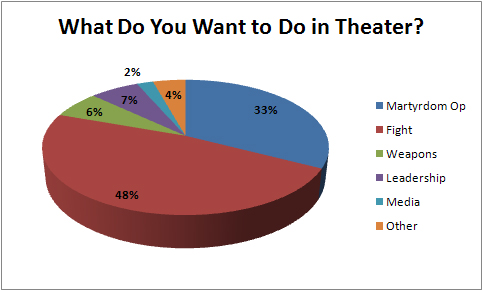
Poll of Potentional Foreign Fighters: The Islamic State of Iraq

Ekhlaas (here) members poll the forum. .....in a recent poll posted two months ago, the question was, “After you arrive in the theaters of jihad (God willing), where will you find yourself?” The respondents can choose from the following (quoting): (Via Jihadica)

Gates: "On behalf of the World" the US becomes Globo-Cop

Via Helena Cobban, here
"...A core responsibility of the U.S. Government is to protect the American people – in the words of the framers of our Constitution, to “provide for the common defense.” For more than 230 years, the U.S. Armed Forces have served as a bulwark of liberty, opportunity, and prosperity at home. Beyond our shores, America shoulders additional responsibilities on behalf of the world..."

The Israeli-Saudi link ...

.... in Haaretz, here

Anti-aircraft missiles for Hezbollah? .. Israel worries about its gallivanting in Lebanon's skies ...

Excerpts from article by Yediot Ahronot correspondent Alex Fishman published in today's edition (translation by IMRA):
"...While Prime Minister Olmert publicly pats the Syrians on the back in order to advance the achievements of the Syrian contacts in Turkey, Barak blames the Syrians in America for being responsible for the delicate situation today on the northern front.
The monitoring of Hezbollah activities isn't like collecting intelligence on a conventional army subject to a government like the Syrian army. This is an organization a large part of which operates in secret and targets that are not purely military targets, like weapons dumps within villages. The collection of intelligence about Hezbollah has to be very tight - both for the purposes of surveillance after the building of its force and also for
preparing a bank of targets, daily surveillance of particular individuals and more.
A considerable part of this activity is carried out from the sky. If Hezbollah succeeds in bringing anti-aircraft batteries into Lebanon, beyond the shoulder fired missiles they already have, then any government, cabinet or general staff that has to approve an activity in Lebanon requiring air cover - like an incursion, targeted killing, kidnapping or retrieval - will hesitate to take the risk.
It isn't a matter of years and not even months. If Hezbollah wants to cause an antiaircraft missile crisis, it could do it within a very short period of time. And then the ball will be on Israel's side.
Should Israel wait until the first anti-aircraft systems are in Lebanon? Should it wait until these devices lock onto Air Force aircraft? And what is to be done if a missile downs an unmanned craft? Is this grounds for an
attack? The government has to give the military clear answers to these questions, as any such action may have long term consequences.
Someone has to make clear to the Syrians the significance of their cooperation with Hezbollah. The Iranians have nothing to lose. The Syrians do. The government should be dealing with all of this now. It cannot wait
for the next government."

'Bomb Bomb Iran'? Not Likely....

David Ignatius in the WaPo, here
"...The administration's wariness of military options is also clear from recent efforts to dissuade Israel from attacking Iranian nuclear facilities.
McConnell and Mullen also informed the Israelis that the United States would oppose overflights of Iraqi airspace to attack Iran, an administration official said. The United States has reassured the Iraqi government that it would not approve Israeli overflights, after the Iraqis strongly protested any potential violation of their sovereignty....
..Though the administration has often been portrayed as divided over military options against Iran, an official denied there are now any sharp rifts. "There is uniformity across the U.S. government about the way to proceed with Iran," the official said. "Everyone from this White House, including the vice president's office, is in agreement that the military option is not the best option at this point, and we should pursue diplomatic and economic pressures...
U.S. opposition to an Israeli military strike now is based on four factors, the official said. First, a strike would retard the Iranian nuclear program without destroying it. (One intelligence estimate is that an attack would delay the Iranians by just two months to two years.) Second, a strike would rally support for the unpopular government of President Mahmoud Ahmadinejad when he faces growing economic difficulty. Third, an attack would undermine U.S. policy in Iraq, when the United States appears to be making some progress, and in Afghanistan. And, finally, a strike against Iran, as with any military action, would have unpredictable consequences..."

Lebanon: "Building on Stable Foundations"

"...Although the construction industry has been battered by the fallout of Israel's incursion in the summer of 2006 and the loss of investor confidence resulting from political infighting, the sector has made steady progress. While a number of major developments were put on ice, projects covering more than 5m square metres have been approved so far this year....While investors are returning to the real estate market, with the renewed interest having a direct impact on to the construction sector, many foreign firms are adopting a cautious approach..."
SFM of FLC responds:
"Investors in Lebanon should move away from the real estate market and into the real productive sector of the economy, such as high value added agribusiness and industry. Even services such as hospitality,education, should focus on the high tech end of the sector. The comparative advantage for Lebanon lies in the quality of high skill brain and manpower. However, the business environment represented by PM Siniura and the Association of Bankers and Merchants are not likely to favor the shift from a rent based economy to a production based one. A major battle of ideas is going to be fought in Lebanon and elsewhere in the Arab homeland for that kind of new approach to the creation of wealth. Affaire a suivre!"

Friday, August 1, 2008

In Fighting al Qaeda, Bush's "Global War on Terrorism" Is Off Target

A New Rand Corp. study urges a "fundamental rethinking" of counterterrorism strategy, ... in US-News, here

Htcac4wo4hca1ta4pkca7ftms1catq2u1gc "Since 2001, al Qaeda has conducted a greater number of attacks across a larger geographic area than at any time in its history. "We find it hard to agree that al Qaeda has been significantly weakened since Sept. 11, 2001," says Seth Jones, coauthor with Martin Libicki of the report titled "How Terrorist Groups End: Lessons for Countering al Qaeda." The authors evaluate al Qaeda since 2001 as being both "strong" and "competent." What's needed, the report suggests, is a "fundamental rethinking of U.S. strategy" to focus on minimizing overt military action and increasing intelligence collection and partnerships with law enforcement agencies around the world." Rand Corporation

How Saudi Arabia's Prince Bandar muscled Tony Blair into silence.

Michael Isikoff and

Mark Hosenball in Newsweek, here


"...The ruling is also likely to fuel criticism that the Saudi government—which portrays itself as a key ally of the United States and Great Britain in the War on Terror—is far less cooperative than it publicly claims. "This shows how the Saudis can get foreign governments to disregard their own justice system," said Ali Al-Ahmed, the director of the Gulf Institute, a Washington-based think tank that is critical of the Saudi government. "Terrorism is being used to blackmail the West. You watch, it is only a matter of time before they do this in the U.S."

"The Hunt for Kurdish Oil.."

Laura Rosen (from Kurdistan) in MoJo, here ".....Hunt Oil isn't the only one. This week, the Wall Street Journal reported that another Bush administration insider, Richard Perle, had approached Talabani seeking an Iraqi Kurdish oil concession on behalf of a consortium involving Turkish oil companies and the Kazakh government. " a the reported International,? Endeavour Houston-based by operated be potentially would oil, of barrels more or million 150 hold to estimated is which concession, K18 The EM administration....?<>