Saturday, October 27, 2007


'Walking Into Iran's Trap'
Ignatius in the WaPo, here
"That's the lesson for Muslim warriors of the Iraq and Lebanon wars: Draw your adversaries deep into terrain that you control; taunt them into starting a war they can't finish. I'm told that the Syrian military, for example, is now changing its doctrine to fight an asymmetric guerrilla war against Israel that it can win, Hezbollah-style, rather than a conventional war it would certainly lose."

Why Iran's Democrats Shun Aid
Akbar Ganji in the WaPo, here
"... Many of the social prerequisites of democracy exist in Iran today, but dollars cannot produce the bravery or love of freedom that individuals need to make the transition possible."
Friday, October 26, 2007
Israel CANNOT have Peace with the Palestinians because '1967 borders' are indefensible
In the New Republic, here
"...The Clinton-Barak parameters have raised the bar so high as to make it nearly impossible for future negotiators to come to a practical understanding that works for both sides. So it's no surprise what currently confronts us: A maximalist Palestinian position and an Israeli retreat to the pre-1967 borders, which are actually the 1949 armistice lines..."
The U S and the Ongoing Lebanese Crisis
Excerpts from an essay presented by David Khairallah, given at the "Arab-US Policymakers Conference" in Washington, DC, October 25.
"... A third cause of instability is the absence of a national military power that can effectively maintain law and order inside the country and be a credible deterrence against foreign aggression. Such a military power would have prevented the outbreak of the civil war. It would have prevented the formation and operation of paramilitary organizations with transnational objectives and affiliations, such as the PLO and Fateh Al-Islam."
"...An effective national military power would also have been the primary vehicle for the defense of the country and its people. In the case of foreign occupation, any need for the formation of groups to carry out guerilla activities or asymmetrical warfare operations would have been met under its auspices and involved the participation of all social groups within the nation."
"...An effective national military power would also have been the primary vehicle for the defense of the country and its people. In the case of foreign occupation, any need for the formation of groups to carry out guerilla activities or asymmetrical warfare operations would have been met under its auspices and involved the participation of all social groups within the nation."
"If one thinks of US interests in economic, political or military terms, then Lebanon presents no significant strategic interest. At best Lebanon would serve as a listening post where ideas, aspirations and frustrations expressed by major groups in the Arab world are echoed. It is also the place where the reasons for anger, frustration and mistrust of the US policy in the Middle East are articulated.
"This does not explain, however, the high degree of interest US officials have expressed and actions they have taken as regards internal Lebanese political developments, especially by the current Bush administration.
"This does not explain, however, the high degree of interest US officials have expressed and actions they have taken as regards internal Lebanese political developments, especially by the current Bush administration.
"Many in Lebanon consider the US responsible for the Syrian military intervention in Lebanon that lasted fifteen years. Those who complained of to US officials of the prolonged Syrian hegemony still recall those officials’ response that "the Syrians are elements of stability in Lebanon".
"Last summer, during the Israeli war on Lebanon, the Lebanese, along with the rest of the world, watched the US, practically alone among all members of the UN Security Council, block a Council’s decision to promptly stop the death and destruction Lebanon endured over thirty-three days. .Such stands remain in the collective memory of people and cannot but deepen the sense of alienation between the US and Lebanon and also other parts of the Arab world.
"Last summer, during the Israeli war on Lebanon, the Lebanese, along with the rest of the world, watched the US, practically alone among all members of the UN Security Council, block a Council’s decision to promptly stop the death and destruction Lebanon endured over thirty-three days. .Such stands remain in the collective memory of people and cannot but deepen the sense of alienation between the US and Lebanon and also other parts of the Arab world.
The dominant belief in Lebanon is that motivation for the US involvement and the stand it has taken from respective parties and issues reflect more an Israeli interest than either an American or Lebanese interest."
"...Disarming Hizballah and putting an end to it as a resistance movement is beyond doubt the main objective of all US efforts in Lebanon..."
"...Many of them, however, realize that the exclusive right of the state to hold arms and resort to the use of force is based on the assumption that the state and those manning its institutions are willing and able to defend the country and its people. The main weakness of the present Lebanese government is that it is perceived as not meeting either condition."
Prospect of "Pandemonium" in Oil Markets make a Strike on Iran "unlikely"
Robert Gates: "Without good intelligence, sending large numbers of troops across the border or dropping bombs doesn't seem to make much sense to me"
Read it in TurkishPress, here
"Without good intelligence, sending large numbers of troops across the border or dropping bombs doesn't seem to make much sense to me," he told reporters after talks with NATO defence ministers in the Netherlands. This applied "for anybody" considering such action, he added."
Thursday, October 25, 2007
Farid Ghadri asks for 'World Jews' to assist him
Here, Ghadri's take on the Modern History of the Middle East is encapsulated in the following:
"Before the advent of absolutist parties and dictatorships, our Arab countries were a perfect model for brotherhood, clemency and coexistence of the three monotheistic religions: Islam, Christianity and Judaism."
Apparently, this cajonesless little man knows not what 'came first': The egg or the chicken! With Meyrav Wurmser's coaching & blessing, he looks upon the Israeli occupation & daily massacre of the Palestinian People as yet another chapter of 'coexistence'.
Wednesday, October 24, 2007
Founder of the "State Department's Office of Iranian Affairs" quits post
Laura Rosen writes in MoJo, here
"... Denehy's departure comes just a few weeks after his colleague, J. Scott Carpenter, left Foggy Bottom for a fellowship at the Washington Institute for Near East Policy. At a forum there featuring Carpenter and other pro democracy experts earlier this month, the International Republican Institute's president Lorne Cramer said he had reluctantly come to the conclusion that the whole Middle East pro democracy program should be moved outside the State Department (where it is unpopular), perhaps to a new institution created in the style of the National Endowment for Democracy.
Denehy and Carpenter both previously worked for the International Republican Institute.
Denehy's and Carpenter's former boss at State, Liz Cheney, left the Bush administration in the spring of 2006 on maternity leave, but never really came back, sources say. Her departure left those she had brought into the State Department somewhat orphaned in a bureaucracy some consider hostile to their efforts to promote regime change in Iran.
Liz Cheney has since become a foreign policy advisor to the Fred Thompson campaign. "
Blackwater fallout: Top Security Official at State Resigns
From TPM, here
The AP, reporting on an internal e-mail announcing the resignation, adds:
"He read his letter of resignation at the weekly Diplomatic Security staff meeting," said the e-mail, which was read to The Associated Press by one its recipients. "There was no detailed reason provided and no effective date identified at this time."


The tea-leaves of an Iranian resignation
From the Economist here.
"... In the past two years, the European diplomats who have been negotiating with Mr Larijani over Iran’s nuclear plans feel he is flexible up to a point—and certainly worth trying to convince that the merits of a “grand bargain” ...
... the background of his replacement, Saeed Jalili, has alarmed the Europeans (Britain, France and Germany) who have been mandated by the West to negotiate with Iran. A former head of the department for America and Europe in the foreign ministry, he is a close friend and ideological ally of Mr Ahmadinejad...
The big question is the state of relations between the president and the Supreme Leader. Does their apparent disagreement, at least over the style of nuclear diplomacy, mean that Mr Khamenei is moving towards a more flexible negotiating position—and may perhaps be more amenable to reform in other spheres too? “Khamenei is the new Khatami”, muses Karim Sadjadpour, an analyst of Iran at the Carnegie Endowment ..."
Imad Moustapha: "Give Syria a Place at the Table"
Read the full interview here, via SyriaComment.
"...The Israelis know very well, and the United States knows absolutely well, that there is no Syrian nuclear program whatsoever. It's an absolutely blatant lie. And it's not like they think we have but they're not sure. They know. Let me be clear about it: Syria has never, ever contemplated acquiring nuclear technology. We are not contemplating it today. We are not contemplating doing this in the future – neither for military nor for civilian purposes. .."
Top Rudy Foreign Policy Says Giuliani Is Preparing For "World War IV"
From Podhoretz' the dilettante-warmonger & luminary to you, via TPM, here
“I was asked to come in and give him a briefing on the war, World War IV,” said Mr. Podhoretz, a founding father of neoconservatism and leading foreign policy adviser to Mr. Giuliani. “As far as I can tell there is very little difference in how he sees the war and how I see it.”
CQ: Democrats worry President Bush’s funding request to enable B-2 “stealth” bombers to carry a new 30,000-pound “bunker buster” is sign of Iran preps
Via WarandPiece, here
"...Previous statements by the Defense Department and the program’s contractors, along with interviews with military experts, suggest the weapon is meant for the kind of hardened targets found chiefly in Iran, which Bush suspects of developing nuclear weapons capability, and North Korea, which already has tested a nuclear device..."


Georges Corm: "L’évolution du statut du Liban dans l’ordre régional et international (1840-2005)
"Les violences
qui y sont commises acquièrent une double connotation qui deviendra une constante de ses crises. Elles sont locales, opposant alors druzes et maronites an quête de puissance dans l’évolution plus large des changements que connaît la Méditerranée de l’Est ; elles sont régionales et internationales, car il s’agit de faire évacuer les forces égyptiennes du Liban et de rétablir l’autorité au moins apparente du Sultan ottoman sur ce territoire et sur l’Egypte." More of the same, Read more, hereTuesday, October 23, 2007
With thoughts like these, Giuliani's place should be the White out-House!
Read on and regurgitate, these are the thoughts of a Clown who dreams of a Presidency, here!
"... But these people are attacking us not for the things that are wrong about us that we have to correct. They’re attacking us for the things that are right about us.
I mean, they’re attacking us for the good things about us. I mean, why are they doing it? They’re doing it because — my wife and the wives of the other candidates addressed a women’s breakfast this morning. You think they have women’s breakfasts with political candidates speaking in Islamic terrorist countries or countries that support Islamic terrorism?
Imagine if they showed up for a breakfast. Maybe they’d get stoned. They don’t want women to have rights. Let’s just deal with it. I mean, that’s just the reality. They don’t want to allow them to have rights … "
I mean, they’re attacking us for the good things about us. I mean, why are they doing it? They’re doing it because — my wife and the wives of the other candidates addressed a women’s breakfast this morning. You think they have women’s breakfasts with political candidates speaking in Islamic terrorist countries or countries that support Islamic terrorism?
Imagine if they showed up for a breakfast. Maybe they’d get stoned. They don’t want women to have rights. Let’s just deal with it. I mean, that’s just the reality. They don’t want to allow them to have rights … "
Efforts to resolve Lebanon's crisis may be too little, too late
In the Daily Star, this Ed. here
"Hoping for a positive outcome is a useful psychological tactic, but it should also be accompanied by sober preparations for one or more disasters..."
Putin: Russia does not want its Muslim neighbor to have nukes, but it also sees Iran as an important market for arms sales and nuclear electricity
On Putin's "trip" to Tehran, Oddly enough, from Israel's Haaretz, read here
"...Russia under Putin does not change its views so quickly. Certainly not because of Israel. Russia has a clear and consistent foreign policy. It was consolidated over the past four years in light of the sharp rise in energy prices, which turned Russia into a rich country, and thanks to Putin's leadership, which seeks to challenge the United States and restore Russia's former glory..."
"...Russia does not want its Shi'ite Muslim neighbor to have nuclear weapons, but it also sees Iran as an important market for the sale of arms and nuclear power plants for producing electricity. As far as Russia is concerned, Iran has been a target of diplomatic influence throughout history..."
"Islamo-fascism Awareness Week" Response Kit
Matt Yglesias says so rightly: "It's a little sad that, as a country, we've reached a point where the Center for American Progress feels the need to publish an "Islamofascism Awareness Week" Response Kit, but it led to a funny picture and it's nowhere near as sad as the fact that we live in a country where there's a serious "Islamofascism Awareness Week" campaign under way."

Joint Chiefs Chairman Mullen: attacking a third Islamic nation in the region "has extraordinary challenges and risks associated with it."
From the NYTimes, here
"He rejected the counsel of those who might urge immediate attacks inside Iran to destroy nuclear installations or to stop the flow of explosives that end up as powerful roadside bombs in Iraq or Afghanistan, killing American troops.
With America at war in two Muslim countries, he said, attacking a third Islamic nation in the region "has extraordinary challenges and risks associated with it." The military option, he said, should be a last resort."

Monday, October 22, 2007
"Pakistan on the Brink"
PAKISTAN ON THE BRINK (excerpts)
"...There is a deep attachment to Islam, for many to the religion of the Islamists but, for the large majority, to Islam in its utopian guise as the source of all answers and solutions. There tends to be a sense of one Pakistani nationality among the people of the Punjab and most people in urban centres in other parts of the country.
Another widely held sentiment is strong anti-US feelings; these are not directed against Americans but against the US government, and are based on what is perceived as its destruction of Afghanistan and Iraq, its condoning the destruction of the Palestinians and Lebanon, ...
"...There is a deep attachment to Islam, for many to the religion of the Islamists but, for the large majority, to Islam in its utopian guise as the source of all answers and solutions. There tends to be a sense of one Pakistani nationality among the people of the Punjab and most people in urban centres in other parts of the country.
Another widely held sentiment is strong anti-US feelings; these are not directed against Americans but against the US government, and are based on what is perceived as its destruction of Afghanistan and Iraq, its condoning the destruction of the Palestinians and Lebanon, ...
These various commonalities do not significantly foster national unity but they do create common attitudes and responses to certain events and situations. All these forces, ...operate beneath the surface but, though pervasive and powerful, do not have the capability to move events on their own. This can only be done by the two major repositories of power in Pakistan : the army and the people.
The army has ready-to-use, mobilized power.
The army has ready-to-use, mobilized power.
The people possess potential power that needs to be mobilized to produce its effect. This cannot be done through elections because they are conducted and controlled by the corrupt and pliable administrative machinery (that is why Benazir Bhutto, even though she believed she had the votes, was forced to make a deal with Gen Musharraf in order to ensure that they would not be nullified in a rigged election). She, as well as some other politicians, have the ability to bring large numbers of people out on the streets, but these demonstrations wield no effective power; a "whiff of grapeshot" can scatter them (actually, a little tear gas will do the trick).
This people power can, however, be effectively mobilized and projected by a dedicated and well-organized group. It is instructive to examine one case where this was successfully done. ZA Bhutto, then prime minister, had the 1977 elections rigged (he didn’t need to as he could have won a comfortable majority in a fair vote, but his vanity demanded an "overwhelming" victory). ..
This people power can, however, be effectively mobilized and projected by a dedicated and well-organized group. It is instructive to examine one case where this was successfully done. ZA Bhutto, then prime minister, had the 1977 elections rigged (he didn’t need to as he could have won a comfortable majority in a fair vote, but his vanity demanded an "overwhelming" victory). ..
If the army is used against its compatriots it imposes severe strains on its discipline and cohesion. If these are felt to be at risk the generals will act decisively to end such action, by whatever means are necessary; this is a red line they will not cross.
The critical situation in which Pakistan finds itself today is because, under intense US pressure, Gen Musharraf has sent in the army to seize control of the tribal areas bordering Afghanistan,...There is real danger of a catastrophe. If Musharraf keeps forcing the army to continue fighting this war it may fracture; all it will take is one crack, since the strain on the whole edifice is so great that this would be enough to break it apart. Even if the army is pulled back into token operations, the tribesmen are so incensed that they may not cease fighting,...
The critical situation in which Pakistan finds itself today is because, under intense US pressure, Gen Musharraf has sent in the army to seize control of the tribal areas bordering Afghanistan,...There is real danger of a catastrophe. If Musharraf keeps forcing the army to continue fighting this war it may fracture; all it will take is one crack, since the strain on the whole edifice is so great that this would be enough to break it apart. Even if the army is pulled back into token operations, the tribesmen are so incensed that they may not cease fighting,...
Meanwhile, the impact of this war, and the ongoing low-level insurgency in Baluchistan, is destabilizing the country. Religious fundamentalism is spreading and terrorist attacks and bombings occur frequently. The US hope that Benazir Bhutto can somehow stabilize the country, defeat internal extremists and mobilize the people against the "Taliban" is based on almost complete ignorance of the country and its dynamics. Even if she becomes prime minister, the war in the tribal areas will be controlled and fought by the generals, not by her. ..
If the army cracks, the country could break down into anarchy, or another military dictator, with a very different orientation, could take over. ...
Critics of the Bush administration point to the invasion of Iraq as its greatest blunder. History may well record that an even bigger blunder was its policies in Afghanistan and Pakistan. Knowing that al-Qaeda was the real enemy, that they were based in Taliban Afghanistan, and that the Taliban themselves had come to power out of their bases in Pakistan, it focussed its attention instead on invading Iraq...
Compounding this initial blunder, the US administration is now trying to salvage US-NATO operations in Afghanistan by forcing the Pakistan government to undertake a war upon its own tribal people...
It has no comprehension that in seeking this tactical gain it is risking a strategic catastrophe. In its blithe ignorance and wishful policy-making it pursues the chimeras of Benazir Bhutto’s promises that, if the US helps her become prime minister, she will take care of everything and sort out all the problems. Ahmed Chalabi once sold them an identical bill of goods, and led them into the Iraq quagmire. Now they follow Benazir Bhutto’s siren song into an even bigger disaster in the making. Some people never learn.
(continue reading here)
U.S. Planners See Shiite Militias as Rising Threat
From the WaPo, here
"Gen. David H. Petraeus and Ambassador Ryan C. Crocker have concluded that Shiite extremists pose a rising threat to the U.S. effort in Iraq, as the relative influence of Sunni insurgent groups such as al-Qaeda in Iraq has diminished drastically because of ongoing U.S. operations..."
Ahmadinejad challenges Khamenei directly and openly with Ali Larijani's firing
From the WashingtonNote, here
"Ali Larijani has essentially been fired by Iranian President Mahmoud Ahmadinejad, but the Supreme Leader Ali Khamenei is not letting Larijani leave the negotiating scene yet.
Despite Larijani's blurry status, Iran has announced that "joint will" of Ahmadinejad and Khamenei that Iran's top nuclear negotiator attend talks on Tuesday in Rome with Javier Solana..."
"Ali Larijani has essentially been fired by Iranian President Mahmoud Ahmadinejad, but the Supreme Leader Ali Khamenei is not letting Larijani leave the negotiating scene yet.
Despite Larijani's blurry status, Iran has announced that "joint will" of Ahmadinejad and Khamenei that Iran's top nuclear negotiator attend talks on Tuesday in Rome with Javier Solana..."
Sunday, October 21, 2007
Fisk: Looking for pro-Hariri militias? "Check the register of the Mayflower Hotel in West Beirut"
Fisk in the Independent writes here
"...There are growing fears, moreover, that many of these guns are from the vast stock of 190,000 rifles and pistols which the US military "lost" when they handed them out to Iraqi police officers without registering their numbers or destination..."
"...Fouad Siniora's Lebanese government – supplied by the US with recent shipments of new weapons for the official Lebanese army – has now admitted that militias are created among Muslim pro-government groups..."
"Widespread reports that Saad Hariri – son of the assassinated ex-Prime Minister Rafiq Hariri – has himself created an embryo militia ...But a number of armed Hariri supporters initially opened fire into the Nahr el-Bared Palestinian camp after its takeover by pro-Al-Qaida gunmen last April. Hariri's men also have forces in Beirut ... might like to check the register of the Mayflower Hotel in the western sector of Beirut." (FLC knows of other hotels in Beirut Hamra district and adjoining streets, where "folks" from Ersal & North Lebanon were kept!)
"The Butcher's Cleaver": Epic novel of Confederate and Union intelligence in the American Civil War will soon be published
For those interested in that aspect of the American Civil War, Pat Lang's book will be fascinating. Take a look at the pre-publication page here.
|
|


Friday, October 19, 2007
Assad visit signals Deepening Rapprochement between Syria & Turkey
Via SyriaComment an analysis in Eurasia Daily Monitor, here
"It is a sign of the dramatic change in the bilateral relationship that Assad’s visit has so far received very little coverage in the Turkish press. In the late 1990s, it was Syria that was vilified for its alleged complicity in the killings conducted by the PKK. In recent weeks, it has been the United States for opposing Turkey’s plans to launch a military strike against the organization’s camps in northern Iraq. Anti-Americanism has risen still higher since the October 10 approval by the House Foreign Affairs Committee of a resolution characterizing the massacres and deportations of Armenians by the Ottoman authorities during World War I as a genocide"
Thursday, October 18, 2007
'Extraordinary' meeting between Putin & Khamenei
Read the NYTimes, here
"...Mr. Putin’s visit highlighted the fact that Russia seems to be increasingly distancing itself from the United States and the Europeans on a strategy to curb Iran’s nuclear program. While those nations have sought to impose new Security Council sanctions on Iran, the governments of Russia and China have resisted, arguing that more time is needed..."
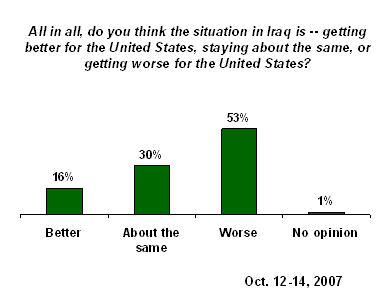
Bush 'explains' his decision to invade Iraq: "We had to do something after 19 young people blew up 3,000 Americans"
Via Matt Yglesias, Richard Rose (University of Aberdeen) talks to Bush, read more here
Wednesday, October 17, 2007
Hariri: "You have to remember that the Iraqi government wants the United States government to stay"
... and other pearls of wisdom, here in NEWSWEEK
Clinton in Foreign Affairs: "I will order spc-units to engage in targeted operations against al Qaeda in Iraq and other terrorist orgs. in region"
Remember, Clinton voted with the Kyl-Lieberman bill, read more in FA, here
"...As we redeploy our troops from Iraq, we must not let down our guard against terrorism. I will order specialized units to engage in targeted operations against al Qaeda in Iraq and other terrorist organizations in the region..."
Tuesday, October 16, 2007
(Excerpts) "Bitter Friends, Bosom Enemies: Iran, the US and the Twisted Path to Confrontation"
Via the WashingtonNote, Excerpts from USAToday's Barbara Slavin book on Iran "Bitter Friends, Bosom Enemies: Iran, the US and the Twisted Path to Confrontation", as shared by the Nelson Report:
Barbara Slavin writes:
The first Bush administration, according to Brent Scowcroft, was eager for contacts with Iran. "We're happy to do it," Scowcroft told me he told various intermediaries. "We could have it official, public or private citizen to private citizen, any way you want it." The two sides got as far in 1990 as agreeing to meet in Switzerland, but "at the last minute the Iranians pulled the plug," Scowcroft said Under Clinton, relations took several steps back because of 'dual containment' -- the effort to sanction and isolate both Iran and Iraq. After Mohammad Khatami was elected Iranian president in 1997, a warming trend ensued but theClinton administration made a fatal error -- since continued by George W. Bush.
It sought to distinguish between the parts of the Iranian regime it liked -- namely Khatami -- and the parts it didn't -- namely supreme leader Ayatollah Ali Khamenei and Iran's military and intelligence establishment. Clinton went so far as to name a delegation to meet with the Khatami government, a team consisting of Bruce Riedel, his top NSC Mideast adviser, then undersecretary of State Tom Pickering and deputy assistant secretary David Welch. But the Iranians wouldn't bite.
Enter George W. Bush. He had the best chance to patch up relations after 9-11 and he blew it. The U.S. and Iran both opposed the Taliban and Iran believed Bush and Cheney, as ex-oilmen, would lift sanctions. Unknown to many, the U.S. and Iran held secret, one-on-one high-level talks in Paris and Geneva from the fall of 2001 through May 2003, talks led on the U.S. side by Ryan Crocker and Zalmay Khalilzad.
In early May 2003, through Swiss intermediaries, the Iranians also presented an offer for comprehensive negotiations (reprinted in the annex to my book). Bush, full of hubris over Iraq, did not even give the Iranians the courtesy of a reply. The Europe talks ended, meanwhile, after yours truly wrote about them on the front page of USA TODAY and al-Qaeda bombings took place in Saudi Arabia that the White House said were linked to al-Qaeda detainees in Iran.
The Iranians did not give up, however. In late 2005 and through the spring of 2006, Ali Larijani, their new national security adviser, sought backchannel talks with Steve Hadley. Larijani went so far as to publicly accept a prior U.S. offer of talks on Iraq in March 2006. Supreme leader Khamenei publicly endorsed the talks, something he had never done before. Again, Bush sawed off the limb. The upshot: Larijani was weakened, Khamenei humiliated and Iran accelerated its nuclear program and its intervention in Iraq.
There is much more, including an intelligence assessment in early 2003 that invading Iraq would spur the two members of the Axis of Evil with real nuclear programs -- Iran and North Korea -- to intensify their efforts. Also the fact that the White House did not even ask the intelligence community for an assessment of the regional impact of toppling Saddam before invading.
It simply assumed that all would go well and that Tehran would be the next evildoer to fall. Instead of dividing our enemies by negotiating with Iran, the Bush administration has united them. And now -- like the child who shot his parents and complains he's an orphan -- the White House blames Iran for taking advantage of the strategic opportunities the United States has provided.
Monday, October 15, 2007
Brookings: "What is Syrian President Bashar Assad up to?"
It's the "Assad Pere-Caution vs. Assad Fils-recklessness" theory, AGAIN. From Brookings' Opinion by Dan Byman, here
Lebanese Malaise
"...One of the opposition's main leaders is the former general and interim president, Michel Aoun. He makes a somewhat convincing case for his own candidacy by claiming the mantle of Maronite representation — he earned the most direct votes from this community in the 2005 elections..."
"...A new president would have the wherewithal to pick a new head for the Lebanese Army and a new head of military intelligence..."
"...But wouldn't such a short-term solution (2 Year lull) keep Lebanon in a state of perpetual crises? Yes, it will and that's a good thing. Lebanon can handle crisis, just take a look at its history..."
Gen. Abizaid: ‘We’ve Treated The Arab World As A Collection Of Big Gas Stations’
Via ThinkProgress, here
“We’ve treated the Arab world as a collection of big gas stations,” the retired general said. “Our message to them is: Guys, keep your pumps open, prices low, be nice to the Israelis and you can do whatever you want out back. Osama and 9/11 is the distilled essence that represents everything going on out back.”
The US 'wali' in Lebanon keeps Minister Murr under a very close watchful eye
Jeff Feltman's almost 'daily' visits to Lebanon's version of Admiral Doenitz (Minister Elias Murr) stems from "founded fears" that this (yet another) mercurial Murr could "flip sides" yet again! "Observers" and people in the know have seen Elias' father, Michel luster his "Opposition" shield and threaten to "lean on Elias" to pull out of Siniora's govt'. Mind you, not that Elias hates ALL the attention!

Sunday, October 14, 2007
Deconstructing the neocon nuclear narrative ...on the Syria "raid"
Via the WashingtonNote, Paul Woodward deconstructs Krauthammer, et al, on the Syria "raid" story, here
"Why would he [Krauthammer] (and Israel) sound so relaxed about chemical weapons? Because as dangerous as they are, they do little to buttress the argument that Iran presents an existential threat to the Jewish state. It’s a nuclear story or no story at all — at least for those looking through the prism of World War IV"
Walid Jumblatt on a "good hair day"?
 Guess again! This is Jules Henri de Sibour, the famous Washington DC architect, pioneer in the exuberant Beaux Arts style, and producer of a staggering number of homes, theaters, hotels and office buildings such as the Jefferson Hotel, the Folger Library ...etc.
"I want to kill you, but not today"
From the ECONOMIST, here
"... But tribal leaders' motives have also been questioned. In Qaem, some claim the Albu Mahal turned against al-Qaeda partly because it had helped a weaker tribe tip the balance of power in the area. Others say that Abu Risha was a devious former highway robber who simply found a new source of income by teaming up with the Americans. In many areas where a tribal awakening is proclaimed, rows have erupted over who is a clan's true representative and who a “fake sheikh”."
Saturday, October 13, 2007
"What the Hell is Going on with the CIA IG?"
Via War and Piece, our friend Larry Johnson wonders, here
"There is a split in the CIA with respect to Helgerson. Some believe he is using 20/20 hindsight to go after officers who were doing their jobs. Others believe he is doing the right thing and upholding the honor of the intelligence professional."
CIA officers, at least some, used torture on terrorist suspects. They did so with the full permission and blessing of George W. Bush and his Attorney General, Alberto Gonzalez.
It is time for the Congress–the House and Senate Intelligence Committees–to get off of their collective asses and figure out what the hell is going on."
... Oh, one more thing on the Syria "raid" ...
ONE catch phrase in the whole article: "A senior Israeli official, while declining to speak about the specific nature of the target, said the strike was intended to “re-establish the credibility of our deterrent power,” Could it be that LEBANON (July 2006') is that much of an ordeal for "Savage State"? Otherwise, we've about just had it with "It's nuclear, no it's not, yes it could be".
If you're interested, read more here
If you're interested, read more here
Brazil won't extradite Lebanese banker
No one is more anxious than Charles Rizk to blow the Al Madina hullabaloo up, for purely "Presidential" Politicking. No one is adamant to keep it under the rug more than M14: Al Madina Bank = Boutros Harb, Ghazi Aridi, Neyla Moawad, Marwan Hamadeh, deputy Head of the "Sho3bat al Ma3loomat" (ISF), Rustom Ghazaleh, Elias Murr ... and many "prominent" second tier-others! Just ask Governor Salameh. (We did!)
Read more here from AP,
A French view of the Iranian situation
Via Pat Lang, where a French Officer gives us his views on the Iran situation, here
"If we need some combination of sanctions, threats and cooperation offers to get Tehran back at the table of negotiations, we should look toward the veterans of the Iran-Iraq war, particularly among the IRGC. They are the future power in the country. We should also understand what they are hoping for. This is a stable and modern Iran, admitted as an international player and feeling safe in its regional environment..."
"Used Hawks" abound in Giuliani's 'Foreign Policy Team'
Michael Hirsh writes this good piece in NEWSWEEK, here
"...Giuliani clearly hopes this image, born of his heroic performance on 9/11, can carry him to the GOP nomination and to the White House. But is he really the candidate who will "keep Americans safer" if his primary tactic is to go "on offense" in the "long war," as he often puts it in his campaign stump speech? Critics will say that the neocons already tried that—in Iraq. Still, what's left of the neocon movement does seem to be converging around the Giuliani campaign, to some degree, because he embraces their common themes: a willingness to use military power, a tendency to group all radical Islamist groups together as a common enemy, strong support for Israel and an aggressive posture toward Iran."
Friday, October 12, 2007
Hersh to Remnick: "Democrats will lose the elections" unless ...
From the New Yorker, watch the video, here
Thursday, October 11, 2007
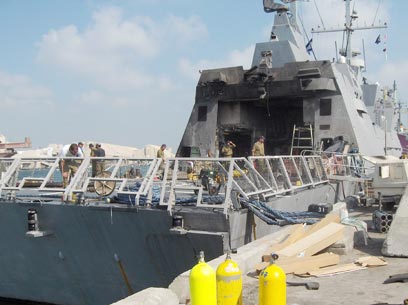
US Intelligence "Triumvirate" skeptical of Israeli conclusions that Syria was on a nuclear weapons track
From Steve Clemons, here
"...This is one of several reasons that this Intel Triumvirate (since Gates is holding DoD's intel portfolio close to himself) has been skeptical of Israeli conclusions that Syria was on a nuclear weapons track. According to my source, "all of them were chastened by the Jonathan Pollard affair" and thus have some "healthy resistence" to intel that is circumstantial rather than definitive."
Changing Course with Syria
Via SyriaComment, here
"... Inviting Syria to the peace conference is not a reward to Damascus for its alleged mischievous behavior; it is a matter of real necessity dictated by the prevailing turmoil in the Middle East to which the Bush administration has contributed so largely. The Middle- East conference offers the Bush administration an opportunity to change course toward Syria without loosing face not to speak of preventing a colossal failure..."

CSIS's Cordesman: "Pandora's Box: Iraqi Federalism, Separatism, 'hard partitioning & US Policy"
"...If such divisions continue and reach the level of partitioning or federalism that effectively divide Iraq on sectarian and ethnic lines the consequences are likely to be much grimmer. It is far from clear that such developments will lead to a large-scale blood bath -- although this is at least possible. However, isolated cases of large-scale violence and local atrocities seem all too likely. Major new displacements of population are almost certain, and will come at great economic cost to those involved..." Continue reading here
Wednesday, October 10, 2007
Russians "furious" with Bush over "lack of coordination & preparation" for the Annapolis Mideast Peace summit
"...Ambassador Ushakov allegedly told Hagel (Chuck) that he's never seen anything like this. He said there are normally side agreements orchestrated, diplomatic understandings, and significant coordination efforts. Most Middle East summits attempted before involved enormous heavy-lifting before the meeting. However, according to a significant source, absolutely nothing of import is happening between White House officials and key stakeholder governments in the region -- including Russia which is one of the Middle East Quartet members..." More here from Steve Clemons.
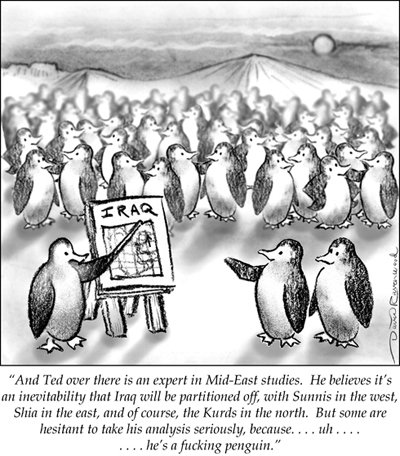
Scowcroft, Brzezinski, Hamilton, Baker, & Others Call for Syria and Hamas to Be Engaged in Israel-Palestine Effort
Via the WashingtonNote, here
"... What may be the most remarkable thing about this bipartisan statement is not only who is saying it but what they are prepared to say.
In the letter to Bush, beyond calling on the US and the parties to focus on the outlines of a final status settlement, the co-signatories defy the administration's views by calling for an end to the policy of isolating Hamas and for a shift in policy toward Syria -- including both US/Syria engagement and renewal of Syrian/Israeli negotiations.
Colin Powell -- who is not (yet) a signatory -- has also called for communication with Hamas, and the Baker-Hamilton Iraq Study Group called for engaging Syria. This letter makes the point even more strongly..."
ICG: "Hizbollah and the Lebanese Crisis"
[Excerpts from embargoed report]
"... At war’s end, Hizbollah’s opponents within and outside Lebanon were hoping to establish an alternative Shiite movement. This rapidly proved an illusion. At almost every social level, Shiite support for Hizbollah has solidified -- a result of both the movement’s longstanding efforts to consolidate its hold over the community and a highly polarised post-war context..."
"... Hizbollahs’ popularity and staying power cannot be properly understood without bearing in mind this collective Shiite experience of victimisation at the hands of more powerful parties, coupled with the state’s utter and repeated failure to protect them..."
"...The war also altered the movement’s relationship with Shiite intellectuals. According to Hassan Abbas Nasrallah, a historian, "prior to the war, Shiite intellectuals were very divided, and few backed Hizbollah. The war changed all that"
"...The pro-Saudi Salafi preachers who backed Hizbollah during the latter part of the war also quickly broke with the movement as a result of its campaign to oust the government and control Beirut’s centre..."
"...None of these represents the Sunni community’s centre of gravity, and most are paying the price of the current sectarian divisions; they are a minority and a shrinking one at that, a phenomenon that mirrors the situation among the Druze..."
"...Practically, this means that Hizbollah’s most important non-Shiite ally – and the key to its efforts to avoid a sectarian label – is Michel Aoun."
"...Although inherently fragile given clear ideological differences, the alliance has stood firm in the face of serious strains and challenges and even though Aoun has paid a steep political price..."
"...As an Aounist deputy remarked, "it is not really in Hizbollah’s interest to bring Aoun to power, because the general genuinely wishes to pursue a state-building and militia-disarming agenda. In a way, Hizbollah is stuck: it doesn’t really want Aoun but, since the July war, it owes him a huge moral debt..."
"...Hizbollah is contemplating a deal whereby Aoun would renounce the presidency in exchange for a major say in choosing the candidate, important ministerial posts in the future government and an electoral law more favourable to Christians..."
"Hizbollah is adapting in several ways. The shift from resistance to deterrence"
"Unlike Amal, Hizbollah does not view politics as an end in itself and has not made Shiite representation its priority. For an expert on the movement, "Hizbollah has only two priorities: the Palestinian question and resistance against U.S. regional projects. All other objectives, including Shiite empowerment, are ancillary..."
Tuesday, October 9, 2007
When you dehumanize a people to the extent Iraqis were, "Blackwater" happens!
From MoJo, here
"will Blackwater survive this latest scandal? It's impossible to know for sure, but there's little reason to believe otherwise. The company, which started as a small-scale provider of firearms training in 1998, has grown into a billion-dollar Goliath, complete with an army of lobbyists and sympathetic politicians to press its agenda on Capitol Hill. Guided by its reclusive founder, Erik Prince, the company, over its short history, has deflected controversy with ease, all the while simultaneously expanding its reach into new markets and generating ever more profitable government contracts
Meaningless House Resolution:"...a major religion that has been behind the Islamic jihad ..."
"...To offer respect for a major religion is one thing, but to offer respect for a major religion that has been behind the Islamic jihad, the radical jihad, that has sworn war upon the United States, its free allies and freedom in Iraq, is another thing."
Monday, October 8, 2007
War on terror is fuelling al Qaeda
Via MoonOfAlabama, this report from the Oxford Research Group, here
"...He described the U.S.-led invasion of Iraq as a "disastrous mistake" which had helped establish a "most valued jihadist combat training zone" for al Qaeda supporters.
The report -- Alternatives to the War on Terror -- recommended the immediate withdrawal of all foreign troops from Iraq coupled with intensive diplomatic engagement in the region, including with Iran and Syria..."
The report -- Alternatives to the War on Terror -- recommended the immediate withdrawal of all foreign troops from Iraq coupled with intensive diplomatic engagement in the region, including with Iran and Syria..."
The Oil Crisis of 2012?
From the National Interest, here
" ...The picture is not entirely rosy, however: Alkadiri reported that clients are extremely worried about regional trouble spots. One is Iran, where a possible conflict could have a disastrous effect on the oil market. This led him to counsel against strengthening sanctions against Tehran, which he said would damage both the U.S. and Iranian economies. Kirsch agreed, saying that a war in the Gulf would likely lead to an average oil price of $150 per barrel and “trigger a global recession...
... Another concern is Iraq."
After Iraq, Iran & Syria, Bill Kristol calls for US Military intervention in Burma!
Via Kevin Drum, who wonders "why anyone takes Kristol seriously? Why is it that a guy who thinks U.S. military action is always the answer is any more credible than the peacenik who thinks it never is?", here
Lessons for Lebanon from Nahr el-Bared
Bruce Riedel at Brookings, here
"...To be sure, Fatah al Islam was no ordinary enemy. This al-Qaeda inspired salafist jihadist network – which reportedly still has several sleeper cells across the country – had enough men and materiel to wage a war like any other regular army battalion.
"...We later learned from testimonies of militants who were captured by the army that Fatah al Islam was planning a string of catastrophic terrorist attacks inside Lebanon, including attacks on UN headquarters in Beirut, large-scale bombings, and assassinations of leading Lebanese political figures. The plot, called 'operation 577', was to lay the foundation for an Islamic emirate in Tripoli..."
Sunday, October 7, 2007
“Ticking Clocks and ‘Accidental’ War,” BY Alastair Crooke
Via SyriaComment, here.
"The view from those most likely to be affected by an “accidental” war, Iran, Syria, Hezbollah and Hamas, all share the conclusion both that war is imminent and that any one of a number of “ticking clocks” may be “engineered” as a provocation that would by-pass the Pentagon chiefs of staff arguments against expanded conflict and trigger war. All of these actors have been preparing flat-out for the coming conflict..."
Intel Community To Release ‘Three Iran Reports’ To ‘Slow Down’ Bush’s Warmongering
NBC's Fineman : "...Those are going to be key to decide what the Bush administration is going to do, and it’s the intelligence community I think trying to slow down what the president, most particularly the vice president, want to do in Iran..."
Read more here, via ThinkProgress.
Read more here, via ThinkProgress.
Chairman of the Joint Chiefs of Staff Pace's "involuntary" exit marks the end of the "Rumsfeld era
From TPM, here
"... Pace was chairman of the Joint Chiefs of Staff the last two years. Gates decided not to renew the general's term, despite Pace's request for another. The public rationale was that Gates wanted to avoid "very contentious" confirmation hearings. There's clearly something to this. Not only was Pace the last senior official still associated with early decisions on the war (he was the JCS vice chairman at the time of the invasion) ..."
"...But the larger import of Pace's forced retirement -- the message that many officers heard clearly, whatever Gates' intention -- is that the sorts of generals who behave as Pace did the past few years are no longer desired in the Pentagon's inner sanctum..."
Friday, October 5, 2007

Who Wants To Bomb Iran? Democrats, Not Republicans, Says Seymour Hersh
From the Huffington Post, here
"...When I asked Hersh who wants to bomb Iran, he said, "Ironically there is a lot of pressure coming from Democrats. Hillary Clinton, Obama, and Edwards have all said we cannot have a nuclear-armed Iran. Clearly the pressure from Democrats is a reflection of - we might as well say it - Israeli and Jewish input." He added the obvious: "a lot of money comes to the Democratic campaigns" from Jewish contributors..."
Wurmser calls for US instigated "regime change" in Iran & Syria
From the Telegraph, here
"... Although Mr Wurmser's recommendations have not yet become US policy, his hard-line stances on regime change in Iran and Syria are understood to have formed the basis of policy documents approved by Mr Cheney, an uncompromising hawk who is deeply sceptical about the effectiveness of diplomatic pressure on Teheran..."
Israel failed to provoke a war with Syria
Haaretz, here
"...The farce came to a partial end yesterday, and even though there is still a gag order on most of the juicy details, we can safely say that behind the successful blackout campaign lies an enormous failure. The silence of official Israel was not meant to protect military secrets. The victim of the operation knows full well what he had and what happened to him... Still, it seems that once again Assad surprised Israel; whoever expected him to respond to the operation in a military operation was wrong..."
More, here
"...The farce came to a partial end yesterday, and even though there is still a gag order on most of the juicy details, we can safely say that behind the successful blackout campaign lies an enormous failure. The silence of official Israel was not meant to protect military secrets. The victim of the operation knows full well what he had and what happened to him... Still, it seems that once again Assad surprised Israel; whoever expected him to respond to the operation in a military operation was wrong..."
More, here
New US military leaders question Iraq mission
From McClatchy's, here
"It's part of a sea change," said Loren Thompson, a military analyst at the Lexington Institute, a national-security research center in Washington. "The ideologues have been replaced by managers who view Iraq not as a cause, but a problem to be solved.
"It remains to be seen, however, whether Gates and like-minded allies can curtail the U.S. commitment to Iraq, avoid a military confrontation with Iran and direct more resources to Afghanistan and to rebuilding and reequipping the Army and the Marines..."

Thursday, October 4, 2007

Avoid the phrase 'occupied territories'
From Matt Yglesias, here
A propos, yesterday's style guide discussion, The New York Observer took a look yesterday at The NYSun guide, including such pearls of wisdom as "Avoid the phrase 'Arab East Jerusalem'" and:
West Bank and Gaza Strip. Territories under Israeli control from 1967 onward. 'The territories' is acceptable on second reference, as are Judea or Samaria for the Southern and Northern regions of the West Bank. Avoid the phrase 'occupied territories.'
Unfortunately, the Observer didn't excerpt the Sun's rationale for its habit of using the phrase "Palestinian Arabs" instead of "Palestinians."

Wednesday, October 3, 2007
Jumblatt: “We missed the opportunity last week if we make the same mistake on the 23rd, the opposition will win"
Nicholas Blanford here
"...Jumblatt is hoping that the White House will stiffen Hariri’s backbone when the Future Movement leader meets Bush on Thursday. The US government is publicly limiting its involvement to calls for a fair and on-time election, free from foreign meddling. US Ambassador Jeffrey Feltman has repeatedly said that the US is not in the business of naming preferred presidential candidates.
Nonetheless, the Bush administration privately supports Jumblatt’s stand, concerned that the election of a consensus president would strengthen Hezbollah, and by extension Syria and Iran, at the expense of Washington’s influence over the current government.
“The Americans are convinced,” Jumblatt said. “But maybe the Europeans and the Saudis need convincing that the president should be elected by the half-plus-one.”
Tuesday, October 2, 2007
Since Israel signed on to the "road map" and committed to dismantling "unauthorized" settlements, ONLY 9 houses have been removed
Matt Yglesias talks to Akiva Eldar, author of the new book "Lords of The Land", here
"... He had a good line about the incompatibility of the settlement policy with the Zionist dream of a secure, democratic Jewish state, noting that commitment to the policy had made Israel "less Jewish, less democratic, and less secure..."

Monday, October 1, 2007
Clinton-Webb bill prohibits funding for a military operation against Iran
This is important in view of the fact that Clinton also supported Kyl-Lieberman, labeling the IRG as "terrorist." Here.
“Any military action against Iran will have an immediate impact on our troops serving in Iraq, our allies in the region as well as long term U.S. strategic interests. Senator's Webb's legislation insures that Congress will play its constitutional role of providing proper oversight over the Administration's policy toward Iran. Congressional oversight and debate can help avoid the mistakes and blunders that have afflicted U.S. policy in Iraq. We cannot allow recent history to repeat itself.”
White House's Perino on Sy Hersh's latest
(...)
Q -- what about the substance of whether we --
MS. PERINO: We don't discuss such things. What we have said and what we are working towards is a diplomatic solution in Iran. What the President has also said is that as a President, as a Commander-in-Chief -- and any Commander-in-Chief -- would not take any option off the table. But the option that we are pursuing right now is diplomacy.
Q But the article very specifically said that this summer in a video conference -- secure video conference with Ambassador Crocker, the President said that he was thinking about "hitting Iran" and also --
MS. PERINO: I'm not going to comment on -- one, I don't know. I wouldn't have been at any -- at that type of a meeting. I don't know. I'm not going to comment on any possible -- any possible scenario that an anonymous source, you know, continues to feed into Sy Hersh. I'm just not going the do it.
Sarkozy ... the "New Poodle"?
From Brookings, here
"... As soon as Sarkozy became President, he sent his foreign minister Bernard Kouchner to Baghdad to express support for US presence there. This was a gesture that surprised both Americans and Europeans. This was his first confidence building measure. He has since upped the ante by banging on the war drums against Iran with abandon. He has described Iran's nuclear enrichment program as the crisis of our times and insists that a nuclear Iran is unacceptable. If Iran does not give up the bomb then it will be bombed he declared..."
House. Res. 690.:Expressing grave concern of the House of Reps. for Iran and Syria's continued ... violations of U.N. Res. 1701 and 1559
Yup ... a new bellicose bill in preparation, here
Petraeus: Iran started helping
from the LATimes, here
"...Gen. David Petraeus, the top U.S. commander in Iraq, said there were signs of a slight drop in the types of attacks associated with Shiite militants since the deal was reached last month, and he dangled the possibility that U.S. and Iraqi officials might be able to do something in return. But he said it was too early to tell whether there has been a real reduction in Iranian support..."
Subscribe to:
Posts (Atom)